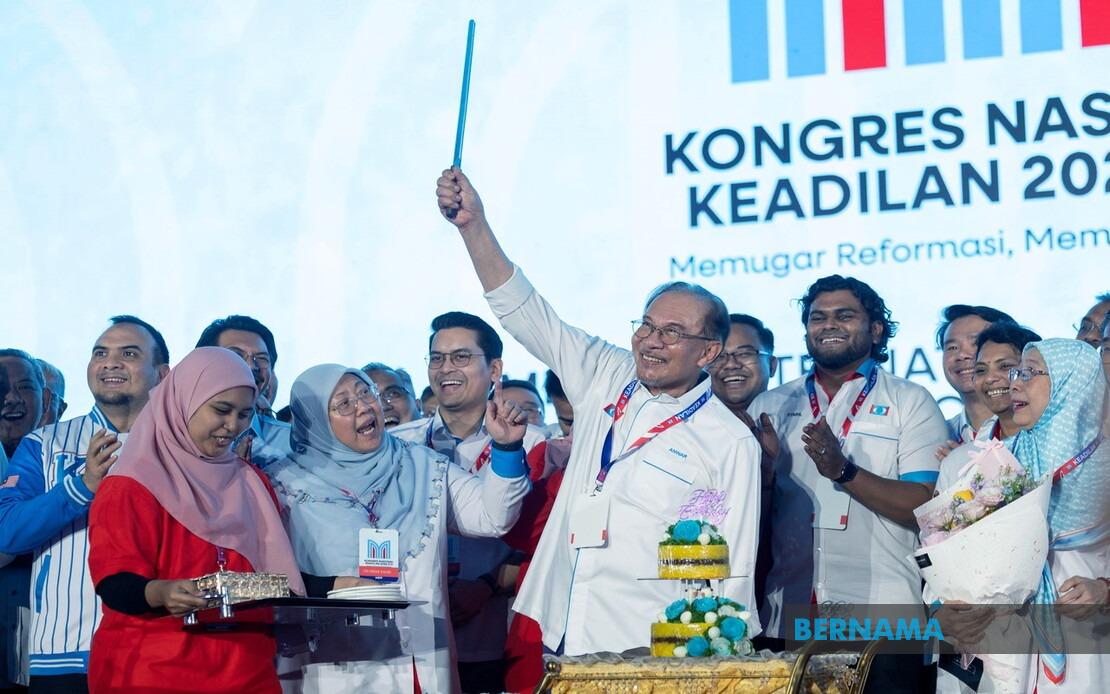
The PKR National Congress 2026, held in Melaka this month, concluded with the party's leadership emphasising a dual commitment to sustaining the current coalition arrangement while preserving the progressive reform agenda that has defined the party since its establishment. This balance between governing stability and transformative change represents a central challenge for PKR as it navigates its role within the Unity Government alongside UMNO and Barisan Nasional. The deliberations underscore the party's determination to prove that reformist principles need not be abandoned upon entering government, a message particularly resonant for members who joined PKR precisely because of its historical opposition stance.
PKR president Datuk Seri Anwar Ibrahim, in his closing remarks to delegates, stressed that maintaining the Unity Government partnership remains essential for delivering economic growth and political certainty to ordinary Malaysians. His framing of the coalition as grounded in shared national interest rather than temporary political convenience signals an attempt to position the arrangement as something more substantial than a mere power-sharing deal. However, Anwar was notably candid in acknowledging that the government's future trajectory depends significantly on decisions made by UMNO and Barisan Nasional leadership, implicitly recognising PKR's junior partner status within the arrangement and the asymmetrical nature of the coalition dynamics.
The Prime Minister used his address to caution all coalition partners against destabilising actions that could undermine the government's effectiveness. This warning appears directed at hardliners within any of the component parties who might view the unity arrangement with suspicion or seek to exploit political openings for factional advantage. For Malaysian businesses and investors, such reassurance carries tangible significance, as policy continuity and governmental stability directly influence economic confidence and long-term planning. The implicit message—that all parties have committed to maintaining the status quo—attempts to draw a line under speculation about potential coalition ruptures or early elections.
Yet PKR's insistence on maintaining reform credentials while in government presents genuine tension. Deputy president Nurul Izzah Anwar articulated this challenge directly, arguing that reform agendas must accelerate rather than stall simply because the party now holds ministerial office. She pointed to the repeal of the Universities and University Colleges Act (AUKU) 1971 as concrete evidence that progressive change remains achievable from within government, a symbolic victory for student activism and academic freedom that had long preoccupied PKR supporters. The successful navigation of this particular reform suggests that working within the system, rather than opposing it, can yield results that PKR's base values.
Anwar provided additional assurances regarding AUKU, indicating the government would neither replace the repealed legislation with comparably restrictive laws nor expand criminal penalties for student activism. Instead, existing general criminal provisions would govern student misconduct, a position intended to reassure both civil society advocates and education sector stakeholders that the reform represents genuine liberalisation rather than cosmetic change. This calibrated approach reflects PKR's attempt to deliver meaningful policy wins while managing the concerns of coalition partners who may harbour reservations about expanded student activism on campuses.
Organisational preparedness emerged as a secondary but significant theme throughout the congress proceedings. PKR leadership signalled to party machinery that readiness for electoral contest should not depend on Parliament's dissolution or official campaign announcements, but rather represent a permanent operational posture. This messaging likely reflects lessons from previous political surprises and the party's recognition that Malaysian politics has grown increasingly fluid, with coalition arrangements and electoral landscapes shifting more rapidly than historical precedent would suggest. For PKR members in marginal constituencies, such exhortations carry practical implications for campaign infrastructure and volunteer mobilisation.
Women's representation in leadership and decision-making structures featured prominently in congress discussions, with PKR Wanita chief Fadhlina Sidek—herself serving as Education Minister—advocating for expanded opportunities for women to influence party and governmental directions. Her concurrent emphasis on openness to criticism and inclusive governance reflects contemporary expectations about institutional accountability, particularly among younger cohorts of voters and party members. The willingness of senior PKR figures to explicitly address gender representation suggests the party recognises this as both a principled commitment and an electoral asset in attracting diverse voter demographics.
Angkatan Muda Keadilan's focus on youth concerns and emerging economic sectors indicates PKR's attempt to position itself as forward-looking beyond immediate governance responsibilities. The youth wing's emphasis on Bumiputera participation in artificial intelligence, semiconductors, and biotechnology reflects awareness that economic competitiveness and equitable growth increasingly depend on technological advancement. By connecting youth empowerment to high-value sectors, PKR frames support for young people not as charitable obligation but as national economic imperative, a framing likely to resonate with policymakers across the coalition.
Generation Z concerns encompassing gig economy recognition, skills development, mental health support, and social protection mechanisms highlight tensions between traditional labour frameworks and contemporary work realities. PKR's willingness to prioritise these issues at a national congress suggests the party recognises that younger voters and workers increasingly evaluate political parties on their responsiveness to modern economic precarity and quality-of-life concerns. For Malaysian employers and labour organisations, such political attention signals that formal legislative or regulatory action on gig work classification and protections may advance during the current government term.
The congress proceedings revealed PKR in a posture of simultaneous consolidation and aspiration. Party leaders sought to reassure coalition partners and investors that stability would be preserved while simultaneously signalling to the party base and reform-minded voters that the progressive agenda has not been abandoned. Whether this dual commitment can be sustained without generating internal contradictions remains an open question, particularly if UMNO or other BN components seek to move policy in more conservative directions on matters PKR considers essential to its identity.
For Malaysian voters and observers, the PKR congress illustrated broader dynamics within the Unity Government—the constant negotiation between parties with somewhat divergent constituencies and policy preferences, held together by mutual calculation that coalition stability serves individual party interests better than fragmentation. The coming months will test whether PKR can simultaneously deliver on reform pledges and maintain coalition harmony, or whether these commitments will eventually generate tension requiring difficult political choices.
Looking forward, PKR's emphasis on organisational readiness and reform momentum suggests the party views the Unity Government as durable but not permanent, preparing for contingencies while working to embed reforms that might survive potential future coalition reconfiguration. This hedging strategy reflects mature political calculation by a party that has experienced rapid swings between opposition and government, opposition and coalition dynamics. Whether such careful positioning ultimately strengthens or weakens PKR's hand in Malaysian politics will become apparent only through the test of actual governance performance and electoral outcomes.

