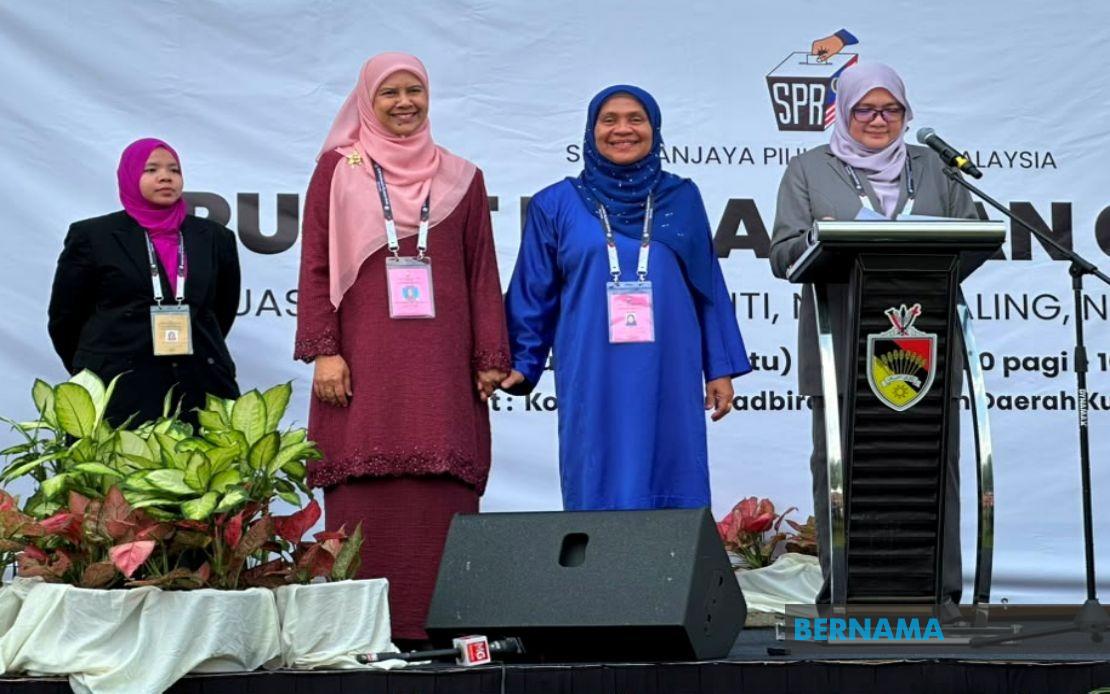
The Pilah state seat in Negeri Sembilan will showcase a historic straight fight between two women candidates in the August 1 state election, marking a significant moment for female representation in the state assembly. Incumbent Datuk Noorzunita Begum Mohd Ibrahim, representing Pakatan Harapan, will face Barisan Nasional challenger S. Leza Md Yasin in what promises to be a closely watched contest. The nomination process concluded on July 18 at the Kuala Pilah District and Land Office, with Noorzunita Begum submitting her nomination at 9.03 am, swiftly followed by S. Leza at 9.09 am. Returning officer Nawal Mohammed Amin confirmed the final candidate lineup following the conclusion of nominations.
Across the state, the 16th Negeri Sembilan election will feature a diverse array of competitive races, with most constituencies presenting multi-cornered contests that reflect the fragmented political landscape in the state. Juasseh, Seri Menanti, and Senaling will all witness three-way contests, while Johol will see a two-candidate race similar to Pilah. The presence of three major political blocs—Pakatan Harapan, Barisan Nasional, and Bersatu—across multiple constituencies underscores the shifting dynamics in Malaysian state politics, where the traditional two-bloc dominance has fractured into more complex competition.
In the Juasseh state seat, voters will choose from Mohd Aidil Abdullah representing PH, incumbent Datuk Ismail Lasim from BN, and Bersatu's Mohd Zuhami Md Yusof. The presence of the Mahathir-led faction competing in Juasseh reflects broader national tensions within the Malay-Muslim political establishment, particularly as Bersatu seeks to maintain relevance following setbacks in recent national politics. Datuk Ismail Lasim's incumbent status provides him institutional advantages, though the split opposition vote could work to either candidate's advantage depending on local dynamics.
Seri Menanti presents another three-way contest featuring PH's Mohd Kamarul Arifin Mohd Wafa, incumbent Muhammad Sufian Maradzi of BN, and Bersatu's prominent figure Datuk Seri Megat D. Shahriman Zaharuddin. Megat's participation signals Bersatu's determination to contest seats held by major coalitions, attempting to carve out electoral space in Negeri Sembilan despite the party's diminished national standing. The involvement of senior party figures in state-level contests indicates the importance both traditional coalitions and Bersatu place on Negeri Sembilan's twelve state seats.
The Senaling constituency will host a three-cornered battle involving PH's Mohd Hanis Mohd Alimin, BN's Mohamad Qayyum Abd Jalil, and Bersatu's Mohd Izzafi Khan. This pattern of triangular contests scattered across multiple constituencies creates uncertainty for all parties, as vote splitting becomes a critical factor in determining outcomes. Voters may find themselves weighing not only policy preferences but also strategic considerations about which candidate has the best prospects of defeating competitors they wish to exclude.
Meanwhile, the Johol state seat will feature a straight fight between PH's Mohd Zailan Mohd Munawar and incumbent Datuk Saiful Yazan Sulaiman of BN, offering a clearer choice for voters compared to the three-way contests elsewhere. The absence of a third contender in both Johol and Pilah may reflect local political dynamics where one candidate failed to secure sufficient nomination support or where party strategies deliberately concentrated resources on fewer constituencies.
The mobilization of high-ranking federal officials from both coalitions underscores the significance these parties attach to the Negeri Sembilan state election. PKR Wanita chief Fadhlina Sidek, who serves as Education Minister, coordinated PH candidate submissions, accompanied by Angkatan Muda Keadilan vice-chief Dr Mohammed Taufiq Johari (Youth and Sports Minister) and Sim Tze Tzin (Deputy Investment, Trade and Industry Minister and Bayan Baru MP). This show of federal support aims to energize grassroots campaigns and demonstrate commitment to state-level contests.
Barisan Nasional similarly deployed senior figures including Deputy Home Minister Datuk Seri Dr Shamsul Anuar Nasarah and Perak Menteri Besar Datuk Seri Saarani Mohamad, the latter also serving as Perak UMNO chairman. The cross-state involvement of Perak's leadership reflects a coordinated regional strategy by BN, suggesting the coalition views adjacent state elections as interconnected struggles rather than isolated contests. Such mobilization patterns typically intensify campaigns, increase voter attention, and elevate the symbolic importance of elections beyond routine state assembly contests.
Negeri Sembilan's political significance in Malaysian federalism should not be underestimated. Positioned as a relatively competitive state where no single coalition has achieved overwhelming dominance in recent years, the results here may offer early indicators of broader electoral trends. The state's twelve constituencies represent a manageable microcosm for analyzing voting behaviour across urban, semi-urban, and rural areas, making the August 1 election a potential bellwether for national political sentiment.
The Election Commission has scheduled early voting for July 28, providing those unable to vote on polling day with an alternative window. The compressed campaign period between the July 18 nomination close and August 1 polling day gives candidates approximately two weeks to canvas voters and build momentum. This timeline creates intensity in local campaigning while limiting opportunities for major narrative shifts or scandal management, making early positioning and grassroots organization critical to electoral success.
For observers of Malaysian politics, the Pilah constituency offers particular intrigue as a female-only contest at state level—a phenomenon relatively uncommon in Malaysian electoral history. The prominence of both candidates and their respective party affiliation suggests this race may receive disproportionate media and activist attention, potentially influencing perceptions about women's political representation. The outcome may carry symbolic weight beyond the single seat's numerical importance to coalition balance in the state assembly.
The diversity of races across Negeri Sembilan's constituencies reflects broader questions about coalition stability and voter behaviour in contemporary Malaysia. With Bersatu contesting multiple seats rather than withdrawing or concentrating exclusively on specific constituencies, the election will test whether the party can rebuild electoral credibility after recent national setbacks. PH and BN, meanwhile, must navigate competitive races while managing their respective internal dynamics and coalition relationships at both state and federal levels. The August 1 polling day will provide concrete data on these political trajectories.

