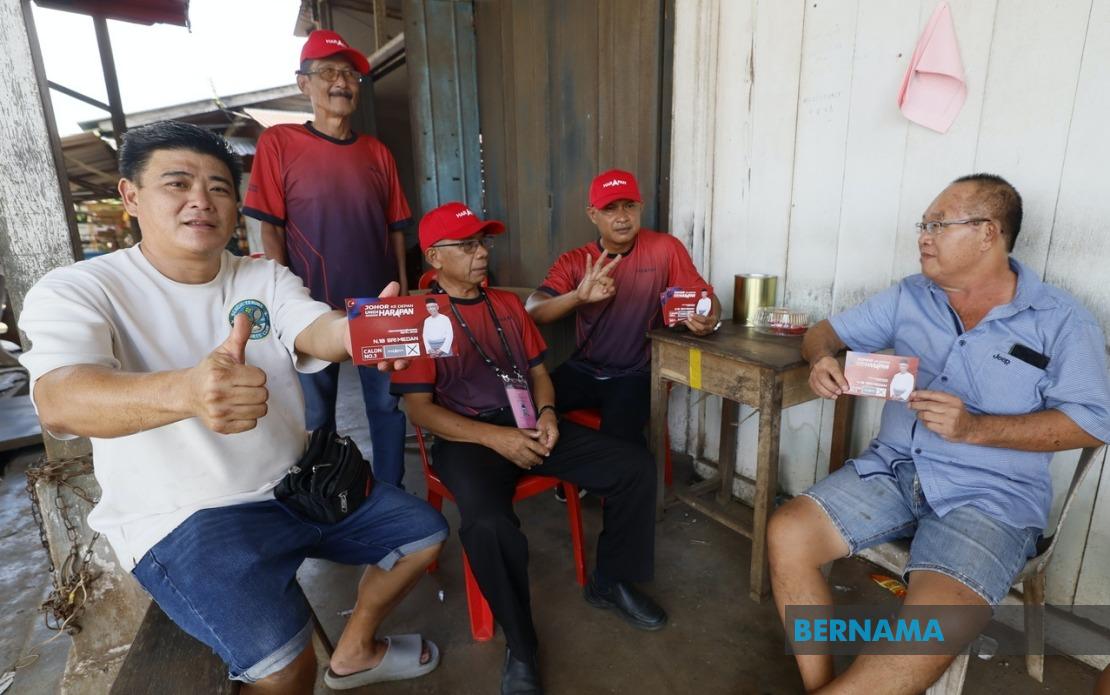
As the 16th Johor State Election campaign enters its final stages, Pakatan Harapan has fielded a distinctly grassroots-oriented contender in the Sri Medan seat. Hishamudin @ Misrin Ishak, known informally as "Cikgu Misrin" throughout his community, is positioning himself as an alternative to the incumbent Barisan Nasional representative Datuk Zulkurnain Kamisan and Perikatan Nasional challenger Ahmad Rosdi Bahari. His campaign philosophy, articulated during ground engagements in Batu Pahat, deliberately eschews grand political rhetoric in favour of addressing the immediate grievances of ordinary residents.
The former mathematics educator's approach reflects a strategic calculation within PH's broader campaign in Johor, a state where the coalition faces the structural disadvantage of contesting a traditional BN stronghold. Rather than attempting to outpromise established political machinery, Hishamudin has framed his candidacy around accessibility and responsiveness to constituent concerns. His principle of "work first, talk later" signals an implicit criticism of politics-as-usual while simultaneously managing expectations about what an individual assemblyman can realistically deliver. This rhetorical positioning holds particular resonance in Malaysian politics, where voter cynicism about unfulfilled campaign pledges has grown measurably over successive election cycles.
Flood management emerges as a central pillar of his policy platform, reflecting the lived experience of Sri Medan residents who have endured recurring inundation. Rather than proposing grandiose infrastructure megaprojects, Hishamudin emphasises systematic, constituent-responsive management of this chronic problem. This focus on recurring local hardship, rather than national political abstractions, demonstrates tactical awareness of what genuinely affects voter decision-making in semi-urban constituencies. The emphasis on flood mitigation also implicitly suggests that existing BN administrations have inadequately addressed this issue despite decades of electoral dominance.
Economic opportunity represents another substantial dimension of his campaign messaging, particularly regarding youth employment and entrepreneurial support. Hishamudin's commitment to facilitate Technical and Vocational Education and Training programmes acknowledges a significant gap in Malaysia's educational ecosystem—the persistent perception that TVET pathways lack prestige relative to university-track education, despite demonstrable labour market demand. By positioning himself as an advocate for skills-based training and digital literacy, he addresses anxieties among middle-class families and working-class parents concerned about their children's career prospects in an increasingly competitive regional economy.
Small and medium enterprises, the backbone of Malaysia's informal economy, feature prominently in his development agenda. His proposal to enhance market access for local entrepreneurs signals recognition that many SMEs operate within geographically constrained customer bases, unable to leverage digital commerce or supply chain integration effectively. For voters in Sri Medan, particularly those engaged in petty trading, hawking, or light manufacturing, this represents a tangible commitment to improving commercial viability without requiring massive capital injection or government subsidy.
Hishamudin's background as a village head provides valuable political capital in contesting what many analysts regard as an improbable victory scenario. His prior experience in local administration offers demonstrable evidence of administrative competence and community engagement, differentiating him from candidates whose political credentials rest primarily on party hierarchy or patronage networks. Within Malaysian electoral contexts, where many voters privilege local knowledge and interpersonal relationships over partisan ideology, his track record in village-level governance conveys credibility that a carpetbagger candidate would struggle to establish.
His explicit commitment to serve residents "regardless of political affiliation" attempts to reframe electoral competition as a manageable disagreement among reasonable people rather than an existential struggle between incompatible worldviews. This inclusive rhetoric, while potentially appearing naive to hardened political observers, resonates with moderate swing voters and cross-cutting coalitions that have increasingly determined outcomes in closely contested Malaysian constituencies. It also insulates his campaign against accusations of partisan exclusivity that might alienate voters sympathetic to multiple parties.
The infrastructure development agenda emphasises proportionate growth across urban, semi-urban and rural zones—a recognition that uneven development generates political resentment and social fragmentation. Rather than concentrating resources in commercially strategic locations, Hishamudin advocates balanced territorial development. This reflects lessons from earlier Malaysian elections where neglected rural constituencies punished incumbents perceived as indifferent to their material circumstances, even when those incumbents delivered substantial benefits to urban and peri-urban areas.
Hishamudin's acknowledgment that Sri Medan remains a BN stronghold demonstrates realistic assessment of his electoral prospects while simultaneously framing his candidacy as a values-driven challenge rather than an expectation of certain victory. This narrative positioning permits him to claim moral victory even in defeat—the narrative becomes one of principled advocacy rather than failed ambition. For PH, competing in apparently unwinnable constituencies maintains organisational presence and voter contact infrastructure while establishing long-term political footprints in regions where the coalition has historically struggled.
The campaigning timeline, with early voting scheduled for July 7 and main polling on July 11, compresses the window for ground mobilisation and voter persuasion. For a candidate lacking the organisational machinery and financial resources of established parties, this compressed schedule represents both constraint and opportunity. The constraint lies in limited time to overcome incumbent advantage; the opportunity emerges from reduced campaign fatigue and the possibility that late-deciding voters may respond to direct, unglamorous messaging about local problem-solving rather than abstract partisan positioning.
Hishamudin's emphasis on digital education and TVET programmes, alongside traditional welfare and administrative competence, reflects evolution within PH's campaign messaging toward pragmatic, service-delivery-focused appeals. This contrasts with earlier Pakatan narrative emphasis on systemic institutional reform and anti-corruption positioning. For younger voters and economically vulnerable constituents, the shift toward concrete material improvement—accessible education, market opportunities, functioning infrastructure—may prove more politically salient than governance reform abstractions.
As the Johor state election approaches its conclusion, Hishamudin's campaign exemplifies broader patterns within Malaysian electoral politics: the declining salience of partisan identity, the rising importance of local grievance resolution, and voter preference for accessible, demonstrably competent candidates over ideologically pure or institutionally connected alternatives. Whether this people-first orientation translates into competitive performance in a traditionally BN seat will provide instructive data about shifting electoral dynamics in Malaysian state-level contests.

