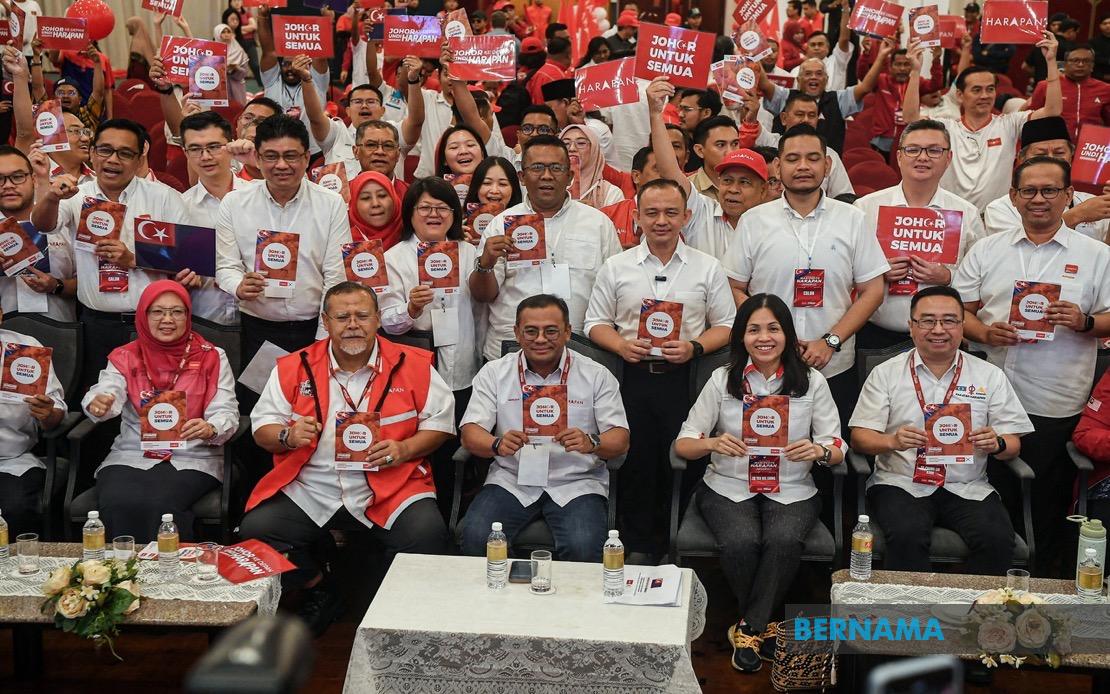
Pakatan Harapan launched its election manifesto for the 16th Johor state election on July 3, pitching 'Johor Untuk Semua' (Johor For All) not as aspirational rhetoric but as a carefully calibrated platform rooted in concrete assessments of what the state's residents require and what its economy can sustain. Johor DAP chairman Teo Nie Ching, who doubles as Deputy Communications Minister, anchored the rollout in pragmatism, arguing that the coalition has mapped out pledges it genuinely believes can be implemented.
The manifesto's architecture reflects an attempt to build a broad political coalition by addressing multiple demographics simultaneously. Teo characterised the package as "very balanced," deliberately spanning generational and familial segments—youth, mothers, and children—rather than concentrating resources narrowly. This deliberate breadth suggests PH's strategists recognised that Johor's electorate, economically and socially diverse, would demand evidence that no constituency would be neglected if the coalition secured state power on July 11.
Among the ten headline commitments, the Johor Health Scheme appears to hold particular symbolic weight. Teo explicitly drew a parallel to Selangor's implementation of a comparable programme, framing that state's experience as proof of concept for sceptical voters. The reference is strategic: Selangor, under PH-friendly governance, has sustained its health initiative for years, providing Teo with concrete evidence rather than theoretical promise. This cross-state benchmarking tactic reflects a broader pattern in Malaysian politics, where opposition-ruled or PH-aligned states increasingly serve as laboratories for policies the coalition intends to scale nationally or expand regionally.
Education policy emerged as a cornerstone priority, signalling that PH views schools and universities as critical battlegrounds for voter confidence. Johor has historically struggled with educational quality metrics relative to wealthier states, and targeting this arena directly confronts a perennial source of voter frustration. The emphasis on reducing barriers to academic success, while not detailed extensively in Teo's remarks, positions the coalition as attentive to parental concerns about their children's futures in an economy increasingly demanding tertiary qualifications.
The commitment to halving waiting times at Johor-Singapore border crossings addresses an economic pain point that affects commerce, commuters, and cross-border workers daily. Johor hosts significant numbers of Malaysians who work in Singapore—a phenomenon that generates foreign exchange, supports household incomes, but also creates congestion at the two main crossing points, Causeway and Second Link. By pledging a 50 per cent reduction, PH is essentially promising to alleviate a friction point in regional economic integration that directly touches middle-class and working-class lives. Teo's confidence that federal-level coordination with the Home Ministry could achieve this target hints at plans to streamline customs and immigration procedures—a goal that has eluded previous administrations.
Housing affordability occupies a central place in the manifesto's deposit assistance scheme for first-time homebuyers. Property prices in Johor, particularly in and around urban centres like Johor Bahru, have climbed steadily, pricing out younger and lower-middle-income families from ownership. By specifically targeting first-time buyers with financial scaffolding, PH attempts to unlock a demographic cohort historically receptive to progressive politics. This pledge also acknowledges that homeownership remains psychologically tied to stability and upward mobility in Malaysian society, making it fertile ground for electoral promises.
The RM500 million youth empowerment fund represents a substantial financial commitment, should PH secure the mandate to deliver it. Youth unemployment and underemployment in Johor, particularly outside Johor Bahru's central business district, present a simmering challenge. A dedicated fund signals serious intent to create pathways into skills training, entrepreneurship, and formal employment. For a state where young voters have shown volatility in their political allegiances, translating fiscal allocation into tangible opportunities could prove decisive.
Teo's repeated invocation of federal cooperation reveals an underlying tension in Malaysian federalism: state-level campaigns increasingly depend on goodwill from federal partners. A PH state government in Johor would be fortunate to align with a friendly federal administration, allowing administrative barriers and resource constraints to dissolve. Her confidence in achieving border-crossing improvements, health scheme replication, and youth funding thus rests partially on assumptions about the federal-state relationship that voters, rather than party machinery, will ultimately validate through the ballot box.
The election calendar—with voting on July 11 and early polling on July 7—compressed the campaign window, placing a premium on swift, memorable messaging. The 'Johor Untuk Semua' framing, with its inclusive nomenclature, attempts to transcend factional and communal divides by positioning benefits as universal rather than targeted. Whether this rhetoric translates into votes remains uncertain, but the manifesto's grounding in identifiable problems and reference to precedent (Selangor's health scheme, federal coordination mechanisms) suggests PH pursued a more granular, evidence-based campaign strategy than abstract ideological appeals.
For Malaysian observers outside Johor, the manifesto illustrates how opposition coalitions increasingly operate: by governing some states competently, building policy libraries, and scaling successful programmes across territories they control. Selangor's health scheme becomes not merely local policy but a template for national aspiration. This stratified approach to power—consolidating strongholds, professionalising governance, and preparing blueprints for wider application—reflects the maturation of PH as a political force, no longer content with rhetorical opposition but invested in demonstrating administrative capacity at the subnational level.

