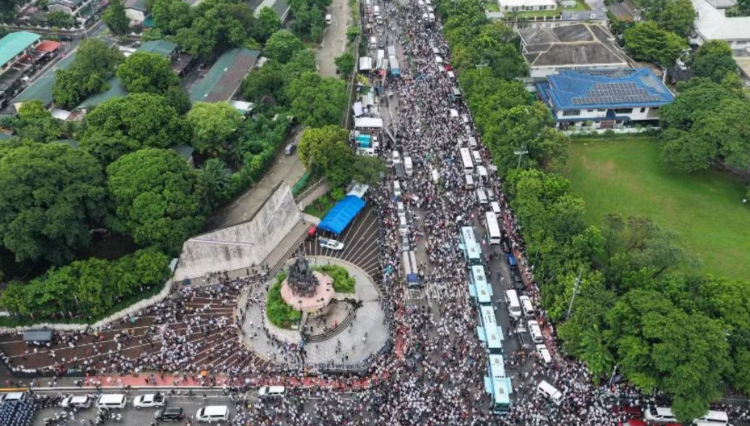
Tens of thousands of supporters from one of the Philippines' most influential religious organisations brought Manila to a standstill on Tuesday as they gathered to oppose the imminent arrest of Senator Rodante Marcoleta, a prominent church member facing graft allegations. The demonstration, centred along EDSA, one of the capital's main thoroughfares, created severe congestion affecting commuters and students throughout the morning rush hour. Police estimated the crowd at 8,000 participants early in the day, with expectations that numbers would swell further as the rally progressed, underscoring the organisational capability and political mobilisation power of the Iglesia Ni Cristo.
The timing of the protest proved particularly significant given the broader political turbulence engulfing the Philippines. The government ombudsman Jesus Remulla announced on Monday that Marcoleta would face charges connected to his failure to declare approximately 75 million pesos in unused election campaign funds, allegations that the senator and his allies view as selective prosecution. For the Iglesia Ni Cristo, the charges represent an attack on one of their own at a moment when the church's traditional political allies face mounting legal jeopardy.
Marcoleta's predicament sits within a wider pattern of legal troubles afflicting the Duterte political faction. Senator Jose "Jinggoy" Estrada, another administration loyalist, was recently charged in connection with a massive corruption scandal involving fraudulent flood control projects that triggered national outrage. Similarly, Senator Ronald "Bato" Dela Rosa, a former police chief under Rodrigo Duterte's brutal drug war, has entered hiding to avoid arrest on an International Criminal Court warrant, leaving the Duterte bloc weakened in the Senate at a critical moment.
The senator's legal jeopardy matters intensely because his Senate vote on Vice President Sara Duterte's impeachment trial, scheduled to begin on July 6, could prove decisive. Duterte requires 16 votes from the 24-seat chamber to survive removal and avoid permanent disqualification from elected office. Marcoleta is regarded as virtually certain to vote against conviction, making his presence and voting capacity crucial to the Duterte defence strategy. The Iglesia Ni Cristo has historically functioned as a significant voting bloc with deep historical ties to the Duterte family's political machine, lending the organisation's mobilisation efforts particular weight.
In a Facebook video statement, Iglesia Ni Cristo spokesman Edwil Zabala articulated the church's position as a principled stand against what it characterises as unjust and discriminatory prosecution. The organisation demanded transparency from authorities and pledged to continue fighting for what it termed justice, framing Marcoleta's potential imprisonment as part of a broader pattern of selective persecution. This rhetoric resonates with the church's base, which views the charges as politically motivated rather than legitimate law enforcement action.
The Iglesia Ni Cristo has demonstrated considerable capacity for rapid political mobilisation in recent months. In November, the church orchestrated a massive rally, drawing hundreds of thousands of supporters, to demand accountability regarding the flood control scandal. Notably, speakers at that earlier demonstration directed blame squarely at President Ferdinand Marcos, reflecting the sharp polarisation that has developed between the administration and the Duterte camp. In January, the church again demonstrated its organisational prowess by staging an enormous rally in Manila opposing Duterte's impeachment, even as the Supreme Court ultimately reversed that first attempt.
The political landscape has shifted dramatically since Marcos and Duterte were allies. Their relationship fractured spectacularly, leaving the former president increasingly isolated and now facing impeachment proceedings. Duterte's fall from grace has been precipitous, moving from the presidency to the vice presidency and now facing removal from that position as well. For the Iglesia Ni Cristo, continued alliance with the beleaguered Duterte faction carries risks, yet the church appears committed to defending its members and maintaining its historical political relationships.
President Marcos took the Tuesday demonstration seriously enough to cancel a scheduled luncheon with foreign press, choosing instead to monitor developments. This decision signals that the administration views the Iglesia Ni Cristo's mobilisation capacity as a genuine concern requiring executive attention. The cancelled engagement underscores how the sect's political activism can command national attention and disrupt the normal conduct of government business.
The broader implications for Philippine governance and the rule of law remain contested and polarising. Critics argue that prosecuting Marcoleta represents legitimate anti-corruption efforts that should proceed regardless of political affiliation or religious affiliation. Supporters of the senator and the Iglesia Ni Cristo counter that the charges represent weaponised justice designed to protect Duterte allies by removing potential votes against her conviction. This fundamental disagreement over whether the prosecution reflects principled law enforcement or political persecution defines contemporary Philippine politics and will likely persist throughout Duterte's Senate trial and beyond.

