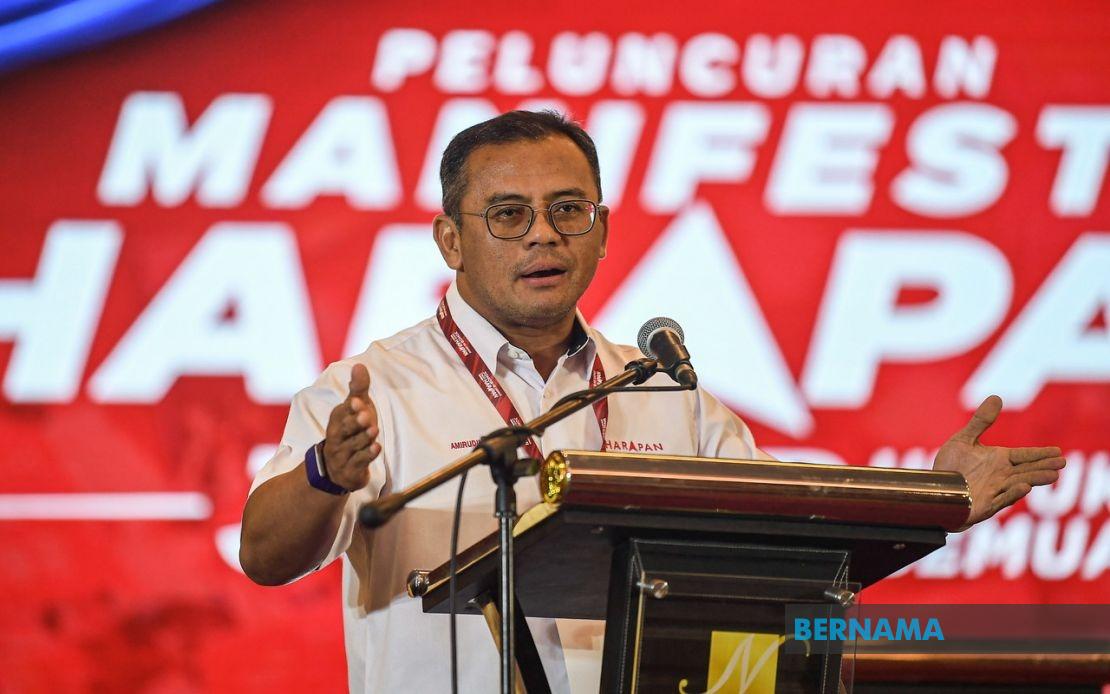
The Federal government together with the state administrations of Penang and Selangor have demonstrated the effectiveness of Pakatan Harapan's governance model through sustained economic expansion, according to PH Presidential Council member Datuk Seri Amirudin Shari. Speaking at the launch of PH's campaign manifesto for the upcoming 16th Johor state election in Johor Bahru, the Selangor Menteri Besar presented economic performance metrics as the coalition's central argument for continuing to lead the nation.
Under the MADANI Government framework established by PH and its coalition partners, Malaysia's currency has achieved its strongest valuation in over a decade and a half, demonstrating the administration's capacity to manage macroeconomic stability in an increasingly volatile global environment. This currency performance reflects investor confidence in the country's economic direction and provides concrete evidence of the coalition's ability to protect Malaysia's financial interests against external pressures that have buffeted regional economies.
The Anwar Ibrahim-led administration has successfully attracted substantial foreign and domestic investment flows while maintaining consistent expansion in the nation's Gross Domestic Product. These metrics form the cornerstone of PH's electoral pitch, positioning economic competence as the primary differentiator between the coalition and its political opponents. The emphasis on quantifiable economic achievements represents a deliberate strategy to ground campaign messaging in measurable outcomes rather than rhetorical promises.
At the state level, the two powerhouse economies of Penang and Selangor together represent nearly 40 percent of Malaysia's total economic output, giving the PH-governed states substantial weight in national economic performance. This concentration of economic activity in coalition-administered territories underscores the political significance of state-level governance in determining national prosperity. Amirudin used this geographic distribution of economic power as evidence that PH's management extends beyond Federal level to encompass the most productive regions of the country.
Selangor's economic valuation has expanded dramatically in recent assessments, growing from RM432 billion in the previous Department of Statistics report to RM460 billion according to the most recent data released two days prior to Amirudin's speech. This RM28 billion expansion in a single measurement period reflects the accelerating momentum of economic activity within Malaysia's most populous and industrially advanced state. The growth trajectory suggests that PH's economic policies are generating compounding benefits rather than temporary improvements.
The Selangor economy now represents approximately twice the economic size of Johor, a comparison laden with political significance given that Johor has traditionally positioned itself as an economic powerhouse. By drawing this contrast explicitly, Amirudin implicitly challenged the assumption that Johor's economic importance remains undiminished, suggesting instead that PH-governed states have surged ahead under the coalition's development model. This calculation carries particular weight in a state election context where voters evaluate competing parties partly on their economic track records and capacity to generate prosperity.
The timing of Amirudin's statements during the Johor election campaign reflects PH's broader strategy of leveraging macroeconomic performance as a persuasive tool in electoral contests. With national and state-level elections becoming increasingly competitive, political coalitions have shifted emphasis toward demonstrable economic results that voters can assess against their personal economic experiences. PH's decision to highlight Federal-level achievements alongside state-level performance demonstrates understanding that voters evaluate political parties through multiple governance lenses.
The invocation of the ringgit's 16-year strength serves multiple purposes within PH's campaign messaging. Currency appreciation benefits certain economic constituencies, particularly importers and holders of foreign assets, while complicating calculations for exporters dependent on currency depreciation. By emphasizing this achievement, PH signals competence in managing complex economic forces while implicitly claiming credit for conditions that may reflect broader regional and global market dynamics beyond direct governmental control.
The coalition's emphasis on investment attraction forms a crucial component of its economic narrative, as sustained capital inflows signal confidence from sophisticated economic actors who deploy resources based on rigorous assessments of political stability and policy direction. Foreign direct investment particularly carries prestige in political discourse, as it demonstrates that international business confidence extends beyond temporary improvements to fundamental confidence in the administration's ability to maintain favorable conditions for capital deployment.
For Malaysian voters in Johor and beyond, this economic performance framing raises important questions about how prosperity translates into household-level improvements and whether state-level economic growth translates into wage growth, employment expansion, and cost-of-living relief. While aggregate economic metrics demonstrate regional expansion, their connection to individual voter welfare remains contested terrain in Malaysian political discourse. Opposition parties are likely to highlight disjunctures between headline economic statistics and household financial circumstances, suggesting that growth benefits concentrate among specific constituencies rather than distributing broadly.
The Johor election campaign thus becomes a referendum on voter trust in PH's economic stewardship and its commitment to ensuring that growth translates into tangible improvements in living standards across different population segments. Economic messaging provides PH with quantifiable claims less vulnerable to subjective interpretation than other campaign themes, yet voters ultimately evaluate economic records against their own financial experiences, which may diverge significantly from official statistics.

