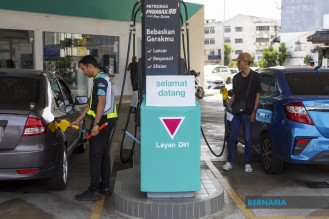
Malaysia's nationwide petrol station network operated by Petronas will maintain adequate fuel supplies through August, according to Datuk Seri Azalina Othman Said, the Minister in the Prime Minister's Department (Law and Institutional Reform). Her statement, delivered during the weekly meeting of the National Economic Action Council (MTEN), provides reassurance to consumers and businesses following earlier concerns about supply continuity. The minister's declaration, based on official information provided directly by Petronas, addresses mounting public anxiety over whether the country's fuel infrastructure could withstand prolonged international energy disruptions.
The Petronas-operated petrol station network represents a critical pillar of Malaysia's domestic fuel distribution system, commanding approximately 50 percent of the nation's total petroleum consumption. This substantial market share flows through Petronas Dagangan Bhd, the energy conglomerate's publicly listed subsidiary responsible for retail fuel distribution. The significance of this network extends beyond mere logistics—it touches every sector of the Malaysian economy, from transportation and agriculture to manufacturing and power generation. Any supply interruption at this scale would reverberate across multiple industries and potentially create widespread consumer concern.
The government's confidence in stable supplies reflects proactive planning rather than passive optimism. To address the volatile global energy environment created by ongoing geopolitical tensions in West Asia, Malaysian authorities have established a dedicated Crisis Management Task Force (PPPK) operating under MTEN's oversight. This specialized unit functions as both a monitoring mechanism and rapid-response infrastructure, tracking real-time developments in fuel availability, petroleum imports, and broader energy security metrics. The task force's establishment signals official recognition that sustained energy supply requires constant vigilance and coordinated government intervention.
Beyond mere supply monitoring, the crisis management framework encompasses multiple interconnected objectives that extend far beyond simply ensuring petrol reaches service stations. The task force actively works to stabilize prices in a volatile market, preventing artificial scarcity and protecting consumers from sudden cost spikes. Simultaneously, it combats fuel smuggling and irregular trading activities that can distort supply chains and deprive the government of crucial tax revenue. These parallel efforts reflect sophisticated understanding that energy security involves economic stability, consumer protection, and regulatory integrity operating simultaneously.
Malaysia's vulnerability to global energy disruption stems from its dependence on imported crude oil, despite being a petroleum producer itself. The nation's production capacity falls short of domestic refining and consumption requirements, necessitating substantial international purchases. West Asian suppliers have traditionally dominated Malaysia's import portfolio, making regional conflicts particularly consequential. The concentration of global oil production and refining capacity in politically volatile regions means that even distant conflicts can directly impact Malaysian fuel availability and pricing within weeks.
To mitigate this geographic and political vulnerability, the government is actively diversifying its crude oil sourcing geography. Officials are pursuing supply agreements with exporters in West Africa and the Americas, markets historically less prone to simultaneous disruption and offering alternative transportation routes. However, this diversification strategy faces practical constraints. Different crude oil grades possess varying chemical compositions and refining requirements; Malaysian refineries cannot simply switch between sources without expensive modifications. Additionally, commercial negotiations with new suppliers involve lengthy timescales and substantial upfront commitments, meaning strategic diversification unfolds incrementally rather than immediately.
The government's recent establishment of formal supply guarantees through August represents a departure from previous uncertainty that triggered parliamentary questioning. Datuk Seri Azalina's statement directly responded to concerns raised by Khairil Nizam Khirudin, a parliamentarian who questioned both Petronas' earlier statement that supplies were guaranteed only through June 2026 and what contingency plans existed if global energy disruptions persisted. This parliamentary pressure illuminates the political sensitivity of fuel supply issues in Malaysia, where energy costs directly impact inflation, transportation expenses, and public sentiment.
For Malaysian businesses and consumers, the extended supply guarantee carries significant implications for economic planning. Manufacturing exporters can commit to delivery schedules without fearing fuel-related production stoppages. Transportation operators can make investment decisions regarding fleet expansion or modernization. Consumers benefit from reduced uncertainty about whether fuel rationing might be necessary during the upcoming months. This psychological and practical confidence acts as a stabilizing force across multiple economic sectors, even if supplies ultimately remained adequate regardless of official pronouncements.
The crisis management framework also reflects broader regional thinking about energy interdependence. Southeast Asia collectively faces energy security challenges similar to Malaysia's, with most nations dependent on imports during peak demand periods. Malaysia's experience managing fuel supply disruption becomes instructive for neighboring countries developing their own energy resilience strategies. Regional cooperation on energy trading, strategic reserve policies, and supply diversification could enhance collective security across Southeast Asia.
Looking beyond August, Malaysia's energy strategy must balance several competing priorities. Maintaining price stability while protecting government revenues, diversifying import sources while managing refinery constraints, and ensuring consumer access while combating smuggling all demand sophisticated coordination. The government's willingness to deploy dedicated task forces and make public guarantees suggests official commitment to treating energy security as a permanent structural challenge rather than a temporary crisis.
For investors and businesses dependent on stable energy inputs, the extended supply guarantee provides working room for strategic planning. However, the fact that this assurance extends only through August rather than providing longer-term certainty indicates ongoing vulnerability in Malaysia's energy position. The government's broader diversification and task force initiatives suggest recognition that lasting solutions require structural changes to import sources and refining capacity, challenges that typically unfold across years rather than months.

