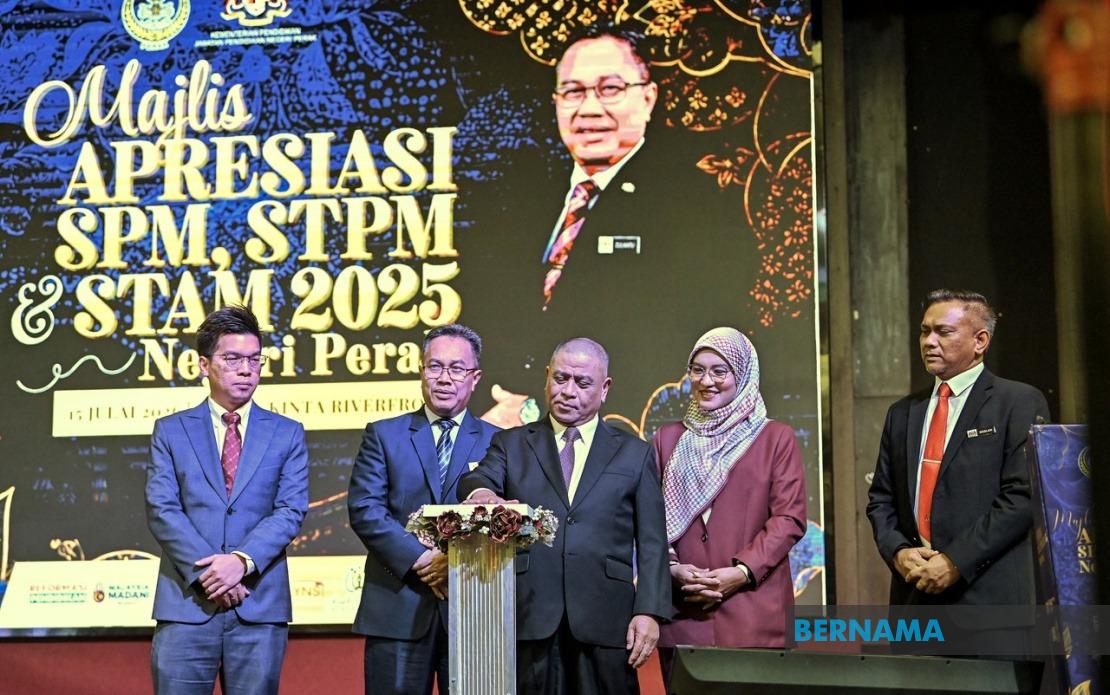
The Perak state government's Menteri Besar Scholarship continues making measurable differences in students' lives by directly addressing the financial pressures that often constrain educational progression. Speaking at an appreciation ceremony for high-achieving school leavers in Ipoh on July 15, beneficiaries and state officials highlighted how targeted financial support translates into improved academic outcomes and expanded opportunities for young people across the state.
Yoong Lam, a 20-year-old from Sekolah Menengah Kebangsaan Sultan Yussuff, exemplifies the programme's impact. Having achieved a perfect Overall Grade Point Average of 4.00 in her STPM examinations, she receives RM1,200 per semester through the scholarship. This sum directly covers essential educational expenses including tuition fees, academic reference materials, and coaching classes. For Yoong, the eldest of two children, the assistance has proven instrumental in easing pressure on her self-employed father, who shoulders the family's primary income responsibilities. She stressed that such support allows students to concentrate on their studies rather than worry about household finances, and she expressed hope that other motivated students would pursue similar opportunities.
Other scholarship recipients underscored how the financial assistance addresses a crucial gap in the educational journey. Muhammad Haziq Hafit, 19, a student from Al-Ulum Al-Syar'Iyyah Religious Secondary School in Bagan Datuk, received RM1,000 to prepare for university entry. Having excelled in the STAM examinations, he plans to pursue education studies at the University of Malaya and views the scholarship as essential preparation for initial university expenses. Similarly, Muhammad Taufiq Ikwan Mohammad Asri, also 19 and from the same institution, described the assistance as particularly valuable for middle-income families, despite being modest in scale compared to other scholarships. He intends to use the funds to purchase necessities before continuing his studies in Egypt.
Peark's education sector has demonstrated remarkable improvement that validates the effectiveness of such support mechanisms. Menteri Besar Datuk Seri Saarani Mohamad revealed that the state achieved an average grade point of 4.49 for 2025 SPM results—the strongest performance in thirteen years and the third consecutive year of gains. This trajectory suggests that comprehensive support strategies, including financial assistance, are creating environments where students can excel. The data also points to an encouraging reduction in educational inequality, with only 0.04 points separating average performance between urban and rural candidates. This convergence indicates that opportunity and quality education are becoming more accessible throughout Perak's diverse communities.
Beyond direct financial aid, the state has layered complementary interventions designed to strengthen student preparation. The Tuisyen Cikgu Saarani (TCS) Programme, led by Yayasan Perak in partnership with the state education department, has become particularly influential in driving performance improvements. Perak Education Director Zulkafli Mohamed Mokhtar attributed recent gains partly to the programme's additional SPM reference book initiative, which provides concentrated, curriculum-aligned study materials developed by experienced educators. These resources distil complex concepts and examination strategies into formats that enable deeper understanding rather than mere memorization.
The scale of distribution underscores the programme's institutional commitment. Sixty-three thousand five hundred and sixty-seven copies of supplementary reference materials have been distributed to daily school students throughout Perak, with particular focus on students identified as having strong potential to pass but requiring additional structured support. This targeted approach ensures that additional resources reach those most likely to benefit, maximizing efficiency and impact. For 2026 SPM candidates, the initiative is projected to benefit nearly 25,000 students across the state, representing a significant proportion of the candidate cohort.
Recognising the importance of religious education pathways, Perak has expanded the reference book scheme for the first time to include students at tahfiz schools and Islamic religious secondary institutions. This expansion acknowledges that excellence and rigorous preparation should not be confined to secular tracks, and that students pursuing Islamic studies deserve equivalent support infrastructure. The Perak Islamic Religious Department has partnered in this expansion, ensuring materials align with religious education curricula and examination requirements. This inclusive approach broadens the conception of merit and opportunity beyond conventional academic hierarchies.
The significance of these interventions extends beyond individual achievement statistics. For Malaysian society, the scholarship and support programmes represent a strategic investment in human capital development during a critical stage when family financial stress can derail promising students. When students can focus on learning rather than household financial emergencies, retention improves, examination performance strengthens, and progression to higher education becomes more probable. For economically disadvantaged families, such support determines whether bright children access university or enter employment prematurely.
Regionally, Perak's approach offers a model that other Malaysian states and Southeast Asian jurisdictions might consider. By combining direct financial assistance with targeted academic support resources, the state addresses both supply-side barriers (family inability to afford education costs) and demand-side constraints (student preparedness for examinations). The focus on rural-urban equity and inclusion of religious education pathways demonstrates administrative sophistication in recognizing diverse pathways to national development. In an era when regional economies increasingly compete for skilled talent, such investments in youth education become essential for attracting investment and building competitive advantages.
The programme's effectiveness also reflects broader governance trends. By linking assistance to merit—measured through examination performance—Perak signals that support rewards achievement while incentivizing effort. This approach avoids both the pitfall of unconditional aid that provides no motivation and the equally damaging trap of merit-based access so stringent that disadvantaged students cannot participate. The visibility of scholarship recipients at state-level ceremonies, as occurred in Ipoh, further signals social validation of educational achievement and may inspire younger students to pursue similar excellence.
Looking forward, the combination of scholarship provision, curriculum support materials, and institutional expansion suggests Perak views educational development as an ongoing process requiring sustained investment. As Malaysia navigates post-pandemic education recovery and prepares students for increasingly knowledge-intensive employment, state-level commitment to removing financial barriers while enhancing pedagogical support becomes ever more critical. The 4.49 state average, the narrowing rural-urban gap, and the expansion to religious schools all indicate that targeted, well-designed interventions do translate into measurable progress, offering encouragement to educators and policymakers throughout the country.

