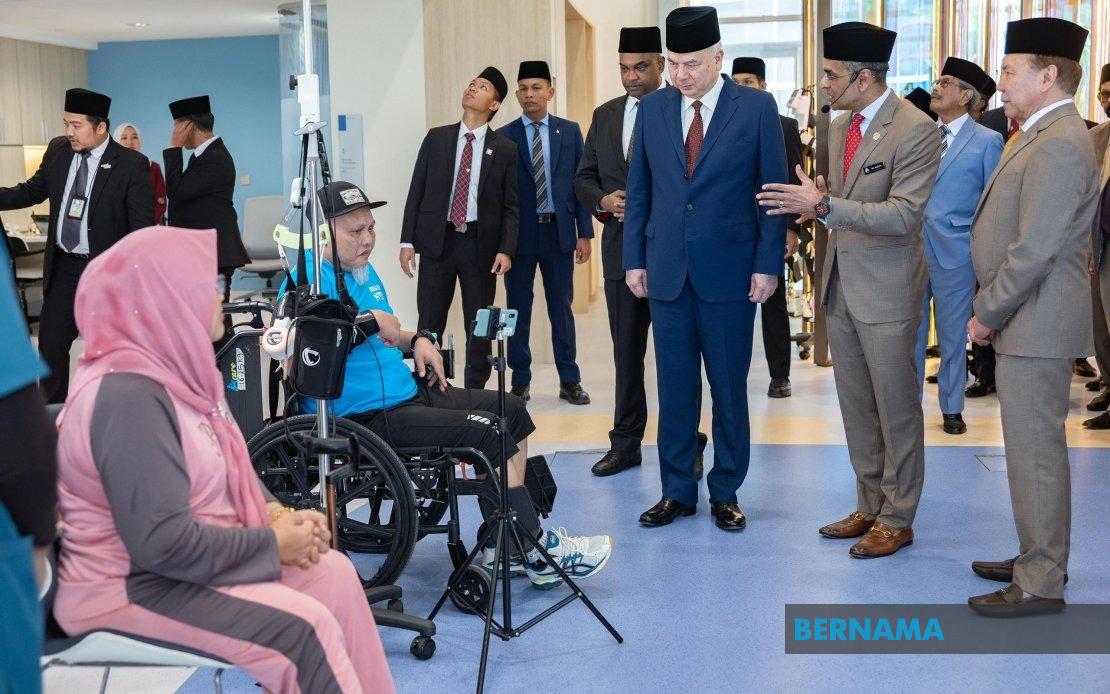
Malaysia's social security landscape took a significant step forward when Sultan Nazrin Shah, the Sultan of Perak, inaugurated the Neuro-Robotics and Cybernetics Rehabilitation Centre operated by PERKESO in Meru Raya on June 16. The facility, now formally known as Pusat Rehabilitasi Perkeso Sultan Nazrin Shah, signals a transformative moment in how the nation approaches worker rehabilitation and healthcare innovation. The architectural design, inspired by traditional gold-thread embossing art, blends contemporary rehabilitation technology with cultural sensitivity—a symbolic gesture that modern Malaysia need not abandon its heritage whilst embracing progress.
The ceremony drew prominent figures including Raja Muda Perak Raja Jaafar Raja Muda Musa, Raja Di Hilir Perak Raja Iskandar Dzulkarnain Sultan Idris Shah, Menteri Besar Datuk Saarani Mohamad, and Minister of Human Resources Datuk Seri R. Ramanan. Their collective presence underscored the project's significance as a national initiative rather than a localized health intervention. The facility represents years of planning that originated during M. Kulasegaran's tenure as Minister of Human Resources from 2018 to 2020, demonstrating how policy visions can eventually materialise into tangible infrastructure serving vulnerable populations.
In his address, Sultan Nazrin characterised the centre not primarily as a technological marvel but as a reflection of national values and societal commitment. The institution pools expertise from multiple disciplines including medical specialists, assistive technology engineers, physiotherapists, occupational and vocational therapists, social workers, and psychological counsellors. This multidisciplinary approach addresses the comprehensive needs of individuals recovering from serious injuries or neurological conditions, moving beyond traditional single-specialist models that have long dominated rehabilitation practice in the region.
The Sultan articulated a philosophical framework positioning rehabilitation as a fundamental human right rather than a charitable service. He framed recovery narratives across different injury types—a stroke survivor regaining mobility, a worker rebuilding strength after neurological trauma, an individual restoring cognitive function following traumatic brain injury. These specific examples ground abstract rehabilitation principles in lived experiences that Malaysian families confronting these challenges will recognise. The emphasis on families as stakeholders reflects understanding that disability impacts entire households, not isolated individuals.
Central to Sultan Nazrin's message was the proposition that advanced technology, whilst important, remains secondary to the human relationships underpinning effective rehabilitation. Sophisticated neuro-robotics equipment and cybernetics systems can facilitate recovery, yet compassionate professionals wielding those tools determine actual outcomes. This distinction matters for Malaysian policymakers potentially tempted to import expensive foreign systems whilst neglecting workforce development and training. The centre's success ultimately depends upon attracting and retaining skilled professionals committed to patient-centred care.
The Sultan made an explicit plea for societal transformation regarding disability stigma. Malaysia, like many Southeast Asian societies, harbours persistent prejudices against individuals with disabilities. These attitudes create employment barriers extending far beyond physical limitations. By calling for prejudice elimination and societal support for rehabilitation programme graduates, Sultan Nazrin positioned workplace inclusion as moral imperative rather than mere compliance obligation. Such messaging from royal authority carries weight in Malaysian civic discourse, potentially influencing private sector attitudes.
Particularly notable was the highlight of PERKESO's partnership with 7-Eleven for post-rehabilitation vocational training and employment placement. This strategic collaboration demonstrates a practical pathway from treatment to economic reintegration—a crucial final step often neglected in rehabilitation services. Workers who complete physiotherapy and psychological recovery yet struggle to secure employment face devastating relapse risks. Employment represents both financial necessity and psychological restoration for individuals previously self-reliant. The 7-Eleven model offers replicable blueprint for other corporations.
Sultan Nazrin extended an invitation for expanded private sector engagement, explicitly requesting corporate participation through corporate social responsibility initiatives, vocational training programmes, and employment opportunities. This appeal acknowledges that rehabilitation centre success ultimately depends upon downstream employment ecosystem collaboration. Without jobs awaiting programme graduates, the finest rehabilitation facility becomes incomplete intervention. Malaysian corporations, particularly multinational operations emphasising inclusive hiring practices, possess capacity to meaningfully respond to this royal encouragement.
The Sultan reframed national progress beyond conventional metrics of physical infrastructure and economic indicators. This philosophical assertion challenges prevailing development narratives often dominated by GDP growth, urban expansion, and technology investment rankings. True societal progress, according to this formulation, encompasses social programme implementation, vulnerable population protection, and second-chance provision for individuals confronting illness, injury, or disability. For Malaysia positioning itself as a regional leader, this framework suggests development legitimacy requires human dimension attention alongside economic growth.
The facility's symbolic naming honours Sultan Nazrin Shah, whose long-standing advocacy for social welfare and human dignity deserves recognition. Yet the honour simultaneously represents broader Malaysian commitment to rehabilitation as national priority. Naming public institutions after sitting monarchs typically signals government elevation of underlying cause. This linguistic choice communicates that worker rehabilitation and disability services carry royal and state importance, potentially influencing budget allocations and institutional prioritization across government structures.
For Southeast Asian context, Malaysia's investment in neuro-robotics rehabilitation infrastructure positions the nation as regional innovation leader in this critical healthcare segment. Many neighbouring countries lack comparable facilities, suggesting potential for Malaysian expertise export and regional hub positioning. PERKESO could attract patients from across ASEAN seeking advanced rehabilitation services unavailable domestically in their home countries, generating economic benefits whilst establishing soft power through healthcare excellence.
The facility's launch occurs against backdrop of Malaysia's ageing workforce and increasing workplace injury rates associated with industrial development. Road accidents, occupational injuries, and chronic neurological conditions place growing demands on rehabilitation services. Demographic trends suggest these pressures will intensify over coming decades. The Meru Raya centre represents essential infrastructure response to predictable demand, yet sufficient capacity across the nation remains questionable. Additional rehabilitation facilities, likely required, should incorporate similar principles emphasising technology, multidisciplinary expertise, and employment reintegration pathways.

%22%2F%3E%3C%2Fpattern%3E%3C%2Fdefs%3E%3Crect%20width%3D%22100%25%22%20height%3D%22100%25%22%20fill%3D%22url(%23ph1354vg)%22%2F%3E%3Crect%20width%3D%22100%25%22%20height%3D%22100%25%22%20fill%3D%22url(%23ph1354vp)%22%2F%3E%3Ctext%20x%3D%2250%25%22%20y%3D%2250%25%22%20text-anchor%3D%22middle%22%20dominant-baseline%3D%22central%22%20fill%3D%22rgba(255%2C255%2C255%2C0.95)%22%20font-family%3D%22Georgia%2C%20'Times%20New%20Roman'%2C%20serif%22%20font-weight%3D%22700%22%20font-size%3D%22320%22%20letter-spacing%3D%22-0.02em%22%3EGRS%3C%2Ftext%3E%3C%2Fsvg%3E)