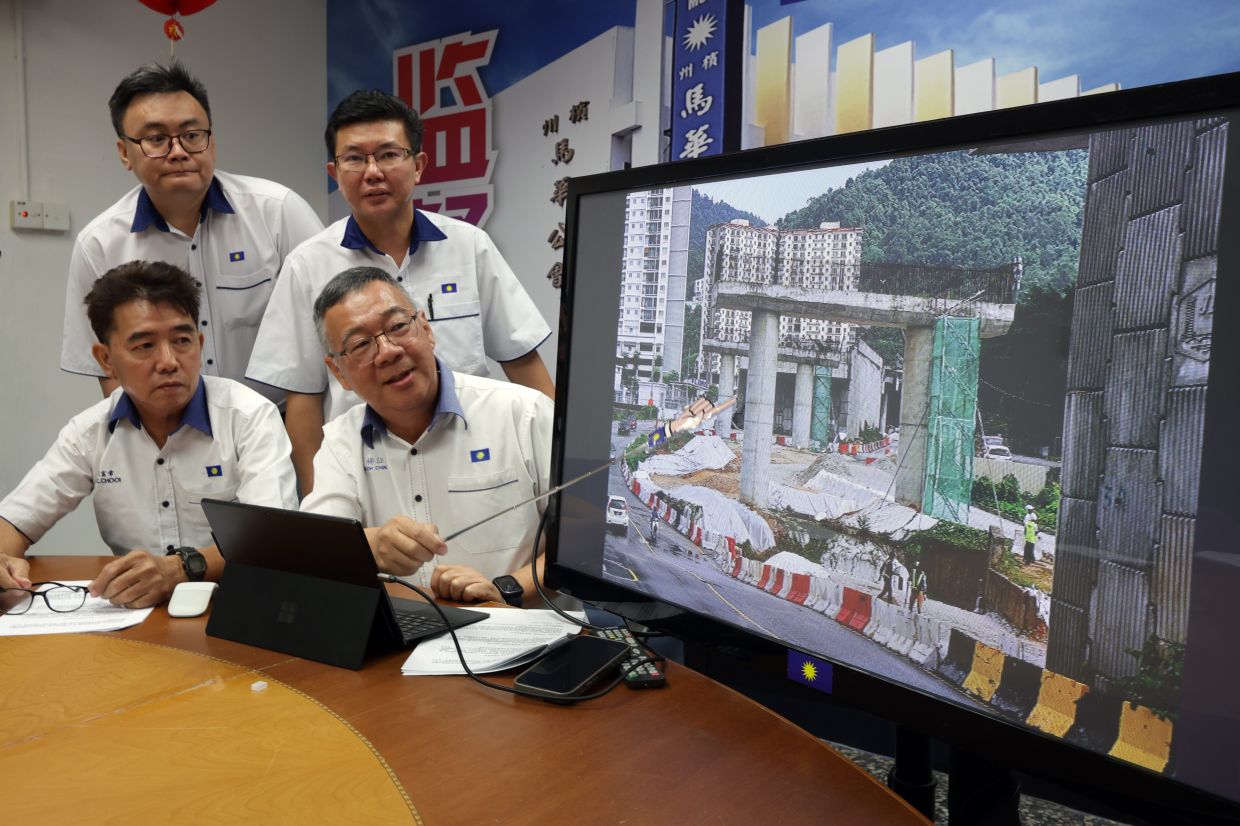
The Penang chapter of the Malaysian Chinese Association has publicly challenged the Penang state government's handling of the Air Itam-Tun Dr Lim Chong Eu Expressway bypass project, demanding full disclosure of financial transactions and technical assessments related to the infrastructure development. Yeoh Chin Kah, the party's state secretary, framed the dispute not as a disagreement over scheduling but as a fundamental question of governmental transparency and the restoration of public trust in major capital projects.
At the heart of the controversy is a credibility gap between official progress statements and what MCA representatives observed during an inspection conducted on July 1. While the state government has reported the 6-kilometre toll-free bypass at 89% completion as of December last year, with an assemblyman subsequently claiming 91% progress, Yeoh's team discovered significant structural work remaining incomplete across multiple sections including Valley Road, Changkat Tembaga, and Jalan Thean Teik. The inspection revealed that while bridge support columns had been erected at some locations, the actual bridge superstructure—the beams and decking that form the traffic-bearing surface—had not yet been installed in many areas. Additionally, finishing works such as road surfacing, safety guardrails, noise attenuation barriers, and electrical and mechanical systems remained outstanding across considerable stretches of the route.
This discrepancy raises important questions about how completion percentages are calculated in Malaysian infrastructure projects and whether the methodology adequately reflects the reality of on-site progress. A bridge that is 89% complete by one accounting method may have received only preliminary foundation work, leaving the majority of the most visible and structurally critical phases still ahead. For residents in Air Itam, Bandar Baru Air Itam, and Paya Terubong—a population exceeding 300,000 people—this distinction matters substantially, as it affects when they can expect meaningful relief from the congestion that has plagued these neighbourhoods.
Yeoh has issued a formal ultimatum, granting the state administration seven days to produce payment records, consultant certification documents, and comprehensive project assessment reports. Should officials fail to comply, Penang MCA intends to escalate the matter by lodging formal complaints with the National Audit Department, Malaysia's premier public accountability institution, as well as the Malaysian Anti-Corruption Commission. The party has also signalled plans to establish a dedicated monitoring committee to track reported completion figures against actual construction progress and to verify that contractor payments align with verifiable work completed on the ground.
The bypass project carries considerable political and practical weight within Penang's infrastructure strategy. Officially known as Package Two of the broader Penang undersea tunnel and three paired roads initiative, the expressway represents a multi-billion-ringgit investment designed to distribute traffic loads and reduce travel time across some of the state's most congested corridors. The infrastructure combines elevated viaducts, underground tunnels, and conventional surface roadways to create an alternative routing that bypasses the Air Itam town centre, which serves as a bottleneck for north-south traffic movement on the island.
The project's timeline has proven consistently optimistic since its inception. Originally slated for completion in 2024, the scheme has already received two formal extensions, with the current promised delivery date set for April 12, 2027. This represents a postponement of approximately three years from the initial target, a slip that invites scrutiny regarding either the initial planning assumptions or the adequacy of resource allocation and project management over the intervening period. For Malaysian infrastructure observers, such delays have become routine, yet they impose genuine costs on commuters, businesses, and public finances.
When contacted for comment, Paya Terubong assemblyman Wong Hon Wai offered a more optimistic assessment, claiming that the project had achieved 91% completion status and remained aligned with the April 2027 completion date. Wong cited a June 30 meeting with construction representatives and indicated that the contractor had committed to launching twelve bridge beams on the Gelugor side during the current period through August, with the remaining six beams to follow in the final quarter of 2027. He also noted that bridge beams on the Bandar Baru Air Itam side had already been delivered into position, though he acknowledged that the roadway would not open to traffic immediately upon construction completion.
Wong's statement introduces a further temporal consideration: the distinction between substantial completion—when construction activity ceases—and operational readiness for public use. Following the end of active construction, the project will require a Road Safety Audit conducted by the relevant government agency, after which the Public Works Department will make the final determination on opening timing. This sequential process could extend the actual gap between construction conclusion and traffic commencement by several additional months, a detail that merits clearer public communication.
The political dimension of this dispute reflects broader tensions within Penang's governance structure. The MCA, as a component party within the Barisan Nasional coalition that holds federal power, maintains a distinct role from the Penang state government, which is controlled by a different coalition. This separation creates incentives for the MCA to scrutinise state administration decisions, both to protect its political standing and to maintain voter confidence in its ability to exercise oversight. Simultaneously, the state government may resist disclosure requirements it views as intrusions on executive authority or as politically motivated challenges to its developmental agenda.
For Malaysian infrastructure stakeholders more broadly, this episode illustrates recurring governance challenges that extend beyond Penang. Major public projects often suffer from communication gaps between contractor claims, government statements, and independent verification, leaving citizens uncertain about realistic timelines and actual progress. The demand for transparency that Yeoh Chin Kah articulates represents a rational public interest in understanding how large sums of capital are deployed and what tangible outcomes can realistically be expected. Whether the state government responds constructively to this pressure will signal important messages about accountability standards within Malaysian state governance.
The Air Itam bypass project, once operational, promises substantial benefits to the regional traffic ecosystem and economic connectivity. However, the current controversy underscores that infrastructure benefits depend not merely on eventual completion but on credible governance, transparent communication with affected populations, and genuine accountability for progress claims. As the April 2027 deadline approaches, continued scrutiny from both internal political actors and the broader public will remain essential to ensuring that this significant regional investment ultimately delivers the promised outcomes.

