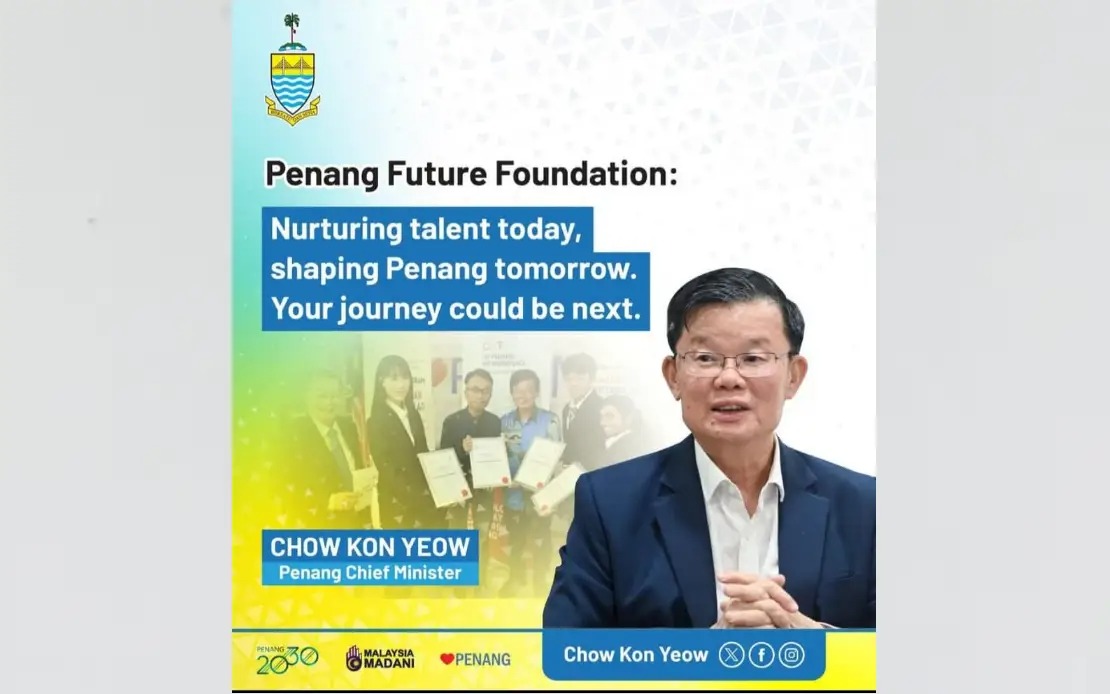
The Penang Future Foundation, a state-backed talent development initiative launched in 2015, has channelled roughly RM47.7 million into scholarship support for 863 high-achieving Malaysian students, underscoring Penang's sustained commitment to building a skilled workforce for future economic expansion. According to Chief Minister Chow Kon Yeow, the foundation—now entering its 12th operational year—continues to serve as a cornerstone mechanism for identifying, nurturing, and anchoring talented individuals within the state, addressing the region's escalating need for qualified professionals across multiple sectors and industries.
The foundation's dual-funding model, which combines government resources with contributions from private enterprise, reflects a collaborative approach to human capital development that has become increasingly important as Penang positions itself as a competitive hub for regional investment and innovation. This partnership structure allows the foundation to expand its reach and financial capacity beyond what state coffers alone could sustain, creating a sustainable ecosystem for talent retention and economic competitiveness.
In the most recent cycle, 58 students from varying socioeconomic and academic backgrounds received PFF scholarships, with the majority pursuing specialised qualifications in Science, Technology, Engineering, Mathematics, Accountancy, and Finance—sectors that align closely with Penang's strategic economic priorities and the broader labour market demand across Southeast Asia. This sector focus reflects a deliberate effort to address skills gaps in high-value industries where Malaysia and the region face persistent talent shortages and where qualified professionals command premium compensation packages.
Chow emphasised that talent attraction and retention have become critical success factors in Penang's long-term development strategy, particularly as the state seeks to sustain growth momentum over the next five decades and maintain its appeal to multinational corporations and technology investors. The state faces increasing competition from rival regions within Malaysia and neighbouring countries for both talent and foreign direct investment, making proactive scholarship initiatives essential for maintaining competitive advantage and building institutional capacity.
For Malaysian students aspiring to access PFF support, the foundation operates two distinct scholarship pathways calibrated to different academic performance levels. The PFF Penang Scholar programme targets high-achieving students with cumulative grade point averages of 3.67 or above, while the PFF Mutiara Scholar scheme extends opportunities to qualified applicants with GPAs ranging from 3.00 to 3.66, thereby widening the pool of eligible candidates and reducing the risk of overlooking talented individuals who may face socioeconomic or educational disadvantages.
This tiered approach demonstrates awareness that academic merit alone does not capture the full spectrum of student potential, particularly among candidates from under-resourced schools or communities where institutional support systems may be comparatively weaker. By offering dual pathways, the foundation balances rigorous selection standards with inclusivity, a philosophy that resonates with contemporary discussions around equitable access to higher education across Malaysia.
Prospective applicants from anywhere in Malaysia are actively encouraged to submit applications for the 2026 scholarship cycle, which will open for registrations beginning July 15 and close on August 5. This nationwide recruitment approach, rather than limiting opportunities to Penang residents, reflects the foundation's strategy to identify the most capable talent regardless of geographic origin, then encourage these individuals to pursue tertiary studies and early-career development opportunities anchored in Penang.
The decision to recruit nationally rather than regionally also serves a practical purpose: it allows the foundation to cast a wider net for exceptional candidates who might otherwise gravitate towards established universities and scholarship programmes in Kuala Lumpur or overseas, thereby channelling talent towards Penang-based institutions and strengthening the state's position as an education and innovation destination within Malaysia.
Interested students should monitor the PFF's official website at www.penangfuturefoundation.my for periodic announcements, application guidelines, and scholarship terms. The website serves as the primary information hub and application portal, making the process transparent and accessible to digitally connected applicants while underscoring the foundation's modern, technology-enabled approach to talent identification and management.
For Malaysia's education sector broadly, the Penang Future Foundation exemplifies how state governments can complement federal initiatives in human capital development, creating specialised funding streams that respond to regional economic priorities and demographic needs. The RM47.7 million invested over eleven years represents a significant public-private commitment to talent development, one that yields measurable returns through enhanced workforce quality and strengthened economic competitiveness. As other Malaysian states and regions consider similar initiatives, the Penang model offers a replicable framework for sustainable, merit-based scholarship delivery that balances excellence with accessibility.

