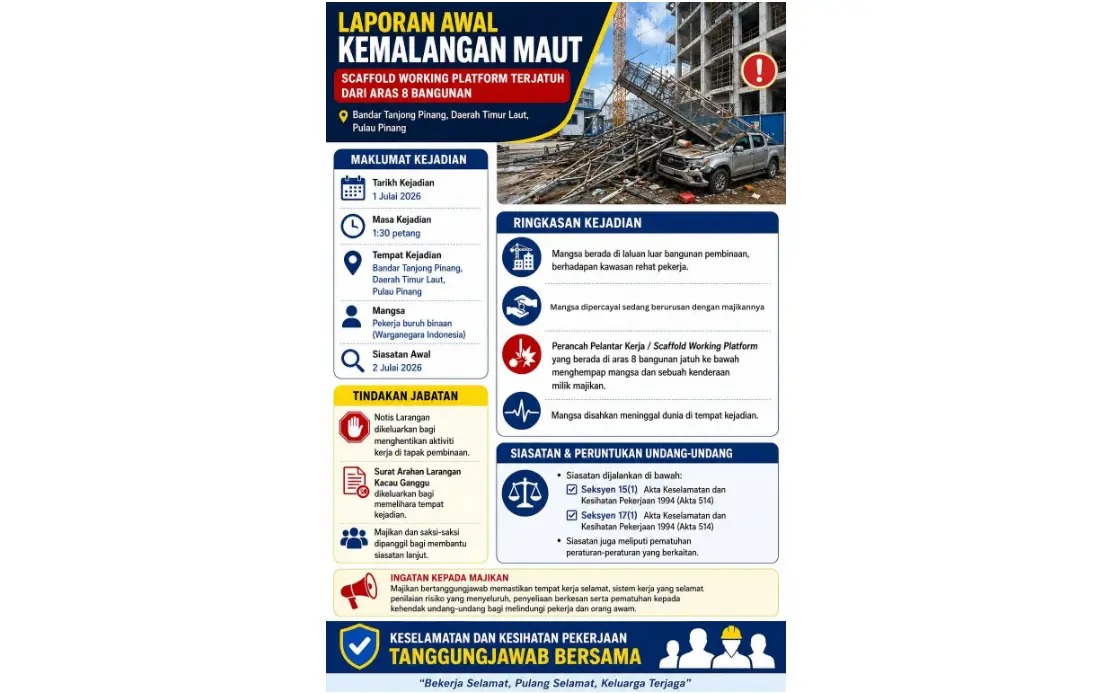
Penang's Department of Occupational Safety and Health (DOSH) has moved swiftly to impose a work stoppage at a Bandar Tanjong Pinang construction site in the wake of a tragedy that claimed the life of an Indonesian worker on July 1. The incident, which occurred at approximately 1.30 pm, has triggered a full regulatory investigation and prompted DOSH to issue a prohibition notice barring any further construction-related activities at the location until authorities complete their inquiry.
The fatality occurred when a working platform forming part of the building's scaffolding system detached from the eighth floor and fell to ground level. The victim, an Indonesian national employed at the construction site, was struck by the falling equipment while positioned on an external walkway situated in front of the workers' rest area. At the moment of impact, the worker was engaged in conversation with his employer when the scaffolding gave way, sending debris cascading downward. The impact also damaged a vehicle belonging to the employer, underscoring the violent force of the collapse.
Beyond the issuance of the work prohibition, DOSH has implemented a non-disturbance order to preserve the accident scene in its original state, protecting crucial evidence as investigators work to determine the root causes of the failure. This dual approach—halting operations whilst maintaining the integrity of the physical evidence—reflects standard protocols designed to facilitate thorough forensic examination of structural and mechanical components.
The investigation currently underway will focus on potential breaches of the employer's legal obligations stipulated under Sections 15(1) and 17(1) of the Occupational Safety and Health Act 1994 (Act 514). These sections establish fundamental duties that employers must discharge to maintain safe working conditions and protect workers from foreseeable hazards. DOSH has already commenced the process of interviewing employers and witnesses present at the time of the incident, seeking to establish a comprehensive timeline and understanding of how such a catastrophic failure occurred.
Preliminary findings suggest that the scaffolding platform's structural integrity may have been compromised, though investigators remain focused on gathering complete information before drawing firm conclusions. The fact that the platform fell from such a considerable height—the eighth floor of a multi-storey structure—raises serious questions about the installation, maintenance, and regular inspection protocols that should have been in place throughout the project lifecycle.
DOSH has signalled that enforcement measures and potential legal consequences will follow if its investigation reveals violations of safety regulations or employer duties. This warning serves as a pointed reminder to all stakeholders operating within Malaysia's construction sector that regulatory authorities maintain zero tolerance for negligence that results in loss of life. The regulatory response carries significant implications for project managers, main contractors, and subcontractors throughout Penang and the broader Malaysian construction industry.
The broader context here matters considerably for Malaysia's evolving workplace safety landscape. Construction remains one of the nation's highest-risk sectors, and fatalities involving migrant workers—who comprise a substantial proportion of Malaysia's construction labour force—have become an increasingly prominent concern among regulators, NGOs, and international observers. The presence of a large migrant workforce in Malaysian construction, whilst essential to project delivery, introduces complexity around language barriers, worker awareness of safety protocols, and compliance monitoring.
DOSH's public statement emphasised that all workplace fatalities demand serious attention and that the regulatory response reflects a commitment to accountability across the sector. The department explicitly called upon developers, main contractors, and subcontractors to prioritise meticulous planning and rigorous safety execution in all construction activities. This messaging transcends the immediate incident, serving as a sector-wide advisory that safety shortcuts and cut-cost approaches to worker protection will invite regulatory scrutiny and potential penalties.
The implications of this incident ripple beyond Penang's construction community. Safety failures at high-profile sites generate reputational consequences for developers and contractors, can delay project timelines significantly, and invite heightened scrutiny from regulators at both state and federal levels. Insurance providers and bonding agencies may also adjust their risk assessments based on the findings of investigations such as this one.
For migrant workers employed across Malaysia's construction sector, incidents of this nature underscore the necessity for enhanced training, clearer safety communication in workers' native languages, and more rigorous third-party monitoring of compliance. The fatality in Bandar Tanjong Pinang represents not merely an isolated tragedy but rather a systematic failure at some point in the safety chain—whether during design, installation, inspection, or ongoing maintenance of the scaffolding system.
As the investigation progresses through its coming weeks, all eyes will remain fixed on DOSH's findings and the regulatory and potentially criminal consequences that may follow. The department's response will signal to Malaysia's construction sector whether safety compliance remains negotiable or whether the cost of negligence has genuinely become prohibitive. Given the stakes involved—protecting lives of some of Malaysia's most vulnerable workers—the investigation's conclusions and any resulting enforcement actions will carry precedential weight across the industry.

