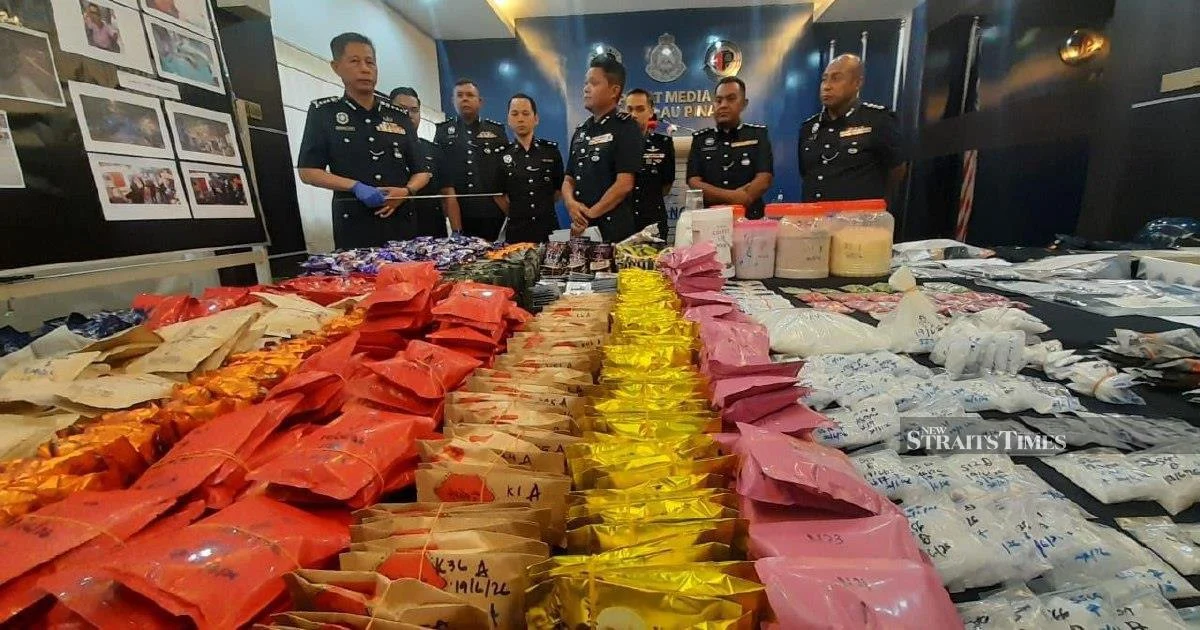
Penang police have arrested a couple in connection with a major drug manufacturing and distribution network uncovered at a condominium in Butterworth, with authorities seizing approximately RM9.7 million worth of controlled substances during the operation. The bust marks another significant blow to organised drug trafficking in the state, highlighting the continuing efforts by law enforcement to dismantle large-scale narcotics operations along the northwestern corridor.
The arrests came after police conducted a thorough investigation into the activities at the residential unit, which had been identified as the nerve centre of a sophisticated drug-processing operation. The couple, whose identities have been registered in police records, were taken into custody following the discovery of the manufacturing equipment and processed drugs on the premises. The seizure represents one of the more substantial single-operation drug busts in Penang in recent months, underscoring the scale of illicit drug manufacturing that continues to operate in urban residential areas.
Authorities recovered quantities of various narcotics at the scene, with forensic and chemical analysis confirming the total street value at approximately RM9.7 million. The condominium location, chosen deliberately for its apparent respectability and relative anonymity amid other residential units, had provided the perpetrators with a degree of operational concealment. However, persistent investigative work and community intelligence ultimately led police to the location and enabled them to move in with sufficient evidence to secure arrests and seizures.
The discovery of an operational drug laboratory within a residential building raises serious concerns about the vulnerabilities of modern housing developments and the necessity for increased vigilance from building management and residents alike. Condo dwellings, particularly in middle-income developments, have increasingly become the target location for drug manufacturers seeking to blend into ordinary neighbourhoods. The relative anonymity of condominium living, combined with multiple entry and exit points and less stringent visitor screening than traditional neighbourhoods, creates an environment where such illicit activity can potentially flourish if left undetected.
For Malaysian residents and policymakers, this case exemplifies the ongoing challenge of drug trafficking and manufacturing within the country's borders. The scale of the operation—from raw materials through processing to distribution—suggests a level of organisation and capital investment that indicates these are not merely street-level dealers but members of a coordinated criminal enterprise. The involvement of a couple in running such a substantial operation also demonstrates how drug syndicates increasingly employ relationship networks and domestic settings to conduct their activities, blurring the lines between personal space and criminal enterprise.
The Penang authorities have not disclosed the complete operational network or the extent to which this particular condominium operation supplied other dealers and distributors across the state or beyond. However, the sophistication implied by the processing equipment and the monetary value involved suggests the bust has likely interrupted supply lines affecting multiple downstream distribution points. This cascading effect means that the immediate impact of this single operation could be felt across a broader drug market geography than simply the area immediately surrounding Butterworth.
The arrest carries implications for how Malaysian law enforcement approaches organised crime in residential settings. Modern drug manufacturing requires significant infrastructure, chemicals, and expertise—elements that cannot be concealed indefinitely without detection. The fact that police successfully identified and acted upon intelligence regarding this operation indicates that information-sharing between various agencies and community tipoffs remain effective tools in combating organised narcotics crime. Building management, neighbours, and regular community reporting appear to have played a role in flagging unusual activity at the unit.
Regionally, the Penang bust reflects broader patterns of drug manufacturing and trafficking occurring across Southeast Asia. Thailand, Myanmar, and Malaysia have all seen increases in synthetic drug production facilities operating in urban areas, with traffickers deliberately targeting residential neighbourhoods to avoid detection by law enforcement. The transnational nature of precursor chemicals and the ready availability of manufacturing expertise through international criminal networks mean that regional cooperation remains essential to disrupting these operations at multiple points in their supply chain.
The charges and legal proceedings against the arrested couple will now proceed through Malaysia's court system, where convictions under the Dangerous Drugs Act carry substantial penalties including lengthy prison sentences and potential fines. The severity of sentencing in such cases serves as a deterrent, though the financial incentives associated with large-scale drug manufacturing continue to attract individuals willing to assume significant legal and personal risks. The successful prosecution of this case will likely contribute to ongoing law enforcement pressure against similar operations throughout Penang and the surrounding region.
Moving forward, the seizure emphasises the importance of sustained anti-drug policing efforts and the necessity for communities to remain vigilant about unusual activities in their residential buildings. Condominium residents are increasingly recognised by law enforcement as frontline observers who can report suspicious patterns—excessive visitors, unusual odours, continuous activity at odd hours, or sealed windows in residential units. Such vigilance, when properly reported to authorities, has proven instrumental in uncovering operations like the one in Butterworth.
The Penang police have indicated they are continuing investigations to identify other individuals involved in the distribution network downstream from this manufacturing point. Such follow-up work is critical to fully dismantling the operation and preventing the rapid reformation of the supply chain. Authorities are also coordinating with other state police forces to determine whether similar manufacturing facilities operate elsewhere or whether this was part of a larger multi-location network. The intelligence gathered from this bust will inform ongoing efforts to refine detection methods and better identify the signatures of clandestine drug operations in residential settings.

