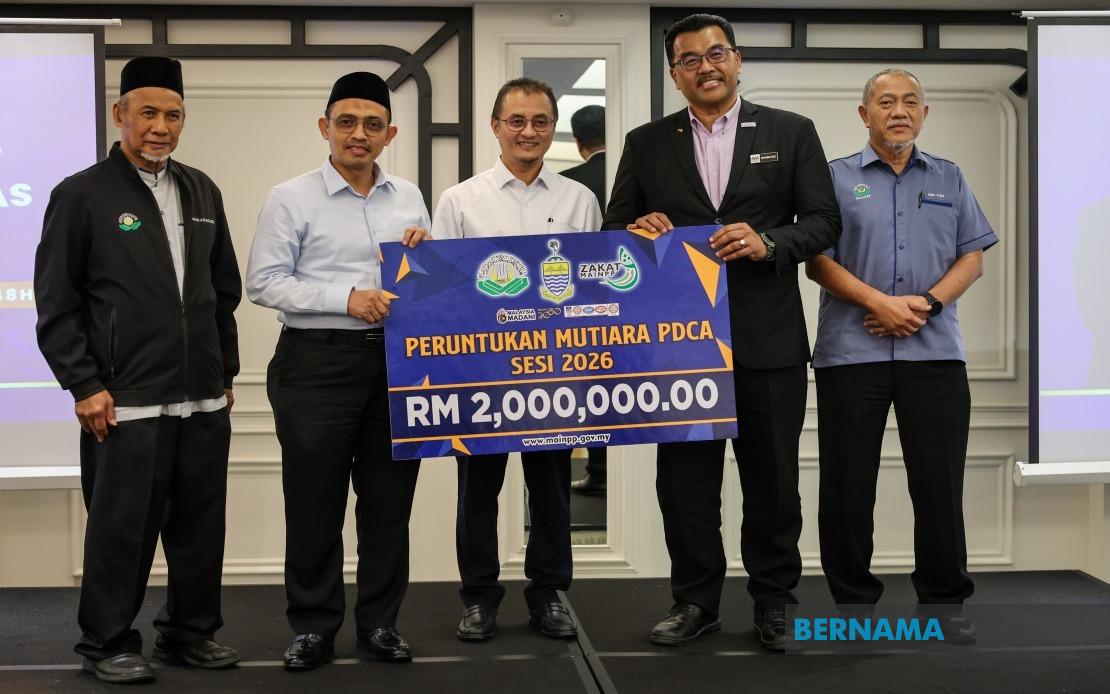
Penang has unveiled a substantial investment in educational equity, with the State Islamic Religious Council (MAINPP) channelling RM2 million into the Mutiara Didik Cemerlang Akademik programme this year. The initiative targets 7,403 Bumiputera students across the state, underscoring a concerted effort to level the playing field for disadvantaged learners seeking academic advancement through structured support systems.
Deputy Chief Minister Datuk Dr Mohamad Abdul Hamid, who also heads MAINPP, outlined the scope of this year's allocations during a briefing in Kepala Batas. The funding supports multiple educational pathways, including supplementary tuition classes, professionally developed learning materials, academic seminars and specialist workshops on examination strategies. By addressing gaps in foundational knowledge and test-taking techniques, the programme addresses barriers that typically hinder disadvantaged students from reaching their academic potential.
The MPDCA initiative, established in 2006, operates as a collaborative framework involving MAINPP, the Penang State Education Department, the Bumiputera Participation Coordination Division under the Prime Minister's Department, and the Penang Regional Development Authority. This multi-agency approach reflects recognition that educational outcomes improve when religious councils, education authorities and federal agencies coordinate efforts rather than operating in silos.
For the 2026 academic year, the programme mobilises 698 coordinating teachers deployed across 71 primary and 38 secondary schools throughout Penang. This teacher-intensive model ensures personalised attention and targeted intervention, moving beyond the limitations of conventional classroom instruction where educators juggle diverse student needs simultaneously.
At the primary level, the programme concentrates resources on four foundational subjects—Bahasa Melayu, English, Mathematics and Science—recognising that mastery of these core areas determines success in subsequent academic stages. For upper secondary students preparing for the SPM examination, the scope expands to 13 subjects, encompassing sciences, humanities and Islamic studies. This breadth reflects the diverse career pathways available to students and ensures the programme supports learners across multiple streams.
MAINPP has also incorporated curricula for government-aided Islamic schools, including specialised modules in contemporary Arabic language, Islamic jurisprudence and Islamic theology. This integration signals commitment to supporting religious education institutions, which serve significant portions of Penang's Muslim population, while maintaining academic rigor alongside religious instruction.
Data from the Education Department demonstrates tangible outcomes since the programme's inception two decades ago. Students participating in MPDCA have recorded measurable improvements in academic performance, suggesting that structured intervention coupled with qualified instruction yields results. For policymakers seeking evidence-based approaches to narrowing achievement gaps among disadvantaged cohorts, the programme offers proof of concept that dedicated resources and coordinated delivery produce positive returns.
Teacher testimonials provide ground-level perspective on programme effectiveness. A Bahasa Melayu instructor at SK Permai Indah described how systematically designed learning modules have enhanced student mastery across language skills—speaking, reading and writing—while removing financial barriers that would otherwise restrict access. The emphasis on classroom-based assessment preparation bridges the gap between traditional examination approaches and contemporary evaluation methodologies, ensuring students navigate evolving assessment frameworks successfully.
At SK Islam Al-Masriyah Halimatun in Bukit Mertajam, educators report particularly strong outcomes among students from low-income households unable to afford private tuition. Interactive learning approaches integrated into updated materials and quiz-based assessments sustain engagement, transforming passive recipients into active participants. This pedagogical shift—from lecture-based delivery to interactive participation—aligns with international evidence on learning effectiveness while remaining fiscally sustainable through public provision.
Beyond the MPDCA programme, MAINPP's broader investment portfolio signals comprehensive commitment to human capital development. The council has allocated RM22.36 million for tertiary education bursaries, RM6.3 million for university transition schemes, RM3 million for early schooling assistance and RM3 million for school uniform support. These layered interventions address the full educational pipeline from early childhood through university completion, removing friction points that typically derail disadvantaged students at transition junctures.
For Malaysian policymakers observing Penang's approach, several implications merit consideration. First, sustained investment in structured academic support yields measurable returns across standardised metrics. Second, teacher deployment remains central to programme success—funding modules alone accomplishes little without qualified personnel implementing them effectively. Third, coordination across government agencies reduces duplication and improves resource allocation, suggesting that siloed departmental budgets may perpetuate inefficiencies.
The Penang model also demonstrates how religious councils can leverage their institutional presence and community trust to advance educational equity beyond their traditional remit. MAINPP's role extends beyond spiritual guidance into economic empowerment through education, exemplifying how faith-based organisations contribute to nation-building objectives when properly resourced and coordinated with government agencies.

