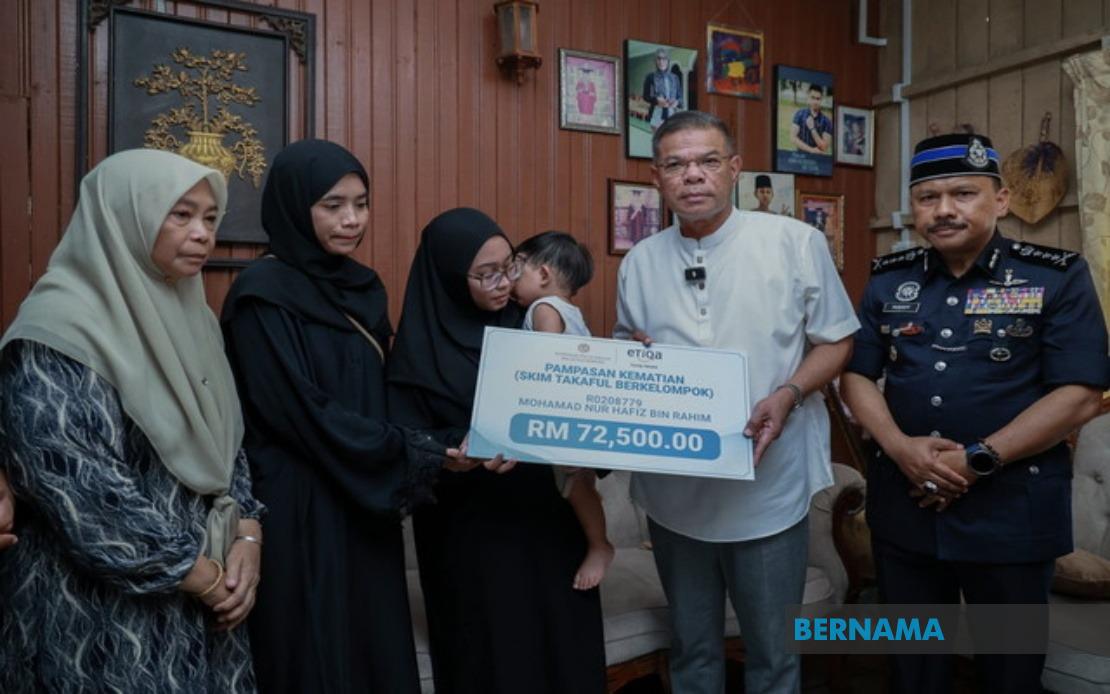
Three Royal Malaysia Police officers perished in a tragic workplace accident in Beaufort, Sabah on August 6 when they came into contact with live electrical current. Corporal Mohamad Nur Hafiz Rahim, 29, Corporal Chiu Teck Siong, 40, and Constable Muhammad Raimi Ismarubee, 26, died at approximately 5.50 pm while attempting to move a metal pole outside Weston Police Station near Sekolah Kebangsaan Weston. The incident has highlighted both the occupational hazards facing law enforcement personnel and the critical importance of rapid institutional support for bereaved families left behind.
Home Minister Datuk Seri Saifuddin Nasution Ismail has responded by pledging to circumvent standard bureaucratic procedures and expedite all financial assistance due to the affected families. During a visit to the home of Corporal Mohamad Nur Hafiz Rahim in Kampung Hutan Pasir, Ketereh, Kota Bharu, Saifuddin emphasized that the police establishment regards the loss of any officer as a significant institutional tragedy, regardless of rank or tenure. The minister's decision to personally oversee welfare arrangements underscores the government's commitment to ensuring financial security for officers' dependents in the immediate aftermath of such incidents.
The immediate financial support mobilized for Corporal Mohamad Nur Hafiz Rahim's family totals more than RM200,000, comprising contributions from both the Sabah and Kelantan Police Contingents as well as takaful insurance payouts derived from the deceased officer's own contributions through the Police Cooperative. Beyond these structured financial mechanisms, Saifuddin has instructed Bukit Aman Management to accelerate processing of additional entitlements. The widow, Fatimah Shahira, has been designated as the beneficiary of her late husband's monthly pension, while his mother remains entitled to her own pension allocation, providing a degree of long-term financial stability for both dependents.
The situation facing Corporal Mohamad Nur Hafiz Rahim's family carries particular poignancy given that his wife must now navigate single parenthood while caring for their two-year-old son. Saifuddin's reassurance that standard procedural timelines would not apply represents a pragmatic acknowledgment that grieving families require immediate financial breathing room during the acute crisis period following a sudden death. Beyond the structured pension and cooperative payments, the minister has signaled that the Sabah and Kelantan Police Contingents remain available to address emerging family welfare needs, whether educational support for the young child or other unforeseen expenses.
In a parallel compassionate gesture, Saifuddin subsequently traveled to Terengganu to meet with the family of Constable Muhammad Raimi Ismarubee, the youngest of the three deceased officers. Raimi's parents, Ismarubee Ismail and Nor Azila Zakaria, received the Home Minister at their residence in Felda Kerteh 2 near Dungun. The compensation presented comprised RM72,500 from the Police Cooperative Group Takaful Scheme, RM1,200 from the PDRM Welfare Fund, and an additional personal contribution from Saifuddin himself. This visit demonstrated that the government's institutional support extended across both Peninsular and Sabah-based officers, reflecting the national scope of the police service.
Constable Muhammad Raimi Ismarubee had been stationed at Weston Police Station since 2024, meaning he had only recently been posted to the Sabah location where he tragically died. As an unmarried officer, his immediate survivors consist of his parents and two siblings, fundamentally altering the family's economic circumstances given that Raimi presumably represented an income contributor to the household. The swift presentation of compensation during the Home Minister's personal visit served both practical and symbolic purposes, affirming that the state recognizes its obligations to officers' families and will not subject them to prolonged administrative delays.
The electric shock incident itself raises important questions about workplace safety protocols at police installations. The fact that three officers came into contact with live electrical current while performing what appears to be routine equipment handling suggests potential deficiencies in either electrical safety infrastructure or procedural safeguards. Police stations are government facilities where safety standards should meet rigorous occupational health standards, yet this incident demonstrates that such protections may have failed. The tragedy underscores the need for comprehensive safety audits across police installations nationwide, particularly regarding electrical hazards that workers encounter regularly.
For Malaysian readers and the broader Southeast Asian context, this incident reflects systemic challenges common across the region: the rapid mobilization of political leadership in response to tragic incidents, the reliance on discretionary welfare rather than institutionalized automatic entitlements, and the persistent bureaucratic friction even within supposedly streamlined government systems. Saifuddin's decision to expedite processing through Bukit Aman Management represents an implicit acknowledgment that standard channels move too slowly for families in acute financial distress. This raises broader questions about whether police welfare schemes should be restructured to provide near-automatic immediate disbursements rather than requiring ministerial intervention.
The delegation accompanying Saifuddin during both family visits included senior police leadership from multiple jurisdictions and contingents, signaling institutional acknowledgment of the incident's gravity. The presence of the Bukit Aman Management director, state police chiefs, and police commissioners underscored that this tragedy transcended normal operational matters and required leadership attention at the highest levels. Such visible institutional responsiveness carries psychological importance for remaining police personnel, demonstrating that their organization recognizes sacrifices and supports families left behind.
Beyond the immediate financial assistance, the incident reveals the complex web of social security mechanisms available to police officers and their families. The combination of pension entitlements, cooperative takaful insurance, contingent welfare funds, and discretionary ministerial contributions creates a patchwork system that ultimately depends on expedited processing and leadership discretion for optimal outcomes. For officers and their families, understanding these layered entitlements and accessing them efficiently during grief presents significant administrative burden precisely when capacity is lowest.
The government's response through Saifuddin's personal intervention has effectively communicated state solidarity with the police force and their families. However, the reliance on ministerial discretion to bypass standard procedures inadvertently highlights systemic weaknesses: why should families require ministerial intervention to access timely benefits that should theoretically be automatic? This incident, while tragic, may ultimately catalyze broader reforms in how police welfare entitlements are administered, moving toward more responsive and less discretionary systems that protect bereaved families through institutional design rather than ad-hoc leadership decisions.

