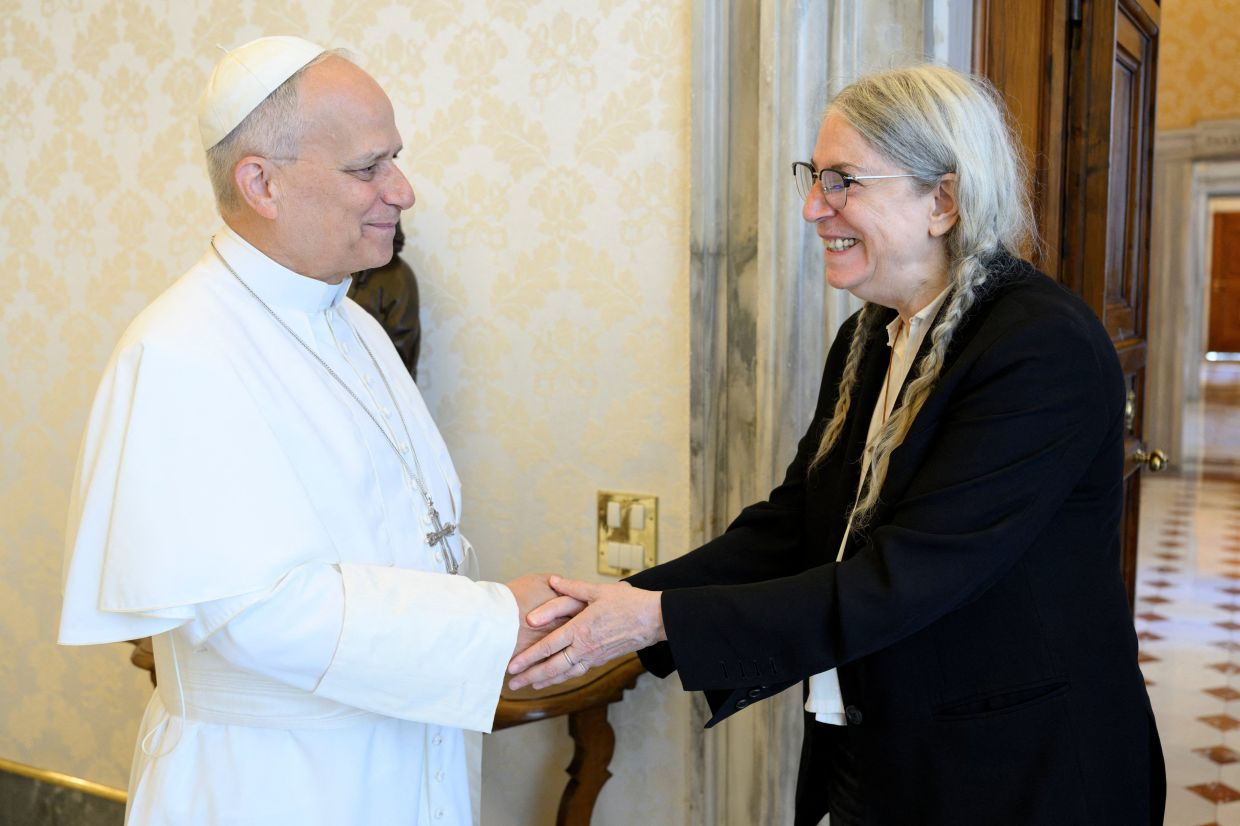
Rock and roll icon Patti Smith, the Chicago-born musician celebrated for pioneering punk rock and poetic songwriting, encountered Pope Leo XIV on Friday in what observers described as an intimate conversation between two figures drawn to spirituality and artistic expression. The meeting took place in the pope's office within the Apostolic Palace, where Smith—dressed simply in her characteristic braids and a crucifix necklace—greeted the pontiff with understated warmth before the pair settled into dialogue that would span four decades of religious evolution within the Catholic Church's highest echelon.
Smith's increasing prominence within Vatican circles reflects a deliberate cultivation of her connection to the Church, facilitated largely through Rev Antonio Spadaro, an influential figure in the Vatican's culture ministry who serves as undersecretary. Despite maintaining that she does not identify as Catholic, Smith has articulated a profound attraction to the spiritual philosophy espoused by recent popes, describing in particular how Pope Francis embodied a "gentle, open, and steadfast sense of humanity" that resonated with her own artistic and moral worldview. Her presence at Vatican functions has become increasingly routine, marking a rare instance of a secular artist being granted sustained access to the Church's institutional corridors.
The trajectory of Smith's Vatican engagement intensified following her 2013 encounter with Pope Francis, whom she subsequently performed for in 2014. When Francis died on April 21, 2025, Smith authored an emotional tribute on social media, composing a poem that evoked the late pope as a dandelion—simple in appearance yet possessing inherent strength. Her lament that "nature and poetry and the suffering shall miss their champion" revealed the depth of personal connection she had forged with Francis during their years of intermittent contact, suggesting that her involvement with the Vatican transcended mere institutional celebrity and approached something closer to genuine spiritual kinship.
According to Spadaro, who participated in Friday's audience, the encounter between Smith and Pope Leo XIV lasted approximately forty minutes—a substantial allocation of papal time that underscores the significance both parties attributed to their meeting. Spadaro's description of the interaction in subsequent communications characterised it as "a conversation between two people discovering they were old friends," highlighting an immediate rapport that developed despite Smith's non-Catholic status. His invocation of "memories woven from words and music, dreams, visions, and hopes" suggests that the discussion ranged across philosophical and artistic territory rather than remaining confined to formal religious instruction or protocol.
Smith's musical heritage adds particular resonance to her Vatican presence, given that she has spent five decades crafting work that interrogates spirituality, mortality, and transcendence through rock music's most experimental traditions. Her 1979 composition, referenced during Friday's encounter, apparently struck a chord with Pope Leo XIV, who praised it as "marvelous"—a moment that capsules the unusual dynamic wherein contemporary secular art finds validation within Catholicism's highest institutional spaces. This musical dialogue between artist and pontiff reflects a broader evolution in how the Church has positioned itself regarding cultural production and contemporary artistic expression.
Smith's involvement with the Vatican reached a notable milestone earlier this year when she performed during the inauguration of the Holy See's pavilion at the Venice Biennale, the prestigious international contemporary art fair. That performance on May 8 coincided with the anniversary of Pope Leo XIV's election, suggesting that her participation was deliberately scheduled to honour the new pontiff's ascendency. The Venice appearance situates Smith within the Church's cultural strategy, positioning her not as a traditional religious performer but as a contemporary artist whose work the Vatican wishes to associate with its modern, progressive identity.
The broader context of this meeting illuminates shifting dynamics within papal governance and the Church's approach to cultural engagement. By facilitating sustained contact between a secular artist of Smith's stature and the pope himself, the Vatican signals receptivity toward creative individuals who operate outside traditional Catholic frameworks yet grapple with profound spiritual questions. Smith's work, frequently concerned with mortality, human dignity, and transcendent experience, aligns thematically with Pope Leo XIV's apparent interest in artistic dialogue—a stark contrast to previous eras when the Church maintained more rigid boundaries between sacred and secular cultural spheres.
Smith's journey from punk rock provocateur to Vatican interlocutor represents a distinctive American cultural trajectory, one possible only for an artist who maintains intellectual independence while simultaneously demonstrating genuine spiritual curiosity. Her repeated returns to the Vatican suggest she perceives something authentic within the institution's current leadership and mission, despite her stated distance from Catholic doctrine. This nuanced positioning—engaged but not converted, respectful but not deferential—offers a model for how secular culture and institutional religion might interact in contemporary contexts.
The meeting also arrives within a week of Pope Leo XIV's own cultural engagement with the artistic world. The pontiff recently attended a concert honouring his papacy featuring acclaimed tenor Andrea Bocelli on Wednesday, July 29, demonstrating a pattern of seeking meaningful exchange with musicians and cultural figures. These encounters suggest a papal administration conscious of its need to maintain relevance within contemporary consciousness and willing to employ artistic mediation to that end.
For Malaysian and Southeast Asian readers, Smith's Vatican presence carries particular significance given the growing awareness of syncretic spirituality in the region and the Catholic Church's own efforts to position itself as open to diverse faith expressions. Smith embodies a type of spiritual seeker increasingly common across Asia—someone who draws from multiple traditions without formal membership in any single religion, yet maintains genuine reverence for spiritual wisdom wherever encountered. Her comfortable dialogue with papal authority suggests possibilities for how the Church might extend its influence beyond traditional demographic boundaries, particularly among intellectually sophisticated audiences sceptical of institutional religion yet spiritually attuned.

