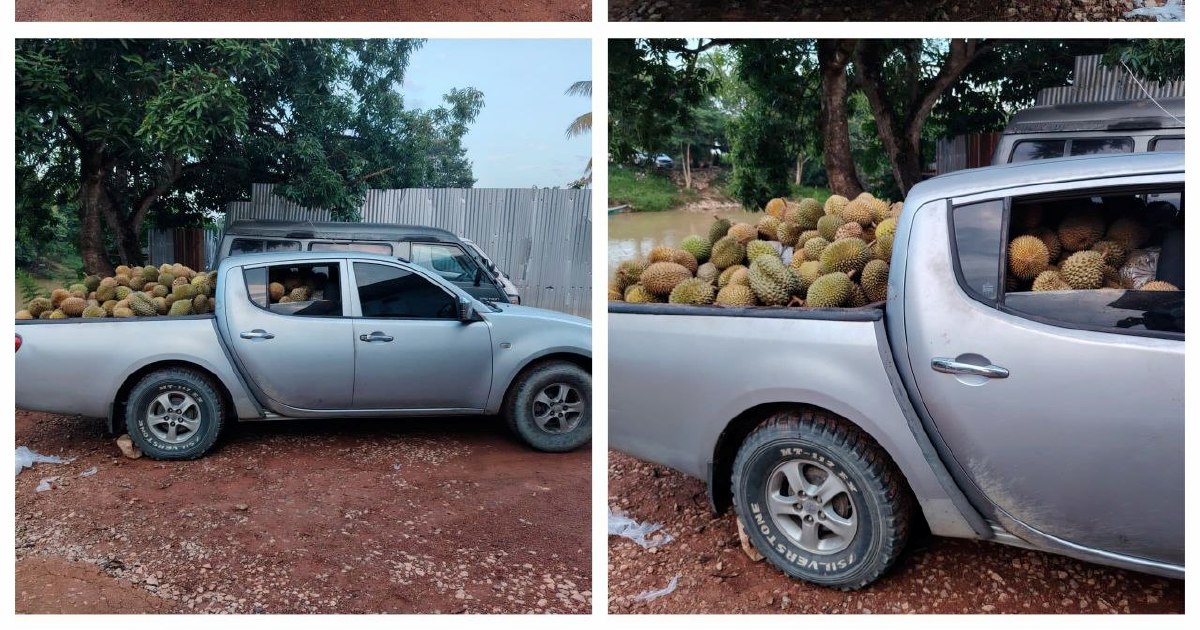
A 22-year-old part-time driver has been apprehended by authorities at Rantau Panjang after being found transporting approximately 700 kilograms of durians believed to have been illegally smuggled across a state border. The arrest occurred during a routine checkpoint operation, marking yet another instance of organized fruit trafficking that has escalated considerably in recent months across the northern border regions of Peninsular Malaysia.
The young driver had reportedly accepted the position with the understanding that his modest daily compensation would amount to between RM60 and RM70, a relatively insignificant sum that masked the true scope and stakes of the operation he had unknowingly become part of. This pattern—recruiting economically vulnerable individuals as couriers with disproportionately low pay—has become characteristic of smuggling networks operating throughout Southeast Asia, where trafficking organizations exploit financial desperation to insulate themselves from direct legal exposure.
The seizure of such a substantial quantity of durians signals the increasingly commercial nature of illegal cross-border fruit movements. Durian trafficking has emerged as a persistent problem in Malaysia's border areas, driven primarily by substantial price differentials between markets and the high demand for premium produce in urban centres. The financial incentives for organized groups are considerable: a single seizure of this magnitude could represent merchandise valued at tens of thousands of ringgit, making the investment in low-wage couriers a calculated business decision rather than opportunistic smuggling.
Rantau Panjang, situated in Kelantan along the Thai-Malaysian frontier, remains a strategic crossing point for contraband of all varieties. The porous nature of the border, combined with limited enforcement resources and the high volume of legitimate commercial traffic, creates conditions ideally suited to smuggling operations. Authorities have intensified focus on the region in response to escalating trafficking incidents, yet interdiction efforts continue to be hampered by the sheer volume of goods moving across the frontier and the sophistication of networks now coordinating these movements.
The economic dimensions of durian smuggling extend beyond the individual criminals apprehended. Thai producers and exporters have long viewed Malaysian markets as lucrative destinations for their produce, while Malaysian importers—both licensed and otherwise—have competing incentives to obtain fruit outside formal channels to maximize profit margins. This structural imbalance creates recurring demand for smuggling services, ensuring a steady supply of individuals willing to assume the risks associated with illegal transportation, particularly when financial circumstances leave them vulnerable to recruitment.
For Malaysian consumers, particularly in states distant from production zones, the presence of smuggled durian entering informal market channels represents both a public health and consumer rights concern. Illegally imported fruit may lack the requisite documentation proving compliance with quarantine and food safety standards, potentially exposing buyers to substandard or contaminated products. Additionally, the proliferation of smuggling operations undermines legitimate domestic producers and licensed importers who operate within regulatory frameworks designed to protect consumers and manage agricultural trade fairly.
The enforcement response to such incidents typically involves both immediate criminal charges against the driver and investigative work aimed at identifying the broader network structure. Malaysian authorities collaborate with Thai counterparts through various bilateral frameworks designed to combat organized crime and smuggling, though operational coordination remains inconsistent. The challenge facing investigators extends beyond apprehending individual couriers; disrupting the organizational infrastructure that recruits, coordinates, and finances these operations demands sustained intelligence work and cross-border cooperation.
The case also reflects broader supply chain dynamics affecting Southeast Asian agricultural trade. As consumer preferences shift toward premium varieties and agricultural production becomes increasingly concentrated and commercialized, the incentives for circumventing regulatory frameworks intensify correspondingly. Legitimate trade channels, while providing oversight and consumer protection, impose compliance costs that informal channels avoid—a fundamental competitive asymmetry that regulatory authorities must continually address through enhanced enforcement and inter-agency coordination.
Looking forward, this arrest underscores the persistent challenge facing Malaysian law enforcement agencies tasked with securing extensive land borders while maintaining the flow of legitimate commerce essential to regional economic activity. Addressing durian smuggling effectively requires multifaceted approaches combining traditional border security measures with supply chain transparency initiatives and cross-border collaboration mechanisms. Until structural economic incentives driving smuggling diminish, or enforcement capacity increases proportionally, such incidents will likely continue recurring with regularity across Malaysia's northern frontier regions.

