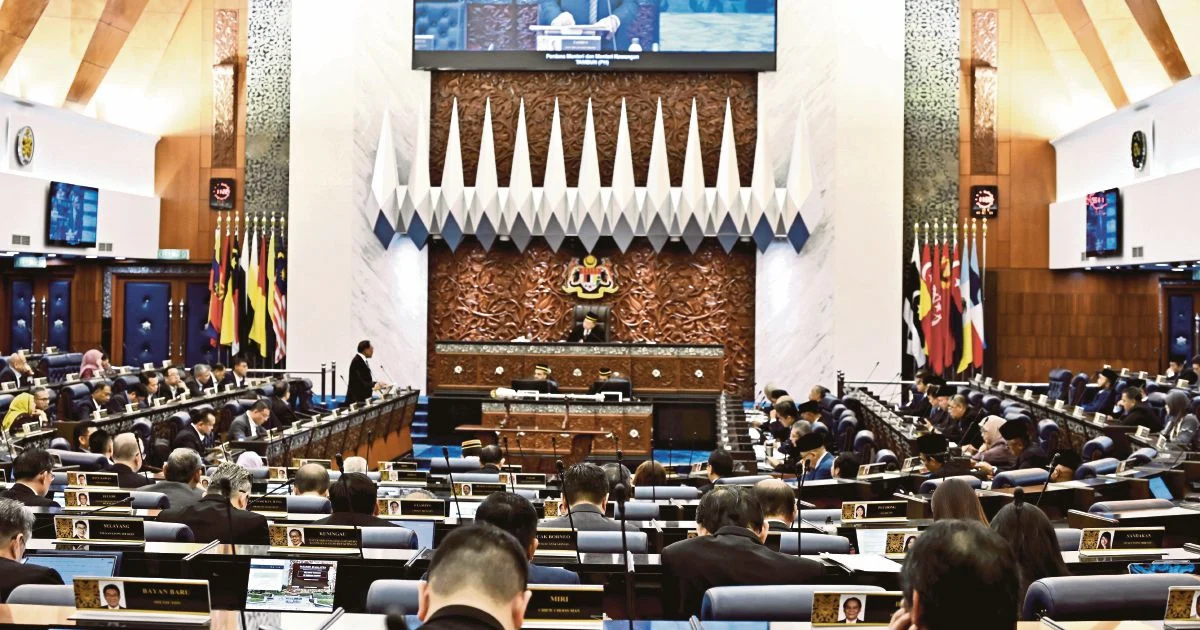
The Dewan Rakyat descended into acrimonious debate within the first hour of the new parliamentary sitting today, as a procedural matter concerning the opposition leader's status spiralled into a broader confrontation that exposed simmering tensions within Malaysia's political landscape. The unexpected flare-up between government-aligned and opposition members reveals the fragile nature of current parliamentary coalitions and the deep divisions that continue to characterise the nation's legislative chamber, even as lawmakers convened for what was expected to be a routine opening session.
Takiyuddin, a prominent PAS figure and government parliamentarian, found himself at the centre of the controversy as exchanges between his faction and Bersatu-aligned opposition members grew increasingly pointed. The specific trigger appeared to centre on administrative and procedural matters related to opposition leadership positions, though the underlying friction suggests broader ideological and strategic disagreements that have characterised interactions between the two Islamist-oriented and Malay-centric parties in recent months. What began as a technical parliamentary disagreement quickly evolved into a platform for airing accumulated grievances.
The nature of the dispute reflects persistent complications within the Perikatan Nasional coalition, the alliance that brought both PAS and Bersatu together in opposition to the current government. Despite presenting a united front publicly, the two parties harbour significant organisational and strategic differences that periodically surface in parliamentary forums. Malaysian political observers have long noted that such coalitions, while functional for certain political purposes, often mask underlying competition for influence and resources within Malay-Muslim political circles.
For Malaysian political analysts, the incident underscores a critical vulnerability in the country's current parliamentary mathematics. The government's comfortable majority depends on maintaining support from diverse coalition partners, while opposition unity remains precarious given the ideological and tactical divisions between major players like Bersatu and PAS. Such unscripted parliamentary confrontations, while appearing to be mere theatrical exchanges, often signal genuine fractures that could reshape coalition dynamics if they deepen further.
The timing of the incident—mere minutes into the sitting—suggests that frustrations had been simmering beneath the surface and required minimal provocation to ignite. Parliamentary proceedings frequently serve as venues where political tensions that cannot be expressed through media statements or private negotiations find release through formal debate. The intensity of today's exchanges indicates that underlying disagreements between these political entities have reached levels where maintaining decorum becomes increasingly difficult.
For Southeast Asian regional politics, Malaysia's parliamentary dynamics merit attention because they influence the broader geopolitical stability of the region. A government weakened by internal coalition tensions or an opposition unable to present coherent alternatives affects policy continuity on matters ranging from trade negotiations to security cooperation with neighbouring nations. The health of Malaysia's legislative institution thus carries implications extending beyond domestic politics into the realm of regional governance and strategic relationships.
The Bersatu perspective, represented in parliamentary exchanges, often emphasises concerns about what party members characterise as marginalisation within broader coalitions. PAS, meanwhile, has consolidated significant grassroots support, particularly in rural and semi-urban areas, giving it considerable influence over coalition arrangements. These structural asymmetries create recurring friction points, as reflected in today's parliamentary clash. Understanding these internal dynamics helps explain why Malaysian coalition governments, despite commanding numerical majorities, frequently experience governance complications.
Parliamentary Standing Orders and procedural rules normally constrain such exchanges, with the Speaker wielding authority to maintain order and decorum. However, the intensity of today's dispute—sufficient to be characterised as genuinely heated—indicates that speakers and procedural mechanisms sometimes prove insufficient to contain political passions. This reality raises questions about whether Malaysia's parliamentary culture adequately facilitates constructive disagreement or whether institutional mechanisms need strengthening to prevent minor procedural disputes from escalating into broader confrontations.
Looking forward, incidents like today's serve as barometers for coalition stability. Malaysian investors, foreign partners, and regional observers monitor such parliamentary episodes closely, using them to gauge the durability of government arrangements and the predictability of Malaysia's policy environment. Extended parliamentary conflicts, particularly those involving core coalition members, can undermine investor confidence and complicate the government's policy execution capacity. The economic implications of political instability, though sometimes understated in analysis of parliamentary theatrics, remain significant for a nation seeking sustainable economic growth and foreign investment.
The specific grievances aired by Takiyuddin and his opponents today, while reflecting immediate parliamentary concerns, also represent deeper questions about power distribution and representation within Malaysia's political system. The prominence of both PAS and Bersatu within Malay-Muslim politics means that their internal relationship significantly influences the broader political environment. Should these tensions continue to escalate, they could eventually necessitate recalibration of coalition arrangements or the emergence of alternative political alliances.
Parliamentary observers will watch closely for whether today's confrontation represents an isolated incident or signals a deterioration in inter-coalition relations. The ability of government and opposition members to maintain sufficient civility despite disagreement remains essential to Malaysia's democratic functioning. While heated exchanges are not unprecedented in legislative chambers, their frequency and intensity serve as useful indicators of underlying political stability or instability within broader governance structures.