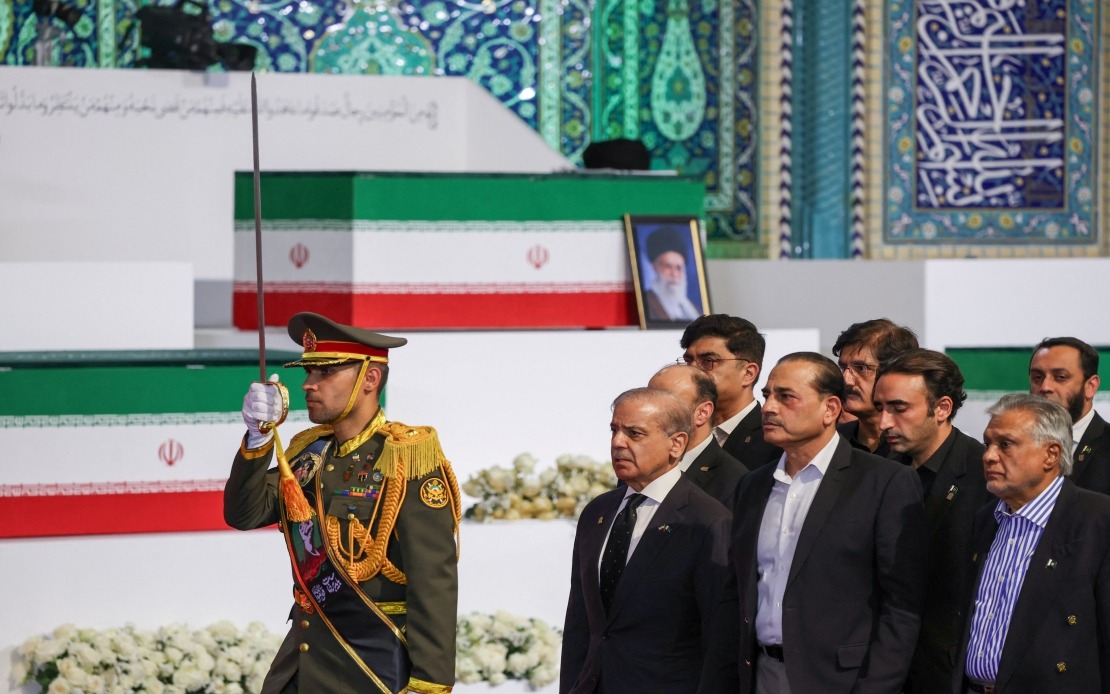
Pakistan demonstrated its commitment to strengthening relations with Iran by dispatching one of the most senior delegations to attend the funeral of Supreme Leader Ayatollah Ali Khamenei in Tehran on Friday, drawing prominent recognition from Iranian officials. Prime Minister Shehbaz Sharif headed the high-profile contingent, which included some of Pakistan's most powerful figures across government, military, and political circles. The scale and seniority of the representation underscored how both nations view their bilateral relationship despite the complex geopolitical dynamics that frequently shape South Asian and Middle Eastern diplomacy.
The funeral ceremony itself drew an extraordinary international gathering, with dignitaries and officials representing approximately 100 countries converging on the Iranian capital to pay final respects to Khamenei, who had served as Supreme Leader since 1989. The attendance reflected the significant influence Iran maintains across the Muslim world and developing nations. Malaysia, Bangladesh, Saudi Arabia, Türkiye, Qatar, Oman, Egypt, Russia, Iraq, China, and India were among the nations represented, illustrating how Khamenei's death resonated far beyond Iran's borders. This gathering provided a rare occasion for high-level diplomatic engagement among regional and global powers, many of whom maintain competing interests in Middle Eastern affairs.
Reza Amiri Moghadam, Iran's ambassador to Pakistan, expressed particular satisfaction with Islamabad's participation, publicly announcing on social media that Pakistan had not only attended at the highest possible level but had also fielded the largest delegation among all participating nations. This distinction carries symbolic weight in diplomatic protocol, as the size and seniority of delegations typically communicate the depth of a country's regard for the deceased and its commitment to bilateral relationships. Moghadam's effusive praise suggested that Tehran interpreted Pakistan's gesture as validation of their strategic partnership during a period of regional uncertainty.
The Pakistani delegation's composition reflected careful calibration by Islamabad's leadership. Deputy Prime Minister Ishaq Dar, who simultaneously serves as Foreign Minister, joined Sharif, ensuring that Pakistan's diplomatic apparatus was fully engaged. The inclusion of Chief of Army Staff Field Marshal Syed Asim Munir signalled that the military, which exercises considerable influence in Pakistani decision-making, endorsed the diplomatic overture. The presence of Bilawal Bhutto Zardari, chairman of the Pakistan People's Party and a senior political figure, alongside National Assembly Speaker Sardar Ayaz Sadiq, Interior Minister Mohsin Naqvi, and Information Minister Attaullah Tarar, demonstrated cross-party consensus on the importance of Pakistani-Iranian relations.
Khamenei's death itself represented a dramatic rupture in Iran's political landscape. The 86-year-old Supreme Leader, who had guided Iran through decades of conflict, sanctions, and regional competition, was killed in what Iran characterizes as a United States-Israeli attack on his compound in Tehran on February 28. Several family members also perished in the attack, compounding the national loss. The circumstances of his death underscore the profound security challenges that Iran faces and the stakes involved in maintaining regional partnerships during a period of heightened tension and uncertainty.
Ambasador Moghadam's public statements reflected Iran's satisfaction with the diplomatic message conveyed through Pakistan's attendance. He described the Pakistani delegation's presence as a testament to the "enduring friendship and brotherhood" between the two Islamic republics, emphasizing that their relationship transcends temporary political fluctuations. The ambassador's language invoked historical narratives of shared destiny and common values, framing bilateral ties within the context of Islamic solidarity rather than mere state-to-state pragmatism. This rhetorical approach positions the relationship within civilisational frameworks that resonate with both nations' self-conception and domestic constituencies.
Prime Minister Shehbaz Sharif himself offered remarks characterizing Khamenei as a leader whose "wisdom, leadership and profound influence on Iran and the wider region will be remembered for generations." This tribute, delivered at a moment of collective mourning, reinforced Pakistan's respect for Iran's political processes and its acknowledgement of Khamenei's regional significance. For Malaysian readers and Southeast Asian observers, such high-level Pakistani participation in Iranian state ceremonies illustrates how neighbouring Muslim-majority nations in West Asia view their interconnected fates and the importance they attach to demonstrating solidarity during critical moments.
The funeral arrangements themselves proceeded according to traditional Iranian protocols. Public ceremonies commenced on Saturday, with the formal burial scheduled for July 9 in Mashhad, Khamenei's birthplace in northeastern Iran. The choice of Mashhad, one of Shia Islam's holiest cities, reflected Khamenei's spiritual significance within the Islamic Republic. The extended timeline for funeral rites allowed international delegations additional opportunity to participate in various ceremonial components, from public mourning processions to formal state events, facilitating extensive diplomatic engagement alongside ritual observance.
For Pakistan, the decision to send such a high-profile delegation carries multiple strategic implications. The two countries share a long border, overlapping security concerns regarding terrorism and regional stability, and substantial economic interdependencies through trade and potential energy partnerships. Pakistan's eastern neighbour, India, also sent a delegation to the funeral, suggesting that major regional powers recognised the importance of marking Khamenei's death diplomatically. The attendance at the funeral provided an occasion for Pakistani officials to reinforce bilateral relationships and potentially address contemporary issues affecting the Pakistan-Iran partnership, from border security to regional positioning vis-à-vis larger powers such as the United States and China.
The international character of the funeral attendance reflects broader patterns in contemporary international relations, where state funerals and succession moments become venues for diplomatic signalling. The presence of delegations from competing powers—including representatives from Russia and Western-aligned nations—illustrated how even moments of national mourning contain geopolitical dimensions. For Southeast Asian nations observing from afar, the event underscores how neighbouring relationships in the Islamic world carry substantial diplomatic weight and how high-level participation in ceremonial events communicates strategic intentions.
Pakistan's diplomatic initiative through its funeral participation must be understood within the broader context of its foreign policy priorities. As a nation facing economic challenges, security threats, and regional competition, Pakistan has consistently sought to strengthen ties with Iran as a counterbalance to other regional dynamics. The funeral attendance represented a concrete manifestation of this strategic orientation, publicly demonstrating to both the Iranian public and international observers that Pakistan values the bilateral relationship and recognises Iran's significance in regional affairs. For observers in Malaysia and throughout Southeast Asia, the event illustrated how diplomatic gestures carry meaning far beyond their immediate context, shaping perceptions of friendship, respect, and commitment that influence bilateral relations over years and decades.

