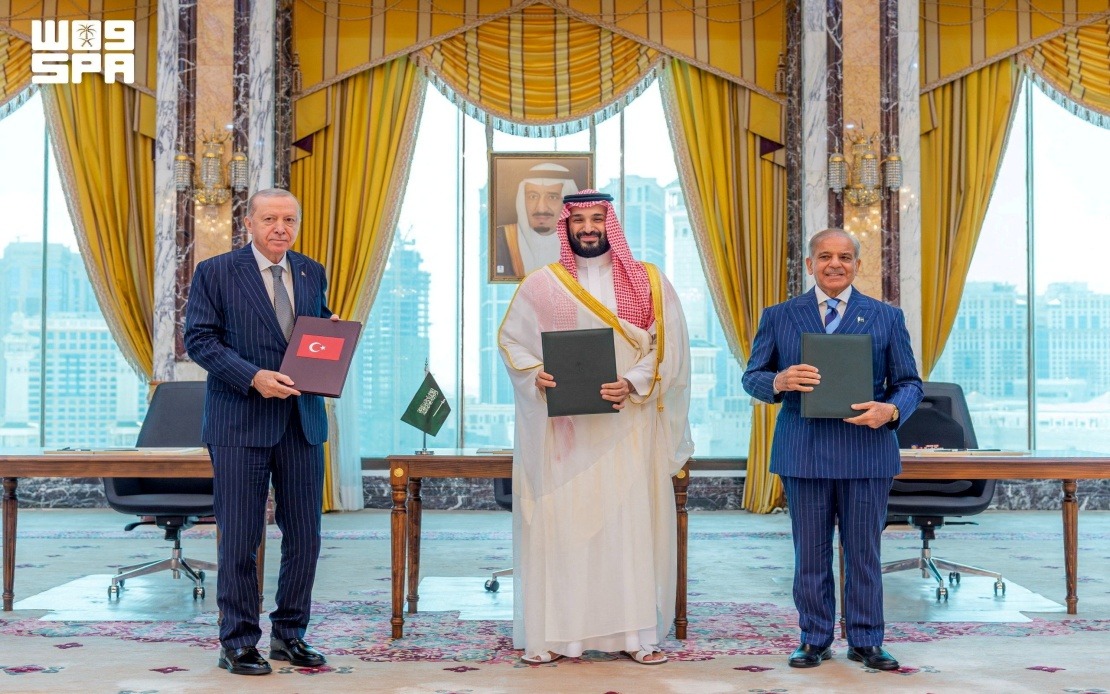
Pakistan, Saudi Arabia and Türkiye have cemented their strategic alliance by signing a comprehensive defence agreement during a summit held at Al Safa Palace in Makkah on Friday. The accord, signed by Saudi Crown Prince Mohammed bin Salman bin Abdulaziz Al Saud, Pakistan Prime Minister Shehbaz Sharif and Turkish President Recep Tayyip Erdogan, represents a significant step in formalising defence cooperation among three of the Islamic world's most influential nations.
Central to the Joint Defence Agreement is a mutual protection clause that treats any armed assault on one signatory as an assault on all three. This commitment carries substantial weight given Pakistan's status as one of the world's nine nuclear-armed states, while Türkiye maintains NATO membership and Saudi Arabia commands the region's most advanced military infrastructure. The agreement builds upon decades of defence partnerships that have evolved gradually, with Pakistan and Saudi Arabia having previously signed a bilateral defence accord in September last year that contained similar reciprocal security obligations.
The three governments emphasised that the pact aims to develop integrated defence capabilities and establish a framework for coordinated strategic deterrence. Rather than representing an isolated bilateral arrangement, the agreement reflects their collective determination to address security challenges within their broader region and internationally. The joint statement underscored their shared commitment to enhancing all dimensions of defence collaboration, ranging from military personnel exchanges to joint training exercises and technological cooperation.
Saudi Arabia's deputy public diplomacy minister, Rayed Krimly, characterised the agreement as enabling the three nations to pool resources and expertise in developing coordinated defence mechanisms. He stressed that the arrangement would strengthen their combined readiness to respond to threats while allowing them to integrate their respective defence capabilities more effectively. Crucially, Krimly addressed regional sensitivities by explicitly stating that the pact neither threatens any other country's security nor represents an escalation designed to heighten tensions with neighbouring states. This clarification appears intended to assuage concerns from Iran and other regional actors who might view the trilateral alignment as a containment mechanism.
The timing of the agreement carries geopolitical significance, occurring amid broader regional realignment and shifting international alliances. Pakistan has historically maintained pragmatic defence relationships with both Saudi Arabia and Türkiye, viewing these partnerships as essential to its security architecture. The formalisation of their trilateral commitment suggests growing coordination among these three Muslim-majority powers to shape their regional security environment in ways that serve their respective national interests.
For Malaysia and other Southeast Asian nations, the development holds lessons about alliance-building among countries with shared values and complementary strategic interests. The agreement demonstrates how nations separated by geography can nevertheless identify common security concerns and institutionalise their cooperation through formal structures. This model contrasts with some regional arrangements that remain purely consultative or lack binding commitments, suggesting the potential value of deeper integration for countries seeking to amplify their collective influence.
Türkiye's participation in this defence arrangement reflects its broader strategic positioning as a bridge between Asian and European security frameworks. As a NATO member, Türkiye brings linkages to Western security architecture while maintaining strong ties across the Muslim world, a balancing act that gives the trilateral agreement additional complexity and reach. The inclusion of Ankara alongside Riyadh and Islamabad creates a framework that spans multiple strategic zones and intersects with various international security architectures.
The defence agreement also signals Pakistan's efforts to strengthen its security relationships at a time when it faces internal security challenges and complex relationships with regional neighbours. By formalising its defence ties with Saudi Arabia and Türkiye, Pakistan positions itself within a multilateral framework that could potentially provide diplomatic and security support during crises. The agreement's emphasis on collective deterrence suggests the three nations see value in presenting a unified position on key security matters.
The practical implications of the pact remain to be seen, as much will depend on how the signatory nations operationalise the agreement through subsequent military-to-military engagement, joint exercises and intelligence sharing mechanisms. The success of such trilateral arrangements typically hinges on establishing credible operational procedures and clear decision-making protocols that enable rapid coordination during potential crises. Whether the agreement evolves into a functioning defence alliance comparable to established multilateral security arrangements, or remains primarily a political statement, will become clearer through implementation efforts in coming years.

