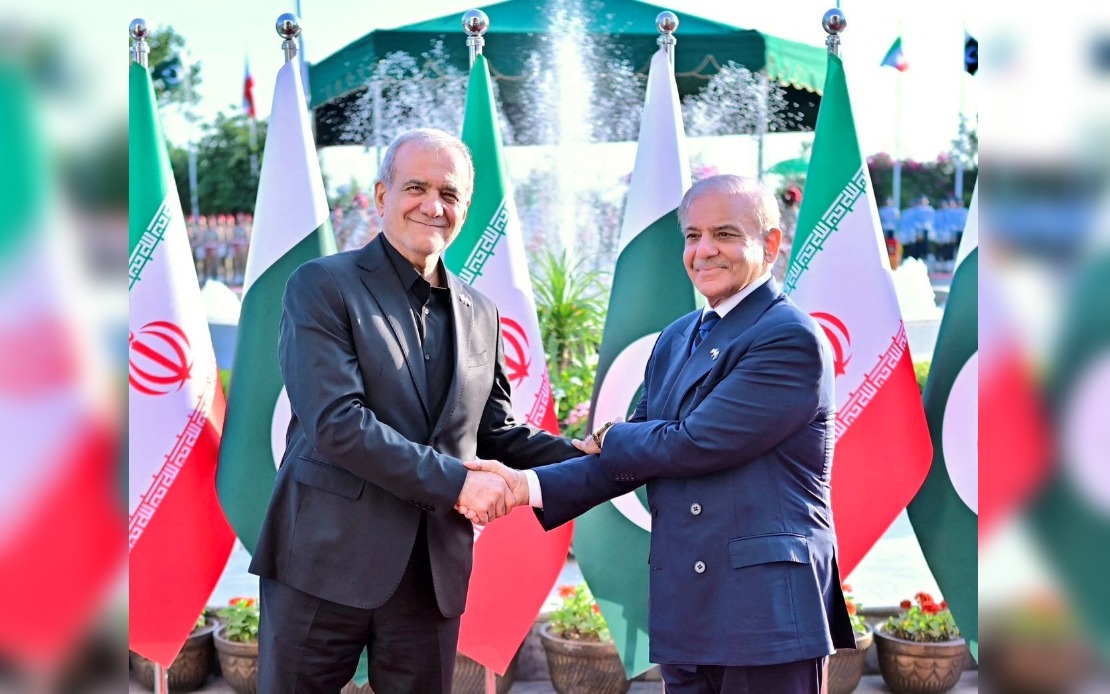
Pakistan has thrown its diplomatic weight behind Iran's ballistic missile programme, with Prime Minister Shehbaz Sharif declaring that Tehran should not face different standards than other nations when it comes to military capabilities. Speaking alongside Iranian President Masoud Pezeshkian during talks in Islamabad on June 24, Sharif made clear that Iran's missile arsenal formed no part of the recently brokered understanding with the United States, positioning Pakistan as a key mediator in the delicate regional balance of power.
The Pakistani premier's public endorsement represents a significant statement of solidarity with Iran at a time of heightened tensions across West Asia. Sharif argued forcefully that the June 17 memorandum of understanding between Iran and Washington contained no provisions whatsoever concerning ballistic missiles, and that the Iranian delegation had never sought to include the issue in negotiations. This framing is strategically important for Pakistan, which has spent months orchestrating dialogue between the two adversaries and now seeks to protect the fragile agreement from collapse or reinterpretation by outside parties.
The question of missile capabilities has long been contentious in international diplomacy, with Western nations traditionally seeking constraints on Iran's arsenal while Iran views such weapons as fundamental to national defence. Sharif's intervention explicitly rejects this asymmetry, stating that "some countries can have ballistic missiles and Iran should not have" represents an unacceptable double standard. This argument carries particular weight coming from Pakistan, which itself possesses an extensive ballistic missile programme and understands intimately the strategic logic behind such deterrent systems.
Pakistan's mediating role in the US-Iran understanding underscores Islamabad's growing importance in regional diplomacy. Beyond the June agreement, Pakistan facilitated an earlier ceasefire between the two sides in April, demonstrating sustained engagement spanning several critical months. Deputy Prime Minister and Foreign Minister Ishaq Dar and Field Marshal Syed Asim Munir, Pakistan's Chief of Army Staff, both contributed significantly to these diplomatic channels, reflecting the high-level political and military commitment to reducing tensions in the region.
Sharif's public gratitude toward Iran for trusting Pakistan's mediation efforts also serves a domestic political purpose within Pakistan itself. By emphasizing Iran's confidence in Pakistani institutions and pledging that "as brothers, we will never let you down," the Prime Minister reinforces narratives of Islamic solidarity and regional leadership that resonate with Pakistani constituencies. This rhetorical positioning is particularly valuable given Pakistan's own security challenges and the benefits it gains from stable relations with its western neighbour.
However, the Pakistani premier acknowledged serious obstacles to consolidating peace, warning that "spoilers all over the world want to scuttle this peace deal." This oblique reference points toward Israel and its allies, whom Sharif implicitly blamed for attempting to undermine regional stability. The arrival of Israeli military strikes on February 28, which prompted Iran to enhance its defensive posture, created the very circumstances that made these diplomatic efforts necessary in the first place.
Iran's President Pezeshkian reinforced the non-negotiable character of his nation's defensive capabilities, stating starkly that without missile systems, "Israel and America would have ploughed through Iran just like Gaza, showing no mercy to either the old or the young." This comparison to Gaza's devastation articulates the existential stakes Iran perceives in maintaining military deterrence, a perspective that shapes every aspect of Tehran's negotiating position. For regional observers, including Malaysia and other Southeast Asian nations monitoring West Asian developments, this statement clarifies that Iran will not voluntarily constrain systems it views as survival mechanisms.
US President Donald Trump's recent acknowledgment that Iran's possession of ballistic missiles represented a reasonable position—comparing it to other nations' arsenals—provided diplomatic cover for the agreement and supports the arguments Sharif advanced. Trump's June 17 statement to journalists in Paris, conceding the logic of Iranian missile capabilities, suggests a potential shift in American thinking, though such statements remain subject to reversal depending on political circumstances in Washington.
The ceremonial aspects of Pezeshkian's visit underscored the significance Pakistan attached to the engagement. Six Pakistani Air Force fighter jets escorted the Iranian president's aircraft into Islamabad, while both Prime Minister Sharif and President Asif Ali Zardari received him officially, and a 21-gun salute honoured the visiting dignitary. These protocols transformed diplomatic discussions into a public affirmation of Iranian-Pakistani solidarity, with implications extending well beyond bilateral relations.
For Malaysia and other Southeast Asian nations, the Pakistani position carries indirect significance. The diplomatic principles Sharif articulated—that nations should not face double standards in security matters and that mediation requires honest brokers willing to challenge perceived inequities—reflect broader debates within the Non-Aligned Movement and developing-world coalitions regarding international law and fairness in security arrangements. Pakistan's willingness to publicly defend Iran's military capabilities, despite potential Western pressure, demonstrates how middle powers navigate competing diplomatic pressures and alliance expectations.
The exclusion of ballistic missiles from the US-Iran understanding, which Pakistan emphasizes, may prove either a genuine diplomatic achievement or a temporary postponement of a more contentious negotiation. If Tehran interprets this omission as international recognition of its right to maintain missiles without constraint, implementation challenges could emerge later. Conversely, if future US administrations or European partners attempt to revisit the question, Pakistan's current endorsement of Iranian missile rights provides diplomatic precedent for resisting such efforts.
Pakistan's robust backing of Iran's military capabilities also reflects calculation regarding regional stability and its own security interests. A weakened Iran facing military pressure would create instability affecting Pakistan's western border, while a militarily confident Iran capable of credible deterrence might paradoxically reduce the likelihood of conflict escalation. This strategic logic underpins Sharif's willingness to spend political capital defending Iranian positions in international forums and during bilateral engagements.
Looking forward, the durability of the US-Iran understanding—and Pakistan's mediating achievements—will depend on whether both sides, and their respective international supporters, resist pressures to expand negotiations into areas like missiles that remain politically sensitive. Pakistan has positioned itself as guardian of the existing agreement's scope, firmly establishing that Iran's defensive capabilities lie outside the framework for dispute. Whether this boundary holds through subsequent diplomatic encounters remains among the most consequential questions for West Asian stability in coming months.

