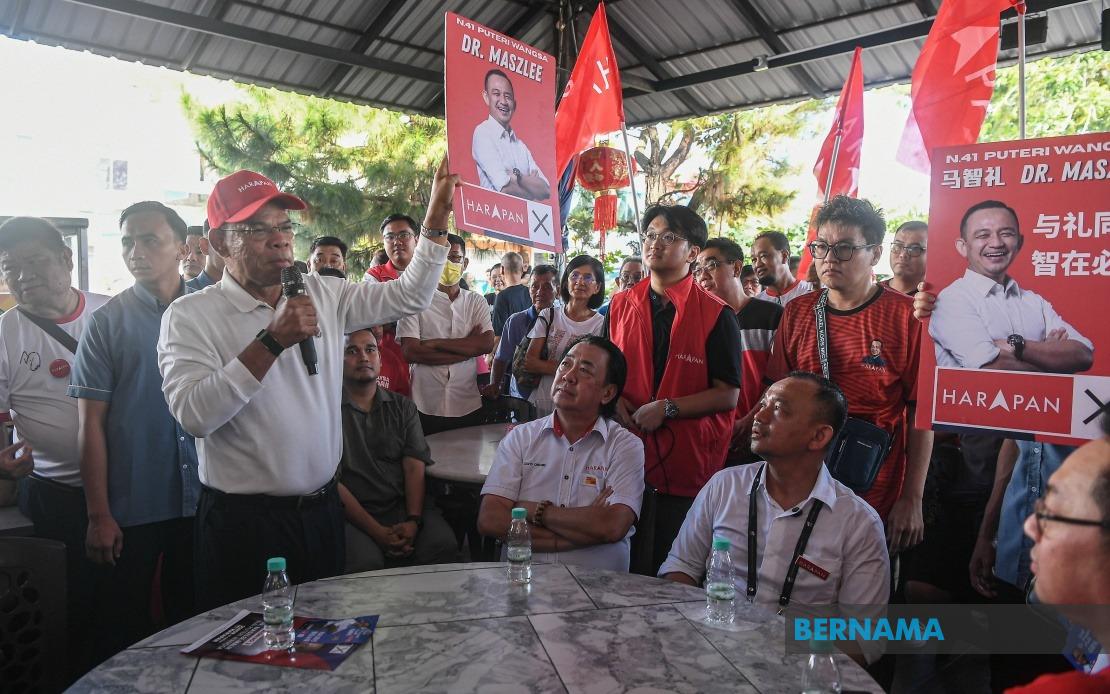
Pakatan Harapan is capitalising on accelerating momentum in the Johor state election campaign through a methodical, constituency-level approach that reflects the coalition's confidence in reading voter sentiment across the state's competitive political landscape. According to Datuk Seri Saifuddin Nasution Ismail, the PH secretary-general, the coalition's rising electoral fortunes stem directly from how systematically it has allocated campaign resources and messaging across the 56 contested seats, moving beyond blanket approaches to instead recognise that each area presents distinct demographic and political challenges requiring customised engagement.
Understanding that Johor's electoral battlefield is far from uniform, PH has implemented what Saifuddin Nasution described as a grading system for constituencies, grouping them according to strategic priority levels determined by real-time assessment of voter reception and local circumstances. This granular methodology acknowledges that a seat like Puteri Wangsa, with its distinct urban and community composition, demands fundamentally different campaign emphases than Johor Lama, which operates within an entirely different social and political context. Similarly, the industrial and working-class character of Larkin requires messaging divergent from the rural dynamics of Endau. Rather than deploying identical talking points across all 56 battlegrounds, PH has segmented its efforts into several carefully calibrated clusters, each receiving intensity of focus commensurate with both opportunity and difficulty.
The coalition's strategic positioning has been considerably strengthened by the opposition's own tactical decisions, which have inadvertently created electoral advantages for PH that campaign discipline alone might not have achieved. Most significantly, PAS's decision to contest only 11 seats whilst explicitly directing its supporters to back Barisan Nasional candidates elsewhere has created confusion and resentment among voters who might have expected stronger three-way competition. This move, according to Saifuddin Nasution, functioned as a political windfall for PH by fragmenting the opposition's coherence and forcing voters into starker binary choices between PH and BN. The strategic unclarity introduced by PAS's limited participation has thrown traditional political calculations off balance.
Contrasting sharply with this fragmented opposition approach, PH has pursued what its leadership characterises as a deliberately transparent strategy centred on clear seat allocation and realistic policy commitments. The coalition's public announcement of its candidate distribution—with PKR fielding 20 candidates, Amanah 19, and DAP 17 across the full slate of 56 seats—demonstrates confidence in the coalition's unity and electoral viability. This transparency extends to its manifesto offerings, which Saifuddin Nasution emphasises are grounded in implementable proposals rather than aspirational promises that ring hollow after elections. For Malaysian voters increasingly sceptical of political overreach and disappointed by unfulfilled campaign pledges, this emphasis on delivery-focused governance represents a substantive distinction from opposition messaging.
PH's momentum has received additional reinforcement from recent high-profile defections and endorsements that signal broader political realignment within the Malay-Muslim voter base traditionally associated with UMNO. The appearance of Datuk Dr Mohd Puad Zarkashi, a former UMNO Supreme Council member, at a series of public discussions alongside Prime Minister Datuk Seri Anwar Ibrahim at Felda Ulu Tiram carries symbolic weight beyond individual candidate recruitment. Such defections indicate that PH's coalition-building efforts are succeeding in peeling away establishment figures from traditional conservative power structures, suggesting deeper voter migration than headline polling might capture. For PH strategists, these endorsements serve as validation that their centrist positioning and inclusive governance model are beginning to appeal beyond core urban opposition constituencies.
The calibre of PH's individual candidates has emerged as a significant campaign asset, particularly in constituencies where local political dynamics remain fluid. Dr Maszlee Malik, PH's Puteri Wangsa candidate, exemplifies the coalition's recruitment strategy: an individual with substantive professional credentials and demonstrated commitment to community engagement who can credibly represent constituency interests rather than simply function as a party apparatus surrogate. Saifuddin Nasution's explicit identification of Maszlee as both qualified and strategically valuable to PH's potential state government signals that candidate quality rather than mere party affiliation will be central to the coalition's post-election governance narrative. This approach carries particular resonance in urban constituencies where voters increasingly evaluate individual representative capability alongside party affiliation.
The electoral mathematics of the Johor contest underline the stakes involved in this campaign refinement. With 172 candidates competing across 56 seats on July 11, the race represents neither an inevitable PH victory nor a certain BN consolidation, but rather a genuinely competitive contest in which disciplined campaign execution may prove decisive. The extended campaign timeline, incorporating early voting on July 7, creates additional windows for momentum shifts and voter persuasion. PH's systematic approach to constituency prioritisation suggests confidence that the coalition has identified sufficient pickup opportunities to potentially shift the state's political balance, though victory remains contingent on translating ground sentiment into actual ballot-box outcomes.
For Malaysian politics more broadly, the Johor election methodologically illustrates how modern political campaigning increasingly relies on data-driven resource allocation and precision targeting rather than traditional broad-based messaging. PH's acknowledgement that different constituencies require different approaches reflects maturation in opposition campaign sophistication, a capacity that has gradually developed through earlier electoral cycles and intensified by competition against BN's substantial institutional resources. The coalition's willingness to publicly discuss its strategic frameworks also represents a shift toward explaining electoral methodology to voters, treating campaign strategy not as hidden architecture but as evidence of serious governance intent.
For Southeast Asian observers monitoring Malaysian political trajectories, the Johor contest represents a crucial test of whether opposition coalitions can sustain organisational coherence and voter appeal across extended electoral cycles. PH's visible capacity to manage internal coalition dynamics—balancing PKR, Amanah, and DAP interests without public rupture—while simultaneously executing sophisticated campaign strategy suggests the coalition possesses institutional maturation that previous Malaysian opposition efforts often lacked. The coming weeks will determine whether this strategic sophistication translates into decisive electoral performance or whether BN's institutional advantages ultimately prove too substantial to overcome.

