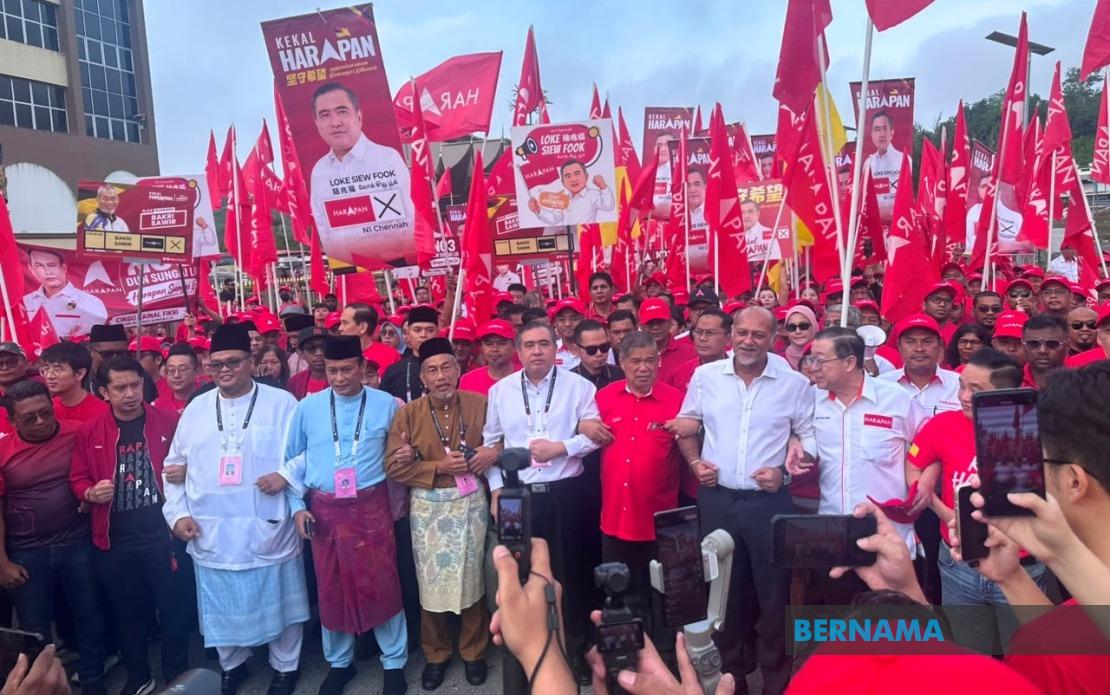
Pakatan Harapan demonstrated considerable organisational firepower across Negeri Sembilan on Wednesday as the coalition's top figures fanned out to support candidates filing nominations for the state election scheduled for August 1. The show of high-profile backing underscored the coalition's determination to build momentum in a state where it secured 17 of 36 seats in the previous 2023 contest, positioning itself as the strongest single bloc ahead of the ballot.
Transport Minister Anthony Loke, who leads the DAP, personally submitted his nomination papers for the Chennah seat in Jelebu, arriving at the Dewan Besar Kuala Klawang nomination centre in the early morning. His presence was reinforced by a formidable supporting cast: DAP chairman Gobind Singh Deo, party adviser Lim Guan Eng, and Amanah president Mohamad Sabu all attended. This concentration of senior party figures at a single nomination venue reflected the significance PH places on the Jelebu constituency, a bellwether area that often indicates broader electoral trends in the state.
In Jempol, the coalition orchestrated similar displays of unity and commitment. Deputy Communications Minister Teo Nie Ching, who also leads the DAP women's wing, escorted PH candidate Teo Kok Seong as he filed papers for the Bahau seat. Communications Minister Fahmi Fadzil attended the same nomination centre to shepherd four candidates competing for the Serting, Palong, Jeram Padang and Bahau seats. Among these nominees, Teo Kok Seong carries the advantage of incumbency, having held the Bahau seat since the 2018 general election, while his three running mates represent fresh blood entering the political arena.
The strategic positioning of ministerial-level figures across multiple nomination centres reflected PH's understanding that the Negeri Sembilan contest carries implications beyond the state itself. With the coalition governing nationally and holding a plurality in the state assembly, maintaining control represents a matter of political prestige and a test of grassroots organisation. The participation of ministers signalled to party members and supporters that the leadership considered the election consequential enough to warrant personal involvement on the crucial first day of the campaign.
Menteri Besar Datuk Seri Aminuddin Harun, who serves as PH's state chairman, arrived at the Port Dickson nomination centre where he filed his own papers for the Linggi seat. His arrival alongside DAP deputy secretary-general Hannah Yeoh, PKR secretary-general Fuziah Salleh, and Prime Minister Anwar Ibrahim's political secretary Farhan Fauzi demonstrated the direct involvement of the federal government's machinery in state-level politics. This interweaving of federal and state leadership structures has become characteristic of PH's operational approach since returning to power in 2022.
Three incumbent state assemblymen also filed their papers on Wednesday, indicating PH's strategy of retaining experienced legislators. Yew Boon Lye in Chuah, Choo Ken Hwa in Lukut, and Dr G Rajassekaran in Sri Tanjung each seek to defend their constituencies. The continued candidacy of these incumbents suggests PH has judged them to possess sufficient local standing and constituent support to warrant re-nomination, a validation that provides continuity while the party simultaneously introduces newcomers into competitive races.
Entrepreneur and Cooperatives Development Minister Steven Sim coordinated nominations at the Wisma MBS nomination centre, where he accompanied six PH candidates. His presence drew supporting figures including Selangor State Legislative Assembly Speaker Lau Weng San, Bukit Gelugor MP Ramkarpal Singh, and PKR vice-president R. Ramanan. This gathering illustrated how PH mobilised not only Negeri Sembilan-based leaders but also drawn figures from neighbouring states to amplify its campaign presence.
The electoral landscape that PH enters in Negeri Sembilan reflects a fractured opposition. The previous state election saw the coalition secure 17 seats, while Barisan Nasional captured 14 and Perikatan Nasional won five. This distribution means no single bloc commanded a majority, forcing PH into a governing position that required careful management of inter-coalition relationships and potential support from independent assemblymen or negotiation with other factions. The dissolution of the state assembly on June 5 following the Yang Dipertuan Besar's consent creates an opportunity for PH to seek a more commanding position, particularly if it can improve upon its 2023 performance.
The Election Commission's timeline grants the competing parties just two weeks between nomination day and early voting on July 28, and another four days until the August 1 general poll. This compressed campaign period means the initial days carry disproportionate importance, as candidates and party machinery must quickly establish campaign infrastructure and messaging. PH's early display of organisational capability through concentrated leadership presence at nomination centres potentially signals to supporters that the party maintains the cohesion and resources necessary to sustain a competitive campaign despite the brief timeframe.
For Malaysian observers tracking broader coalition dynamics, the Negeri Sembilan contest represents a modest but meaningful indicator of PH's current political health. The federal government's direct involvement through ministerial attendance suggests confidence rather than anxiety, though the coalition maintains tight control over candidate selection and campaign messaging. The mix of returning incumbents and new candidates also hints at PH's effort to balance proven performers with fresh voices, a strategy designed to appeal simultaneously to existing supporters and new voters.
The regional implications extend beyond state boundaries. Negeri Sembilan sits within Malaysia's west coast economic corridor and maintains demographic and commercial ties to Selangor and Kuala Lumpur. Electoral outcomes in the state therefore carry symbolic weight within PH's broader Southeast Asian position, where the coalition has positioned itself as the primary vehicle for democratic reform and coalition-building. A strong showing in Negeri Sembilan would reinforce PH's claim to sustained grassroots support, while any loss of ground might embolden rival factions and complicate federal politics.

