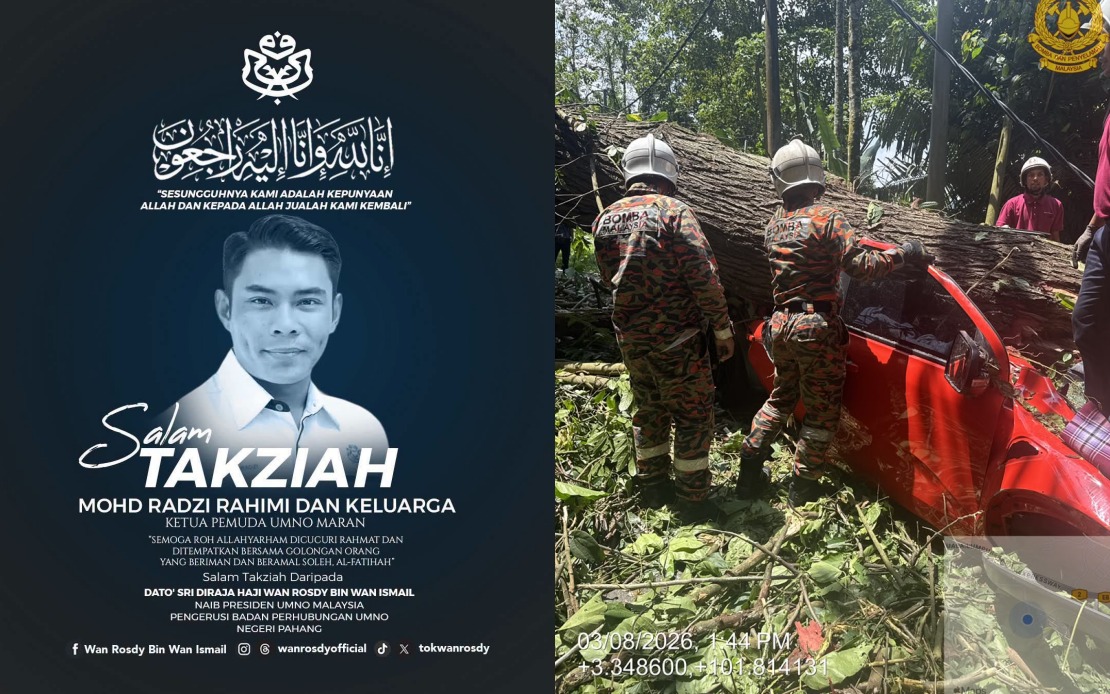
Pahang's political establishment has paid tribute to Mohd Radzi Rahimi, the Maran UMNO division's youth chief, following his death in a tragic accident on the Kuala Lumpur-Bentong road near Janda Baik. The incident, which unfolded in the afternoon hours, claimed the lives of four people when a substantial tree fell onto the four-wheel-drive vehicle they occupied, also injuring a young child who was travelling with them.
Datuk Seri Wan Rosdy Wan Ismail, Pahang's Menteri Besar and chairman of the Pahang UMNO Liaison Committee, conveyed deep sorrow at the loss of Edy Radzi, as he was commonly known. Wan Rosdy's statement emphasised the significant void left by Radzi's sudden passing, characterising him as someone whose leadership style centred on community welfare and an unwavering commitment to constituent interests. The Menteri Besar framed the incident not merely as a personal tragedy affecting Radzi's immediate family, but as a consequential loss reverberating across multiple layers of the state's political and youth structures.
The ripple effect of this accident extends beyond a single family's grief. The Maran UMNO division, which Radzi led in youth affairs, represents a critical organisational unit within the broader Pahang UMNO machinery. His role as youth chief positioned him at the intersection of grassroots mobilisation and party strategy, making his contributions integral to UMNO's operational presence in the state. The loss simultaneously impacts the Pahang UMNO Youth movement more broadly, suggesting that the incident has deprived the youth wing of an established personality within its leadership cadre.
Alongside Mohd Radzi, the accident claimed three additional lives, expanding the tragedy's human cost. Nuriani Mohammad Jafri and her son Muhammad Rizz Hazim perished in the same collision, as did Mohammad Nizam, identified as her younger brother. The fatalities underscore the indiscriminate destructiveness of such incidents, affecting families with no connection to the political sphere while simultaneously removing a public figure from the community he served. This layering of loss—combining a youth leader's untimely death with the destruction of an entire family unit—adds a particularly poignant dimension to the broader narrative.
For Malaysian readers, this incident serves as a sobering reminder of the unpredictability of roadside hazards, particularly along stretches of older highway infrastructure like the Kuala Lumpur-Bentong corridor. While deforestation and land-clearing practices remain contentious environmental issues across Southeast Asia, the maintenance of vegetation proximate to busy transport arteries represents a distinct public safety concern that affects drivers and passengers indiscriminately. The old KL-Bentong road, part of Pahang's transport infrastructure linking Selangor with the interior regions, sees regular traffic from both local commuters and visitors exploring the hill stations around Janda Baik.
Wan Rosdy's formal condolence extended to the bereaved families, invoking both Islamic prayer and secular expressions of sympathy. The language employed—references to divine mercy and pleas for strength—reflects the manner in which Malaysian political leaders typically navigate public grief, bridging personal loss with religious sentiment. Such statements serve a dual function: offering genuine consolation while simultaneously affirming the leader's accessibility and emotional engagement with constituents' suffering.
National UMNO Youth leadership also mobilised responses to the tragedy, with Datuk Dr Muhammad Akmal Saleh, the national youth chief, directing condolences toward Radzi's immediate family. His invocation of Islamic prayers for forgiveness and eternal rest mirrors the state-level tributes, suggesting a unified organisational response across UMNO's hierarchical structure. This consistency in messaging indicates that even in moments of crisis, political parties maintain careful coordination around public communication.
The incident raises questions about tree maintenance protocols along Malaysia's road network, particularly concerning older routes that may traverse forested areas or contain mature vegetation. The Bentong district, nestled in Pahang's geography, includes stretches of landscape with significant tree coverage, making it vulnerable to such incidents, especially during periods of inclement weather or soil degradation that compromises root stability. For road users and safety advocates, this tragedy underscores the importance of regular inspection regimes for hazardous vegetation along transport corridors.
Mohd Radzi's career within UMNO Youth structures represented a pathway typical of Malaysian political trajectories, wherein local division-level leadership positions serve as launching points for broader influence. His positioning as Maran's youth chief suggested either genuine grassroots credibility within his division or party recognition of his organisational capabilities. The loss of such emerging figures in sudden, preventable circumstances represents not merely a personal family tragedy but a potential disruption to institutional continuity within political organisations that depend heavily on their mid-level leadership layers.
The injured child who survived the incident remains part of this tragedy's unresolved aftermath, their recovery and psychological processing of the event representing ongoing consequences beyond the immediate fatalities. Medical and social support systems will necessarily engage with this surviving victim, though their story is unlikely to receive the same public attention as tributes to the deceased political figure.
For Pahang UMNO operatives and the broader Maran constituency, the weeks following this incident will likely involve both ceremonial mourning—funeral arrangements, condolence visits, and memorial statements—and practical reorganisation of youth division leadership. The succession process within UMNO Youth structures typically follows established protocols, though the unexpected loss of a seated division chief may create temporary friction around selection procedures.

