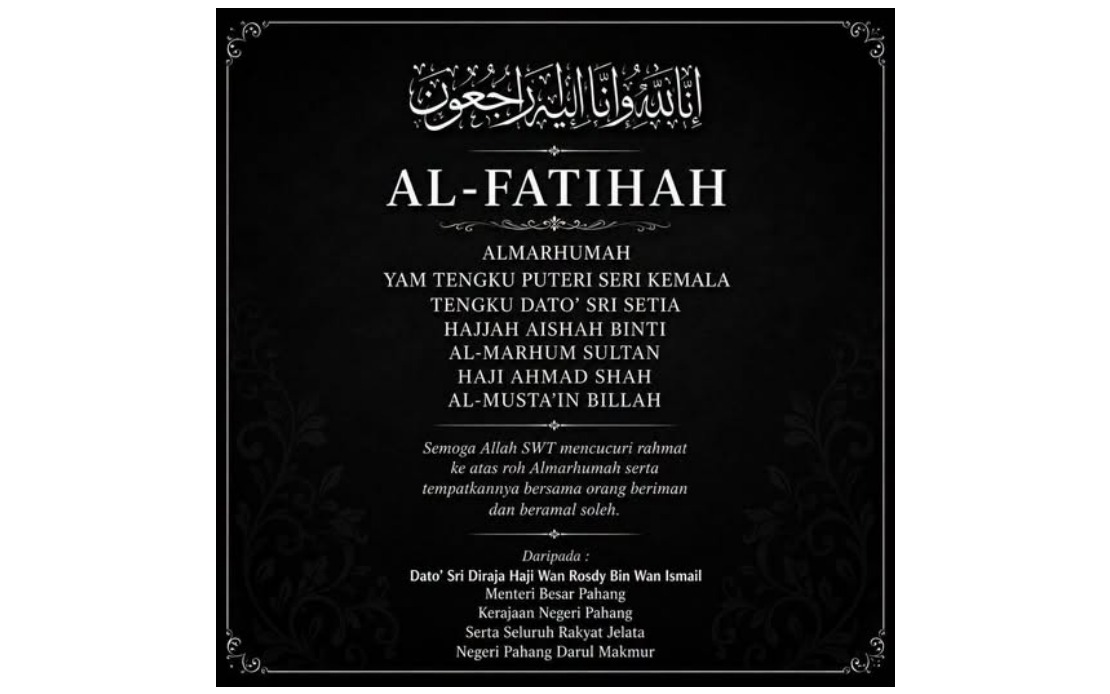
Pahang Menteri Besar Datuk Seri Wan Rosdy Wan Ismail has formally extended his condolences following the death of Tengku Puteri Seri Kemala Tengku Datuk Seri Aishah, the elder sister of the Sultan of Pahang, who passed away on Tuesday evening. The senior state administrator released a statement expressing sympathy for the loss, which he described as particularly significant for the reigning Sultan Al-Sultan Abdullah Ri'ayatuddin Al-Mustafa Billah Shah, Tengku Ampuan Pahang Tunku Azizah Aminah Maimunah Iskandariah, and the broader Pahang Royal Family during this period of mourning.
Tengku Puteri Seri Kemala's death occurred at a Kuala Lumpur medical facility at 9.15 pm on Monday evening, marking the end of a life deeply connected to Pahang's royal lineage and the wider Malaysian royalty network. Her passing represents not merely a family matter but a significant moment in the state's institutional life, given the prominence of the royal household in Pahang's governance and cultural identity. The funeral arrangements proceeded with considerable dignity, with her remains subsequently transported to the Pahang Royal Mausoleum in Pekan, the royal burial site that has long served as the final resting place for members of the sultanate.
In his carefully worded statement, Wan Rosdy articulated the collective sorrow of both the state administration and Pahang's population more broadly, positioning his remarks as a formal expression of respect from the governmental apparatus. The Menteri Besar's public acknowledgment carries particular weight in Malaysian political culture, where such statements serve as important markers of institutional respect and continuity during moments of transition within royal households. By speaking on behalf of the entire state rather than in an individual capacity, Wan Rosdy affirmed the government's alignment with the values of loyalty and reverence traditionally shown toward the sultanate.
The language employed in Wan Rosdy's condolence message reflects established protocols within Malaysian Islamic governance frameworks, incorporating Islamic supplications for mercy and forgiveness. His invocation of divine compassion for the departed soul—specifically requesting that Allah grant her mercy, absolve her transgressions, acknowledge her virtuous acts, and admit her among the faithful—demonstrates the interweaving of Islamic observance with state administration in Malaysia's constitutional monarchy system. Such formulations are standard in official condolences from Muslim-majority state governments and serve to demonstrate both personal faith and institutional respect for Islamic principles.
The death of Tengku Puteri Seri Kemala represents one of those periodic losses that punctuate the life of Malaysia's extended royal families, prompting reassessment of generational continuities and dynastic responsibilities. As the sister of a reigning Sultan, she occupied a position of considerable historical significance within Pahang's royal structure, though one that typically remained somewhat removed from day-to-day governance matters. Nevertheless, members of the immediate royal family circle occupy important ceremonial and symbolic roles within the state's institutional framework, and their passing marks the evolution of the sultanate itself.
The Pahang Royal Mausoleum in Pekan, where Tengku Puteri Seri Kemala was laid to rest, functions as both a historical repository and a sacred space within Pahang's cultural geography. The choice of this location underscores the family's commitment to maintaining continuity with historical traditions and ensures that the departed remains connected physically to the state's royal legacy. The mausoleum itself represents centuries of accumulated history, hosting the mortal remains of generations of sultans and significant members of the royal household, each interment adding another layer to Pahang's institutional memory.
For observers of Malaysian political and constitutional affairs, such moments offer opportunities to reflect on the stability provided by the country's system of constitutional monarchy. The orderly expression of condolence from senior government figures to royal family members, combined with adherence to established funeral protocols, demonstrates the institutional maturity that has characterized Malaysian governance since independence. These processes, while rooted in deep historical and religious traditions, also reflect modern state structures and the separation between ceremonial royal functions and administrative governmental functions.
The relationship between the Pahang state government and the sultanate operates within frameworks established by the Malaysian Constitution and Pahang's own state legislation, which define the roles, responsibilities, and interactions of various parties. When the Menteri Besar issues condolences, he does so partly as a government administrator and partly as a representative of Pahang's Muslim population, navigating the dual religious and secular dimensions that characterize Malaysian governance. This balance has proven crucial to maintaining social cohesion and institutional legitimacy throughout Malaysia's post-independence period.
For regional observers in Southeast Asia and beyond, the Malaysian royal system's capacity to manage succession, maintain continuity, and preserve institutional identity during periods of loss represents a noteworthy example of constitutional monarchy functioning in a Muslim-majority democracy. The formal yet respectful acknowledgment of the passing of a senior royal family member, combined with adherence to Islamic funeral practices and traditional protocols, illustrates how Malaysia has successfully integrated multiple governance traditions into a functioning modern state apparatus.
Looking forward, Tengku Puteri Seri Kemala's death marks another generational transition within Pahang's royal household, with implications for how the sultanate navigates the future. As the state moves forward, the memory of departed members of the royal family continues to shape institutional culture and public consciousness, reminding citizens of both the enduring nature of the monarchy and the transient character of individual lives within larger historical structures. The formal expression of collective mourning, as demonstrated through Wan Rosdy's public statement, reinforces these cultural continuities while affirming the continuing bonds between government and monarchy that remain central to Malaysia's constitutional framework.

