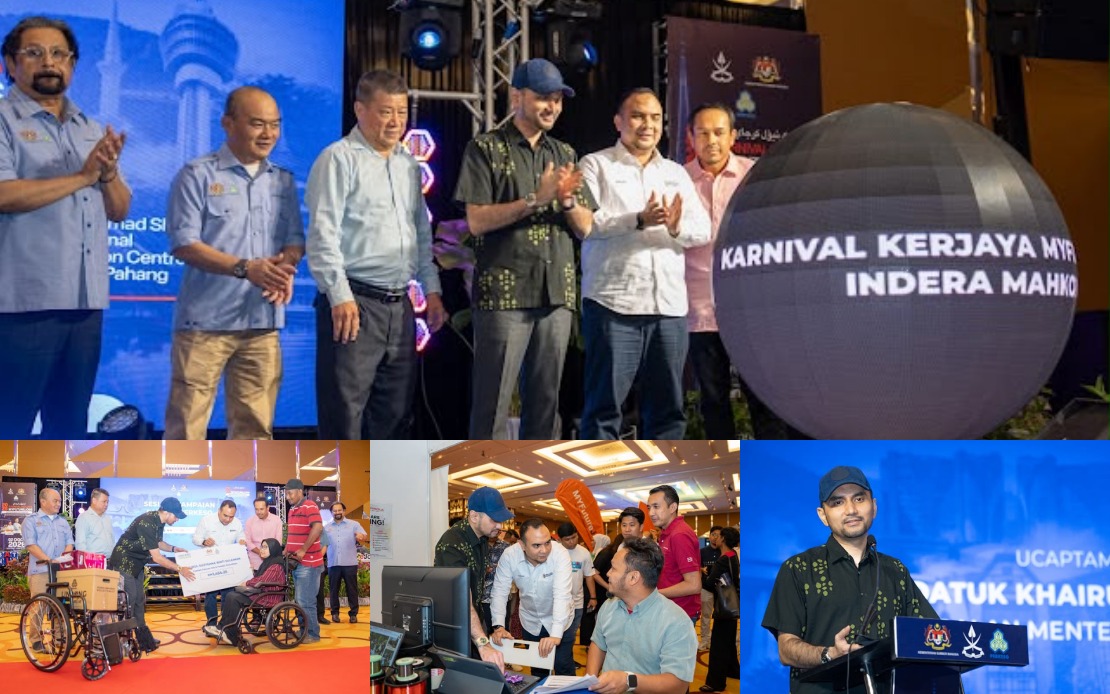
Pahang has emerged as the employment leader on the east coast of Peninsular Malaysia, recording a labour force participation rate of 65.3 per cent during the first quarter of 2026, with its unemployment rate standing at a modest 1.9 per cent. These figures underscore the state's growing economic dynamism and the effectiveness of targeted job-creation programmes that have gained momentum across the region over the past three years.
Deputy Human Resources Minister Datuk Khairul Firdaus Akbar Khan attributed these encouraging outcomes to a deliberate strategy of expanding employment pathways for Malaysian workers. Speaking at the opening of a major career fair in Kuantan, he highlighted the critical role played by the MYFutureJobs programme, a nationwide initiative administered by the Social Security Organisation (PERKESO). This platform represents a cornerstone of the government's commitment to bridging the gap between job seekers and employers, creating structured channels through which unemployed and underemployed individuals can access sustainable work opportunities across diverse sectors.
The magnitude of PERKESO's achievement in Pahang becomes apparent when examining the longitudinal data from 2023 onwards. Between that year and July 24, 2026, the platform facilitated employment for 26,877 job seekers within the state. This figure represents a tangible human impact, reflecting thousands of individuals who transitioned from unemployment or underemployment into formal work arrangements. Complementing these placements, PERKESO organised 1,277 interview sessions and career carnivals throughout Pahang during the same three-year window, creating multiple touchpoints where workers could connect directly with recruiters and explore opportunities aligned with their skills and aspirations.
The immediate context for these developments was highlighted at an event in Kuantan, where the Indera Mahkota MyFutureJobs Career Carnival 2026 brought together 30 employers offering 6,000 job vacancies. This concentration of recruitment activity in a single location reflects a deliberate strategy to make employment services accessible to rural and semi-urban populations who might otherwise face barriers to job searching. For Southeast Asian economies grappling with structural unemployment and skills mismatches, such decentralised approaches offer valuable lessons in democratising access to economic opportunity.
Beyond mere job placement, the Deputy Minister stressed the importance of continuous skills development as a prerequisite for sustainable employment. The government's training programmes aim to equip workers not simply with entry-level qualifications but with the adaptive capacity to evolve alongside changing industry demands. This emphasis on lifelong learning recognises a fundamental reality in modern labour markets: initial job placement represents merely the first step in a career trajectory that increasingly demands flexibility, technological literacy, and willingness to retrain. Malaysian workers, particularly younger cohorts entering the labour force, face intensifying competition from automation and globalisation, making such upskilling initiatives essential rather than optional.
The involvement of the Prime Minister's political secretary, Datuk Ahmad Farhan Fauzi, in launching the Pahang-level Sahabat MADANI initiative at the same event signals political prioritisation of employment creation beyond ministerial level. Sahabat MADANI represents a broader governance philosophy centred on community engagement and volunteerism as mechanisms for translating government policy into ground-level action. Rather than operating purely through bureaucratic channels, this movement mobilises civil society to serve as intermediaries between state institutions and grassroots populations, particularly in peripheral communities that might otherwise experience service delivery gaps.
The recruitment target of 2,000 Sahabat MADANI members in Pahang had been reached by the time of the carnival, demonstrating genuine community uptake of the voluntary framework. Ahmad Farhan articulated an expansive vision for the initiative, characterising volunteers as both community servants and informational conduits for government awareness. This dual function—combining humanitarian service with administrative feedback loops—reflects an understanding that effective governance requires not merely top-down policy implementation but also bottom-up intelligence gathering about community needs and programme efficacy. For Malaysia and comparable Southeast Asian contexts, such hybrid models potentially offer advantages over purely technocratic or purely grassroots approaches.
The statistics generated since the MYFutureJobs platform's expansion further illustrate scale and momentum. By 2026, the portal had attracted 11,857 registered job seekers, while advertising over 10,000 vacancies across the state. These numbers, though significant in absolute terms, warrant contextualisation within Pahang's broader demographic and economic landscape. The state's population and workforce size mean that while these figures represent meaningful employment gains, they also suggest that the challenges of fully integrating all potential workers into formal employment remain substantial. Unemployment at 1.9 per cent, whilst exceptionally low by international standards, may mask underemployment, wage inadequacy, and sectoral concentration issues not captured in headline statistics.
The sectoral diversity of employers participating in these career fairs reflects Pahang's economic complexity beyond resource extraction. The state's economy has traditionally rested on mining, agriculture, and tourism, but these fairs suggest deliberate efforts to diversify into services, light manufacturing, and emerging sectors. For regional observers, Pahang's employment transition offers insights into how resource-dependent economies might gradually broaden their economic base whilst absorbing workers displaced from traditional industries. This diversification process, managed properly, can prevent the labour market hollowing that has afflicted some commodity-exporting regions elsewhere in Southeast Asia.
The government's emphasis on reaching underserved populations, particularly rural communities and those in geographically isolated areas, acknowledges a persistent equity challenge across the region. Urban-rural employment disparities have long characterised Southeast Asian labour markets, with provincial populations facing transport costs, information asymmetries, and limited local opportunities that constrain their career mobility. By conducting carnivals and training programmes throughout Pahang rather than concentrating them in the state capital, policymakers attempt to level a historically skewed playing field. Whether such decentralisation sufficiently addresses deeper structural inequalities remains an open question requiring longitudinal evaluation.
Moving forward, Pahang's trajectory will partly depend on whether the gains achieved thus far prove sustainable or represent temporary peaks driven by cyclical economic conditions and concentrated policy attention. The state's ability to maintain its east coast leadership position whilst driving further employment growth hinges on multiple factors: continued investor confidence, skills alignment between training outputs and employer demands, and macroeconomic stability. Regional observers watching Pahang's employment model should anticipate that whilst the quantitative achievements are genuine, qualitative dimensions—wage levels, job security, advancement prospects—deserve equal scrutiny in assessing whether these placements translate into genuine socioeconomic mobility for participants and their households.

