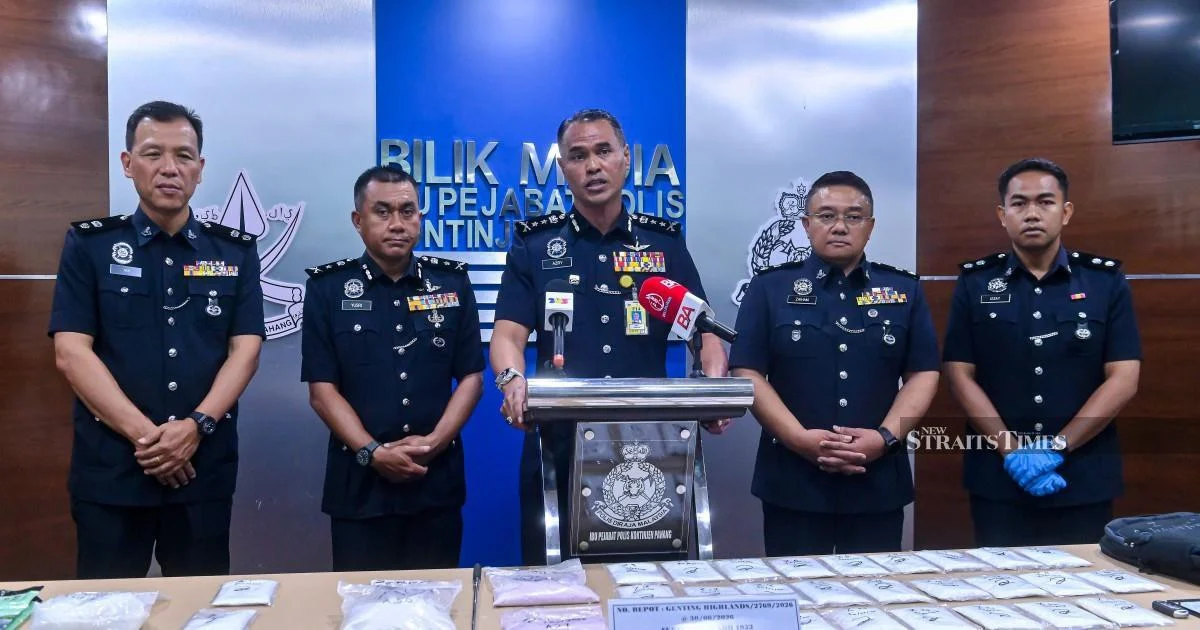
Pahang's enforcement agencies have completed Operation Hawk, a comprehensive three-day anti-narcotics drive that achieved significant results in combating drug trafficking and consumption across the state. The coordinated campaign targeted identified drug distribution zones spanning all eleven districts within Pahang, demonstrating the authorities' commitment to disrupting the supply chain and apprehending individuals involved in the illicit drug trade at various levels.
The scale of arrests—totalling 333 individuals—underscores the widespread nature of drug-related activities across Pahang's diverse landscape, from urban centres to smaller municipalities. These detainees included both active traffickers believed to be distributing substances within their communities and end-users whose consumption patterns contribute to sustained demand in the local market. The breadth of the operation across every district signals that drug problems are not confined to specific regions but represent a statewide challenge requiring coordinated intelligence and deployment.
Assets seized during the three-day operation exceeded RM500,000 in combined value, comprising three distinct categories that illustrate the operational scale of drug networks in the state. Confiscated narcotics themselves represent the direct enforcement targets, while seized cash demonstrates the financial proceeds flowing through these criminal enterprises. Vehicles recovered from suspects indicate the infrastructure criminals employ to distribute products and evade detection, highlighting how drug operations are embedded within broader logistical networks.
The targeting of hotspots across all eleven districts reflects sophisticated intelligence gathering and strategic planning by authorities. Rather than dispersed, reactive enforcement, this operation employed a deliberate mapping of known concentration areas, suggesting that intelligence agencies had accumulated sufficient information to execute a coordinated strike. This approach maximises impact by focusing resources where they yield the greatest disruption to organised drug distribution networks operating within Pahang.
For Malaysian readers accustomed to periodic drug enforcement announcements, Operation Hawk's scale warrants attention as evidence of both the entrenched nature of narcotics problems and the capacity of state-level enforcement to mount substantial responses. Pahang, as one of Malaysia's largest states by area with diverse socioeconomic conditions, faces particular complexities in drug enforcement. Urban areas like Kuantan present traditional trafficking challenges, while more remote districts may harbour clandestine laboratories or serve as transit points for substances destined for Peninsular Malaysia's major markets.
The timing and intensity of such operations often reflect broader enforcement priorities at national level. Regular cycles of intensive crackdowns, typically announced publicly to demonstrate law enforcement effectiveness, serve multiple purposes: they genuinely disrupt criminal operations, generate valuable intelligence on emerging trends and networks, and provide visible evidence of state commitment to public safety—a concern consistently ranked as important by Malaysian voters across elections.
Understanding the composition of the 333 arrests becomes crucial for assessing Operation Hawk's true impact. If the majority were end-users or street-level distributors, the operation successfully interrupted supply at lower levels and removed consumers from the market temporarily through detention. However, if significant numbers included mid-level traffickers or suppliers with established networks, the enforcement action strikes closer to the organisational hierarchy, potentially disrupting operations more substantially. Public announcements typically do not disaggregate arrest categories, leaving observers to estimate the distribution.
The seizure value of RM500,000 presents a useful metric for comparing enforcement effectiveness across time and regions. Analysts can extrapolate how much value passes through Pahang's drug markets monthly or annually, offering rough estimates of the overall illicit economy's scale. A single three-day operation capturing half a million ringgit suggests that trafficking volumes substantially exceed the amount intercepted, with the vast majority of drugs and proceeds escaping detection—a sobering reality underlying the persistent challenge of drug enforcement.
For Southeast Asian context, Pahang's drug problems reflect broader regional patterns. The state sits within supply corridors connecting narcotics production zones in the Golden Triangle and synthetic drug manufacturing facilities throughout Southeast Asia to consumption markets in Malaysia and beyond. Enforcement operations in individual states, while valuable, operate within a regional system requiring coordination across borders, particularly with Thailand and the regional centres through which fentanyl, methamphetamine and other synthetics transit.
The operational focus across all eleven districts also indicates that authorities are employing a territorial approach to enforcement rather than concentrating narrowly on major cities. This inclusive strategy recognizes that drug problems reach into smaller towns and rural areas, where community-level impact may be even more pronounced due to smaller population bases and fewer social services. Such comprehensive operations require substantial coordination among state police, narcotics officers, and potentially federal agencies, representing significant deployment of enforcement resources.
Moving forward, the outcomes of Operation Hawk will likely inform subsequent enforcement cycles. Intelligence gathered from the 333 detainees, interrogations, and examined drug shipments will populate operational databases, revealing patterns about sourcing, distribution routes, and end-market dynamics. This accumulated intelligence, shared across state lines and with federal agencies, contributes incrementally to understanding Malaysia's broader narcotics landscape—knowledge essential for designing longer-term supply reduction strategies beyond periodic enforcement sweeps.
Public announcements of seizures and arrests serve important functions beyond operational reporting. They signal to communities that enforcement agencies maintain active surveillance and capacity to disrupt criminal activities, potentially deterring casual involvement in drug markets. Simultaneously, they demonstrate to political leadership and the public that significant resources devoted to drug enforcement produce tangible results, justifying continued investment in what remains an expensive, labour-intensive law enforcement priority.

