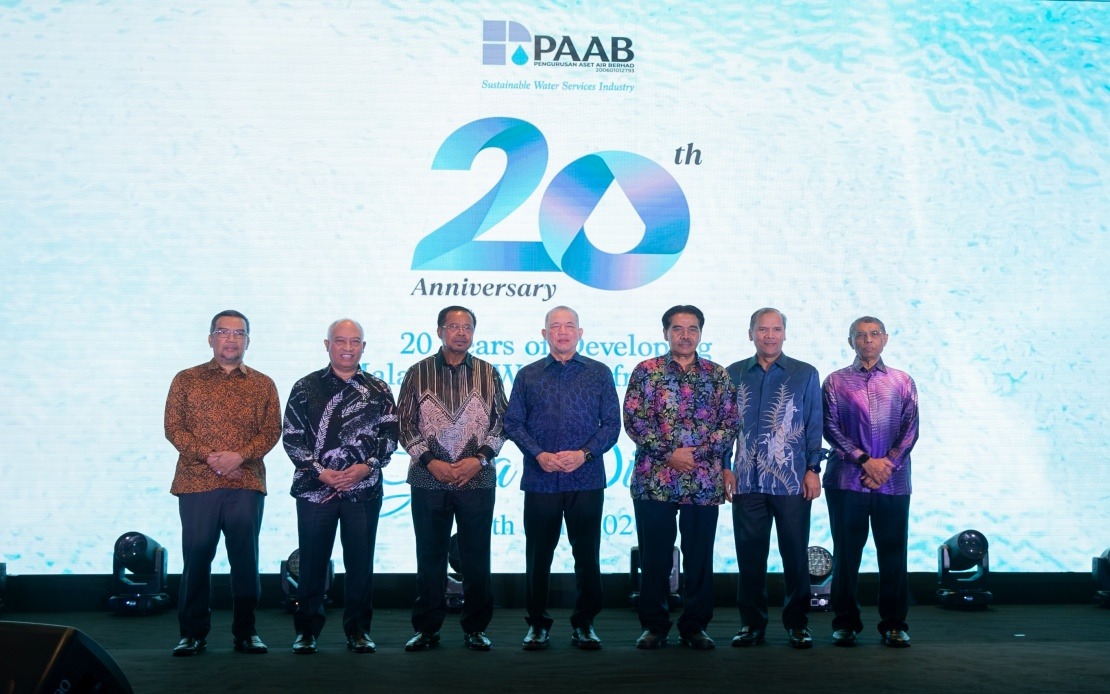
Pengurusan Aset Air Berhad (PAAB) commemorated two decades of stewardship over Malaysia's water sector transformation, a milestone underscoring the entity's instrumental role in overhauling national water services and bolstering supply resilience for millions of Malaysians. Wholly owned by the Minister of Finance Incorporated, the organisation has evolved into a linchpin of public infrastructure development since its inception on May 5, 2006, marshalling unprecedented capital flows into a sector long hampered by fragmentation and underinvestment.
The sheer scale of PAAB's financial commitment reveals the severity of challenges that confronted the water industry two decades ago. The organisation has financed the assumption of RM23.04 billion in water utility debts while simultaneously channelling RM23.84 billion into tangible infrastructure upgrades. Combined, these RM46.88 billion in interventions represent a comprehensive recapitalisation of a sector that struggled with ageing assets, service interruptions, and inconsistent quality standards across Malaysia's patchwork of water operators. This financial engineering has allowed strategically sequenced modernisation rather than piecemeal, chronically underfunded maintenance.
As of December 2025, the National Water Services Industry Restructuring Plan had gained formal commitment from ten states, with completed initiatives demonstrating measurable physical progress. Twenty-one new water treatment facilities now operate nationwide with combined daily processing capacity reaching 2,085 million litres—a substantial expansion of treatment throughput addressing supply constraints in growing urban and industrial zones. Storage infrastructure has simultaneously expanded through 42 new reservoirs holding 783 million litres, providing crucial buffer capacity during peak demand and supply disruptions. Complementing these facilities, pipeline renovation and extension programmes have modernised 3,263 kilometres of distribution networks, reducing leakage pathways that historically plagued Malaysia's water systems.
Deputy Prime Minister Datuk Seri Fadillah Yusof, who holds the Energy Transition and Water Transformation Ministry portfolio, delivered the commemorative address at the Menara Felda Platinum Park gathering, delivering a message that balanced recognition of progress with stark urgency about unresolved systemic problems. His intervention carries particular weight given his cabinet-level responsibility for coordinating water policy across federal and state jurisdictions, a notoriously complex governance landscape in Malaysia's federal system where water remains a state matter.
The most pressing issue animating official concern is non-revenue water (NRW)—water entering distribution networks but never reaching paying customers, lost to leakage, theft, and metering failures. Malaysia's national NRW rate hovering near 40 per cent represents an extraordinarily high loss ratio by international standards, where developed economies typically achieve 15-20 per cent efficiency. This leakage translates into squandered treatment capacity, elevated operational costs absorbed by remaining customers, and perpetual supply shortfalls despite rising investment. Fadillah's critique challenged the adequacy of multi-decade planning horizons when immediate crises demand urgent remediation, signalling frustration with incremental approaches to infrastructure problems that compound daily.
The Deputy Prime Minister explicitly linked water sector performance to Malaysia's strategic economic positioning, noting that high-value foreign investment in data centre infrastructure—a sector offering substantial employment and technology transfer—depends on assured water supply reliability. Data centre operators typically require consistent, potable water for cooling systems, making water security a silent but critical factor in competitive location decisions. Nations losing international investment to more reliable peer economies face economic consequences extending well beyond water utility revenues, encompassing lost tax receipts, employment, and technological capability building.
Fadillah articulated the fundamental tension embedded in Malaysia's water restructuring strategy: multi-decade implementation timelines (extending to 2050) collide with urgency of contemporary problems requiring faster resolution. Ten years of PAAB-led transformation, while substantial, had not substantially moved the NRW needle, prompting calls for sharper, more coordinated federal-state action. This critique implicitly questioned whether voluntary, protracted state-by-state adoption of restructuring protocols could outpace the deterioration of ageing networks, or whether more muscular intervention mechanisms might be necessary.
PAB's own articulation of its mandate frames the restructuring programme as a staged journey toward complete cost recovery by 2050, divided into four distinct phases spanning four decades. The Migration phase (2008–2020) involved foundational industry reorganisation and initial debt assumption. The Stabilisation period (2021–2030) currently underway aims to stabilise service delivery and contain leakage expansion. Consolidation (2031–2040) would consolidate operational gains, while Full Cost Recovery (2041–2050) envisions tariffs sustaining operations without subsidy. This lengthy pathway reflects the structural challenge of repositioning water utilities as financially viable entities while maintaining affordability for low-income households—a tension unresolved anywhere globally.
Capital deployment patterns illuminate investment sequencing priorities. Of the RM23.84 billion in capital expenditure deployed through December 2025, approximately RM8.33 billion financed projects already handed over to state water operators for ongoing management. Another RM1.84 billion remains committed to construction-phase projects, while the largest tranche—RM13.67 billion—sits in design and planning stages, indicating a pipeline of infrastructure commitments awaiting implementation. This distribution suggests that capital bottlenecks and implementation capacity constraints, rather than funding availability, may represent the binding constraint on accelerating water service improvements, a concern relevant for Malaysian policymakers contemplating whether additional financing would meaningfully accelerate outcomes.
PAB's emphasis on measuring success through improved water service quality rather than purely financial metrics reflects evolving infrastructure governance philosophy. The organisation explicitly stated that impact on households—cleaner, more stable, higher-quality water reaching taps reliably—constitutes the ultimate metric of institutional effectiveness. This framing acknowledges that infrastructure investment divorced from service delivery improvements amounts to capital expenditure rather than genuine development. For Malaysian households experiencing supply interruptions and water quality concerns, PAAB's two-decade trajectory represents a long, ongoing transformation rather than a completed achievement, with the 20-year anniversary serving as inflection point prompting renewed urgency rather than complacency.

