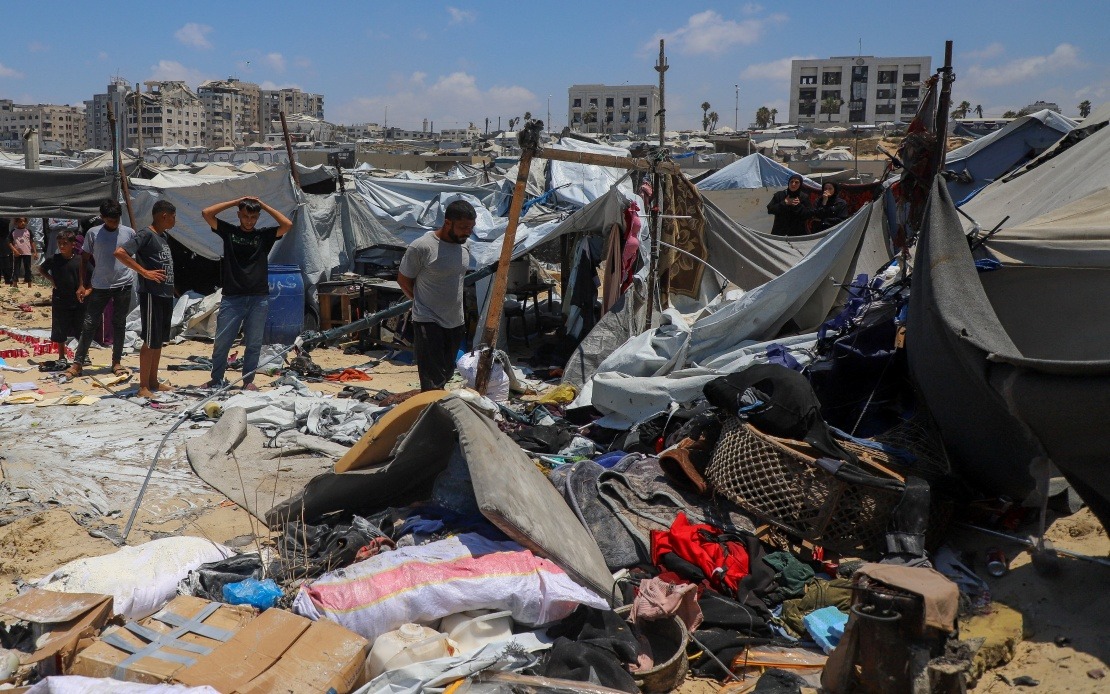
The scale of destruction across the Gaza Strip has reached unprecedented levels, according to assessments compiled by the Palestinian Government Communication Centre at the Prime Minister's Office. The latest weekly situation report, released this week, documents that Israeli military operations have destroyed more than 90 per cent of the territory, while occupation forces now maintain control over approximately 80 per cent of the war-affected landscape. These figures underscore the magnitude of the humanitarian crisis unfolding in one of the world's most densely populated regions, with immediate implications for the Palestinian civilian population and broader Middle Eastern stability that resonates across the Southeast Asian diplomatic landscape.
The destruction intensified significantly during the week spanning June 29 to July 6, as Israeli military campaigns expanded across multiple population centres. Khan Younis, Rafah, and Gaza City became focal points of heightened operational activity, with local medical sources confirming that at least eight Palestinians lost their lives during this period. Beyond the direct casualties, the military operations involved extensive shelling of residential neighbourhoods and systematic demolition of homes, a pattern that forced additional Palestinian families to abandon their properties and seek shelter in already overcrowded displacement camps. The deliberate targeting of civilian infrastructure has compounded an already dire humanitarian situation affecting approximately 2.3 million people in the coastal enclave.
Parallel to operations within Gaza itself, Israeli forces have maintained aggressive enforcement measures across the occupied West Bank. During the same weekly reporting period, military raids swept through multiple Palestinian cities and towns, including Ramallah, Nablus, Hebron, Bethlehem, Jenin, Qalqilya, Tulkarem, and occupied Jerusalem. These operations involved forced entry into homes, arbitrary detention of residents, restrictions on movement through checkpoints and roadblocks, and the seizure of personal property. The coordinated nature of these raids suggests a systematic approach to territorial control and population management that extends well beyond the immediate military conflict into the realm of administrative domination.
Beyond state military action, settler militias affiliated with Israeli colonial interests have launched their own campaign of violence against Palestinian communities and their assets. These extrajudicial attacks included arson attacks on civilian infrastructure, such as the burning of a cafeteria in al-Lubban ash-Sharqiya village, physical assaults on Palestinian shepherds grazing livestock east of Bethlehem, and attempts to forcibly appropriate agricultural animals. Additionally, settler groups have blocked access to vital community facilities, including the main entrance to the village of Burqa, further restricting Palestinian movement and economic activity. These attacks operate within a broader context of territorial expansion and resource appropriation that has accelerated in recent years.
The targeting of Palestinian agriculture represents a particularly concerning dimension of the ongoing conflict, with implications for long-term food security and economic sustainability. The Palestinian Ministry of Agriculture documented extensive damage to the agricultural sector across the occupied West Bank during the reporting week. Israeli forces and associated militias destroyed Palestinian olive cultivation through uprooting, burning, and damaging 2,559 trees concentrated primarily in the Salfit, Jenin, and Nablus regions. These olive groves represent not merely economic assets but cultural and historical heritage, with some trees having survived for generations within Palestinian family holdings.
The agricultural destruction has created immediate economic hardship affecting at least 125 farmers whose livelihoods depend on crop cultivation and livestock raising. The documented direct financial losses from the agricultural damage alone reached approximately US$11.78 million during a single week, illustrating the economic toll of the conflict on vulnerable Palestinian rural communities. When extrapolated across the months of ongoing operations, such losses accumulate into a devastating erosion of economic capacity within Palestinian territories. The destruction of agricultural infrastructure and productive capacity particularly impacts rural populations with limited alternative income sources, forcing migration toward already congested urban centres or international displacement.
For Malaysian policymakers and regional observers, the escalating scale of destruction carries significant geopolitical implications. Malaysia has historically maintained a principled position supporting Palestinian self-determination and has consistently advocated for Palestinian rights within international forums. The documented destruction of civilian infrastructure and agricultural assets raises serious questions regarding compliance with international humanitarian law and the Geneva Conventions. The concentration of destructive operations suggests a pattern extending beyond immediate military objectives into the domain of collective punishment, a practice prohibited under international law that Malaysia and other Southeast Asian nations have repeatedly condemned.
The humanitarian crisis intensifies pressure on regional actors and the international community to pursue diplomatic interventions. Southeast Asian nations, through mechanisms such as ASEAN, possess diplomatic leverage that could be mobilized to support humanitarian access, ceasefire negotiations, and reconstruction initiatives. The scale of destruction documented in this report—affecting water systems, medical facilities, educational institutions, and residential infrastructure—creates humanitarian imperatives that transcend political considerations. Malaysia's capacity as an Islamic-majority nation with established diplomatic channels across the region positions it potentially to facilitate dialogue and humanitarian coordination.
The destruction of more than 90 per cent of Gaza Strip infrastructure presents unprecedented reconstruction challenges that will require years of international assistance and investment. The displacement of large populations, destruction of economic capacity, and psychological trauma affecting an entire generation of Palestinian children create long-term development obstacles that extend far beyond the immediate conflict. Regional stability depends substantially on addressing these underlying grievances and human suffering through genuine political settlement rather than military domination. For Malaysian stakeholders engaged in Middle Eastern affairs, economic development initiatives, or humanitarian operations, the trajectory documented in this report signals an urgent need for intensified diplomatic engagement aimed at achieving sustainable peace and rehabilitation of Palestinian territories.

