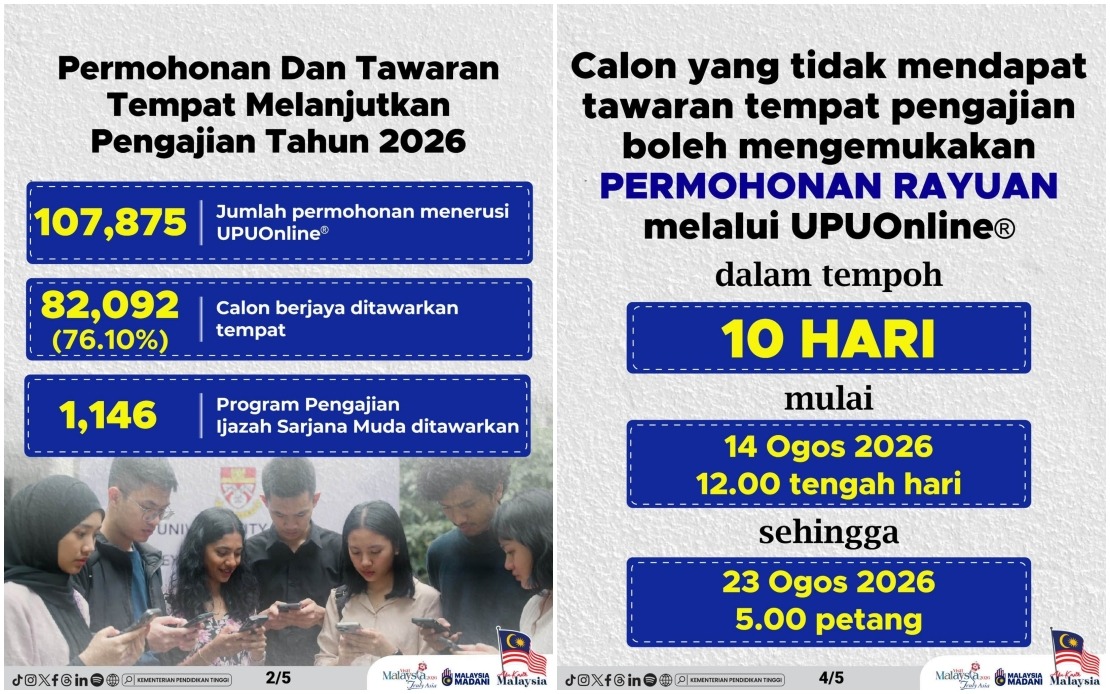
The Ministry of Higher Education (KPT) has announced that 82,092 candidates have secured undergraduate places at Malaysia's 20 public universities for the current academic year, representing a substantial intake across 1,146 bachelor's degree programmes. This figure corresponds to 76.10 per cent of the 107,875 applications deemed eligible to proceed through the UPUOnline system, the centralised portal managing admissions to Malaysia's higher education sector.
The admissions outcome reflects the ministry's commitment to a merit-based allocation framework, where successful candidates have been selected and ranked according to their individual merit scores in descending order. This transparent approach ensures that places are awarded to those demonstrating the strongest academic credentials, maintaining standards across the public university system and upholding principles of fairness in the competitive selection process that tens of thousands of Malaysian school leavers navigate annually.
For Malaysia's education sector, the intake figures highlight the ongoing capacity constraints within the public university system relative to demand. With approximately one-quarter of eligible applicants not receiving offers through this initial round, the placement rate underscores the continuing pressure on Malaysia's tertiary education infrastructure. Public universities remain the primary pathway for many Malaysians, particularly those from middle and lower-income backgrounds, making the allocation of limited places a consequential policy matter affecting social mobility and opportunity distribution.
The ministry's announcement includes provision for unsuccessful candidates through a structured appeals process operating via UPUOnline. Beginning at noon on 14 August and extending until 5 pm on 23 August 2026, candidates who did not receive initial offers have a ten-day window to lodge appeals requesting reconsideration. This mechanism provides a secondary opportunity for borderline applicants whose circumstances or scores may warrant alternative placement outcomes, though the number of additional places available through appeals typically remains limited.
The appeal process represents an important safeguard within Malaysia's higher education admissions framework, acknowledging that initial algorithmic allocations may occasionally overlook deserving candidates or create unexpected placement gaps. For students who narrowly missed offers, particularly those from disadvantaged backgrounds, this second-chance window can prove decisive in accessing public university education. The structured timeframe and digital platform ensure consistency and accessibility, though candidates must actively navigate the system to benefit from the opportunity.
From a regional perspective, Malaysia's public university admissions model reflects broader Southeast Asian challenges in scaling tertiary education access amid demographic pressures and limited institutional capacity. Countries throughout the region grapple with similar tensions between maintaining academic standards, expanding opportunity, and managing fiscal constraints on public universities. Malaysia's merit-based approach contrasts with quota systems adopted elsewhere, though debates continue regarding whether standardised testing adequately captures diverse forms of merit and potential.
The KPT's explicit messaging to successful candidates emphasises the importance of maximising the educational opportunity being extended to them. This framing reflects growing national concern about graduate employment outcomes, skills alignment with industry demand, and the broader return on investment in higher education. Malaysian universities face increasing pressure to demonstrate that their programmes produce graduates equipped for an evolving labour market, particularly in emerging sectors like technology, green energy, and digital services.
The sheer scale of Malaysia's tertiary education demand—with over 107,000 eligible applications competing for places at just 20 public institutions—illustrates why private universities and alternative pathways have expanded significantly over recent decades. The gap between demand and public sector supply has created substantial commercial opportunities for private institutions, creating a two-tiered system that reflects and potentially reinforces socioeconomic stratification in access to higher education quality.
Looking ahead, the admissions cohort joining Malaysia's public universities this year will be entering an institution confronting significant transformation pressures. Universities are navigating shifts toward research-intensive models, industry partnerships, and internationalisation whilst simultaneously serving primarily domestic student bodies with diverse preparation levels and socioeconomic circumstances. The 82,092 admitted students will experience vastly different institutional environments depending on which university accepts them, as Malaysia's public universities demonstrate pronounced variations in research output, international rankings, and resource distribution.
The timing of admissions announcements and appeals processes carries practical implications for school leavers managing competing deadlines with other educational pathways. Students rejected from public universities face decisions about private sector alternatives, technical institutions, or overseas education options, each with distinct financial, temporal, and career trajectory implications. The ten-day appeals window thus functions as a critical decision point for many Malaysian families navigating education investment choices.
For policymakers, the persistent gap between applications and available places signals ongoing pressure for public higher education expansion, though budget constraints and competing priorities limit near-term capacity growth prospects. Improving the efficiency of existing institutions, strengthening community colleges and polytechnics as alternatives to university education, and better aligning university programmes with labour market needs represent policy approaches being considered across the region to address access constraints without proportional increases in public spending.

