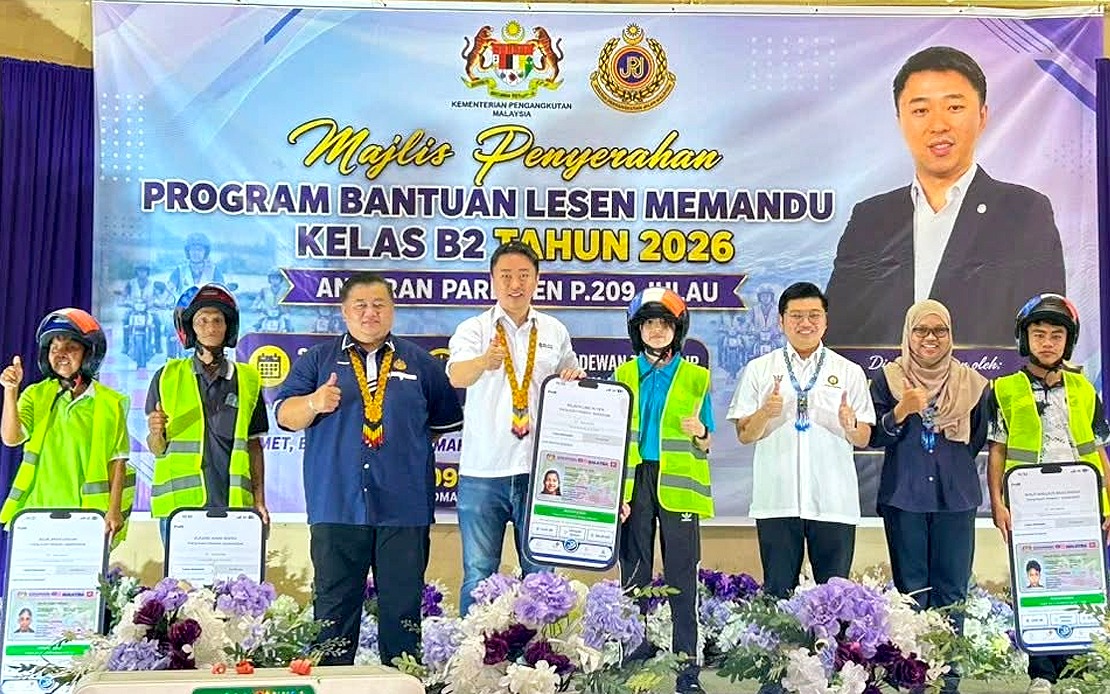
The Driving Licence Assistance Programme (BLM) concluded at Julau Closed Stadium in Sarikei on June 28, benefiting 885 rural participants who now hold valid Class B2 Probationary Driving Licences. The initiative represents a targeted effort to extend critical mobility and financial relief to remote communities in Sarawak's Julau parliamentary constituency, where motorcycle ownership serves as the lifeline for agricultural workers and smallholders managing orchards, oil palm plots, and forest-based livelihoods.
The programme's significance extends beyond formal licensing requirements. Participants gain immediate access to Malaysia's domestic fuel subsidy scheme, enabling them to purchase petrol at government-controlled rates rather than market prices. For rural workers whose daily transportation costs directly impact household economics, this benefit translates into meaningful monthly savings. The subsidy mechanism effectively reduces the operational expense of motorcycles, which serve as primary transport for reaching scattered agricultural plots and market access points throughout Julau's dispersed settlement patterns.
Bajik Undum, 57, from Rumah Ajau in Ulu Kuntau, Pakan, exemplified the programme's tangible impact. Previously lacking a valid driving licence, she had purchased non-subsidised petrol despite using her motorcycle daily to travel to her orchard and transport agricultural produce. The financial burden of unsubsidised fuel proved substantial relative to her income. Upon obtaining her Class B2 licence through the assistance programme, she became eligible for subsidised petrol, immediately reducing her daily transport expenses and easing the household's financial strain—a transformation she attributed directly to the scheme's expansion.
Kudang Jenggi, 64, the programme's oldest male participant, emphasised the legal security dimension alongside economic benefits. As a bird's nest house caretaker in Bayong, Sarikei, his work requires regular motorcycle travel. Before securing his licence through BLM, he navigated road transport enforcement checkpoints with apprehension, facing potential penalties for unlicensed riding. The licence eliminated this legal vulnerability whilst simultaneously granting him fuel subsidy eligibility. For rural workers whose income operates at narrow margins, avoiding traffic violations and associated fines represents crucial financial protection.
Daniel Padong, 45, from Rumah Pom in Ulu Amot, Pakan, articulated the programme's relevance within Sarawak's contemporary economic context. His daily commute to an oil palm smallholding depends entirely on motorcycle transport. Recent petrol price increases had sharply elevated his operational costs, compressing profit margins on agricultural output. By obtaining his Class B2 licence and accessing fuel subsidies through the BLM scheme, he effectively recovered transportation cost efficiency, improving his daily economic viability as a smallholder operator navigating volatile global commodity markets.
The initiative was officially closed by Julau Member of Parliament Datuk Larry Sng Wei Shien, who simultaneously serves as chairman of the Malaysian Timber Industry Board (MTIB). His dual role reflects the intersection of parliamentary representation and sectoral economic stewardship within Sarawak's political economy. Sng Wei Shien's participation underscored the scheme's alignment with broader rural development priorities and resource-based industry support strategies. The presence of Sarawak Road Transport Department (JPJ) director Norizan Jili indicated institutional coordination between transport regulatory bodies and social assistance programmes.
The 885-participant cohort represents a substantial addition to licensed riders within Julau's rural communities. This scale suggests successful grassroots outreach, effective awareness campaigns, and programme accessibility that overcame transportation barriers and documentation hurdles typically encountered by dispersed agricultural populations. The inclusive nature of the scheme—accepting participants across a broad age spectrum, as evidenced by its oldest female and male beneficiaries in their sixties—demonstrates design flexibility accommodating diverse demographic and occupational circumstances.
Rural Sarawak's geographic isolation and infrastructure constraints have historically limited residents' access to formal licensing frameworks. Multiple factors compound this challenge: substantial distances to licensing centres, irregular transport schedules, cumulative documentation requirements, and licensing fees that represent significant expenditure for low-income households. The BLM programme's deployment directly addresses these structural barriers, bringing licensing services to rural constituencies and removing financial obstacles through government subsidisation. This decentralised service delivery model generates particular importance within Sarawak's dispersed settlement geography.
The fuel subsidy dimension reflects Malaysia's domestic policy priority of cost-of-living support for lower-income populations. Motorcycles constitute the dominant personal transport mode throughout rural Southeast Asia, serving agricultural, commercial, and domestic mobility functions simultaneously. Access to subsidised petrol therefore carries disproportionate economic significance for rural household budgets compared to urban populations with diversified transport options. The BLM scheme's strategic linkage of licence acquisition to fuel subsidy eligibility creates a compound policy incentive mechanism encouraging formal transport sector participation.
The programme's conclusion marks a checkpoint in Sarawak's rural development trajectory. Aggregate impacts will unfold through multiple channels: enhanced transport security and law compliance, reduced household transport expenditure, improved market access for agricultural producers, and formalised integration into national transport regulatory frameworks. The 885 newly licensed rural residents collectively represent expanded economic agency within Julau's smallholder agricultural economy. Future evaluation of the scheme's economic impact on rural household incomes and agricultural productivity will provide evidence regarding policy effectiveness and replicability potential across comparable rural constituencies throughout Malaysia.

