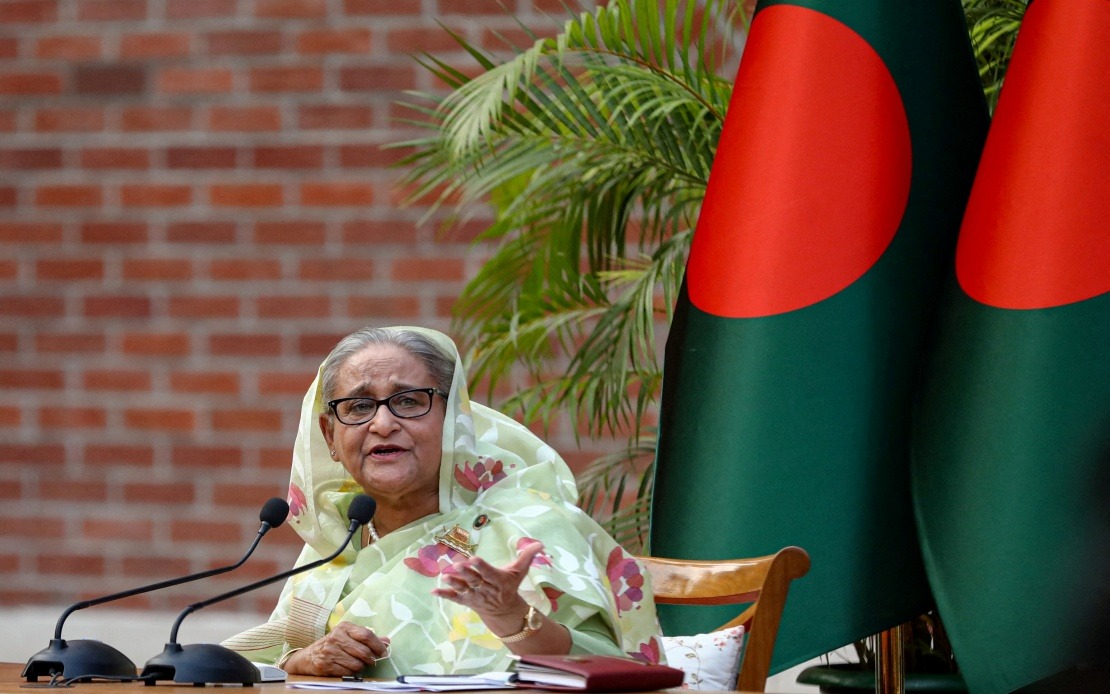
Sheikh Hasina, the 78-year-old former prime minister of Bangladesh who has been living in exile in India since August 2024, has declared her intention to return to her country and face court proceedings despite the grave risks she acknowledges facing. In a written interview with Kyodo News, Hasina made explicit reference to the dangers confronting her, noting that authorities could imprison her or pursue capital punishment, yet expressed unwavering resolve to appear before the judiciary. Her defiant stance comes amid extraordinary political turbulence in Bangladesh, where a military-backed interim administration has taken control following her departure and the subsequent February 2026 elections that brought the opposition Bangladesh Nationalist Party to power under Prime Minister Tarique Rahman.
Hasina's flight from Bangladesh was precipitated by massive civil unrest that erupted in mid-2024, when student-led demonstrations against a government quota policy for civil service positions spiralled into a broader anti-government uprising. The initial protests, triggered by a June 2024 high court decision reinstating a 30 percent employment quota reserved for descendants of Bangladesh's 1971 independence war veterans, transformed into a popular movement encompassing wider grievances against Hasina's governance. The scale of violence during this period remains contested, with United Nations estimates suggesting approximately 1,400 deaths, predominantly inflicted by security forces responding to the disturbances. Hasina has consistently denied culpability for these deaths, asserting instead that the movement was orchestrated by political opponents seeking to destabilise her administration.
The legal jeopardy facing Hasina intensified dramatically in November 2025 when Bangladesh's war crimes tribunal convicted her in absentia and imposed a death sentence for crimes against humanity linked to the security forces' response to the demonstrations. This verdict represents one of the most severe consequences Hasina has encountered during her storied and controversial political career, which has spanned multiple decades and four separate terms as prime minister. The trial's conduct—held without her physical presence or direct participation—has drawn international scrutiny and concern from human rights organisations including Human Rights Watch, which while acknowledging that perpetrators of abuses must face accountability, has questioned the procedural legitimacy of convicting an absent defendant in such grave circumstances.
India, where Hasina has sought refuge, has become the focal point of diplomatic wrangling between the two nations. Bangladesh's government formally requested India's extradition of Hasina, prompting New Delhi's Ministry of External Affairs to publicly acknowledge receipt of the demand while carefully noting that the matter requires examination through proper legal and judicial channels. This diplomatic posture reflects India's delicate balancing act—maintaining relations with both the exiled former leader and Bangladesh's new authorities while navigating international law and bilateral obligations. For Malaysian observers, the situation underscores how regional powers navigate the complex intersection of legal proceedings, political change, and diplomatic relations among neighbours.
Hasina's defence strategy centres on challenging the political motivation underlying her conviction. She has suggested that international forensic experts could independently examine the circumstances surrounding individual deaths during the 2024 unrest, potentially uncovering facts that would exonerate her of responsibility for the violence. This argument implicitly contests the tribunal's findings and proposes that a more impartial investigation could alter the trajectory of her case. Her rhetorical framing positions the conviction as persecution rather than prosecution, a distinction that carries significant weight in international legal discourse and public opinion. The former prime minister maintains that she did not order killings, and that the movement was exploited by her adversaries within Bangladesh's fractious political landscape.
Hasina's long tenure in Bangladesh politics, including her role as daughter of founding father Sheikh Mujibur Rahman, has made her a polarising figure. Her third term as prime minister was marked by the devastating July 2016 Holey Artisan Bakery attack in Dhaka, in which militants killed 20 hostages of multiple nationalities—nine Italians, seven Japanese, two Bangladeshis, one Indian, and one United States citizen of Bangladeshi origin—along with two police officers responding to the incident. The attack claimed victims working on a Japan International Cooperation Agency-supported rapid railway development project, creating lasting ramifications for Bangladesh's international partnerships. Seven Islamist militants were initially sentenced to death in 2019, though these sentences were subsequently reduced to life imprisonment, illustrating Bangladesh's shifting approach to such grave offences.
The interim period following Hasina's departure saw the installation of an administration led by Nobel Peace Prize laureate Muhammad Yunus, who was proposed by student protest leaders for the chief adviser position. This transitional government gave way to elections in February 2026 that decisively favoured the Bangladesh Nationalist Party, whose leader Tarique Rahman now serves as prime minister. Rahman's government has moved aggressively to consolidate power, including imposing a complete ban on all Awami League activities since May 2025—a measure that effectively removes Hasina's political party from the legal landscape. These developments reflect the magnitude of political rupture that Hasina's departure has precipitated within Bangladesh's governance structures.
Hasina's public statements regarding Bangladesh's future acknowledge the profound divisions afflicting her nation while articulating a vision of reconciliation tempered by accountability. She has emphasised that while the country requires healing, genuine reconciliation cannot extend to absolving those responsible for criminal acts, arguing instead that proper legal processes must adjudicate such matters. This formulation attempts to position her as supportive of justice while maintaining that legitimate proceedings must distinguish between accountability and revenge. Her rhetoric strategically frames the current situation not as persecution of a political rival but as part of a broader healing process for a traumatised nation.
Regionally, Hasina has positioned Bangladesh's stability as consequential beyond national borders, contending that a stable Bangladesh matters for South Asian development, maritime security in the Bay of Bengal, and international development partners including Japan and other nations that have invested resources and goodwill in the country's advancement. This broader perspective acknowledges the interconnected nature of South Asian politics and economics, where Bangladesh's internal upheaval inevitably affects neighbouring states, regional supply chains, and bilateral relationships. For Malaysia and other Southeast Asian nations, Bangladesh's political trajectory carries implications for regional stability, investment security, and the broader geopolitical balance in South Asia.
The timing and staging of Hasina's statements represent calculated political messaging aimed at multiple audiences simultaneously. Her written interview format allows careful articulation of her position without direct media pressure, while her emphasis on returning to face trial projects confidence in her legal position and moral standing. Yet the practical likelihood of her return remains uncertain given Bangladesh's current political configuration under hostile leadership and the formal extradition request pending before India. Her vow to return may serve primarily as a declaration of defiant opposition to what she characterises as politically driven persecution rather than a concrete near-term intention.
The broader context reveals how Bangladesh's 2024 upheaval represents not merely a change of government but a fundamental realignment of political forces and a rupture in institutional continuity that may take years to stabilise. Hasina's exile and death sentence symbolise the stakes involved in Bangladesh's internal power struggles, where individual leaders face existential threats when political fortunes shift. Her insistence on the distinction between impunity and accountability reflects awareness that her legal fate will be interpreted as either vindication of the new order's legitimacy or evidence of victor's justice. This ambiguity, unresolved and likely to persist, will shape Bangladesh's political trajectory and international standing for the foreseeable future, while also influencing how developing nations throughout the region perceive the risks of political transition.
As Bangladesh consolidates its new political arrangement under Tarique Rahman's leadership, Hasina's continued exile and defiant rhetoric maintain the wound of her ouster as an active rather than historical matter. Her invocation of international standards for legal proceedings and forensic investigation suggests she will pursue her case through multiple channels rather than accepting the tribunal's verdict as final. The coming months will likely determine whether India accedes to Bangladesh's extradition request, a development that would fundamentally alter the trajectory of South Asian politics and establish precedent for how the region's powers handle similar situations involving exiled leaders and their receiving countries.

