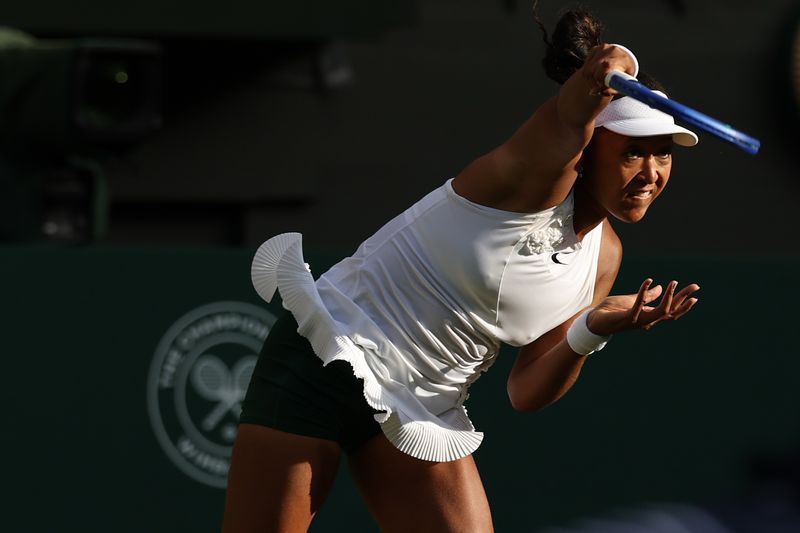
Naomi Osaka opened her Wimbledon fortnight by walking onto Centre Court in a striking kimono-inspired ensemble drawing homage to her beloved Kill Bill character, and closed out her fourth-round assignment by demolishing top seed Aryna Sabalenka in a display of commanding tennis that harked back to her Grand Slam-winning days. The Japanese 14th seed's 6-2, 7-6(2) destruction of Sabalenka propelled her into the quarter-finals at the All England Club for the first time, marking a triumphant return to the form that carried her to four major titles across hard courts.
Osaka's elimination of Sabalenka represents the latest in a cascade of shocks that has upended the women's draw at SW19. With defending champion Iga Swiatek and 2022 victor Elena Rybakina both falling in the third round, the top three seeds have been wiped out entirely. The withdrawal of fourth-ranked Barbora Krejcikova—who succumbed to fellow Czech Karolina Muchova 7-5, 5-7, 6-3 in Sunday's fourth-round action—ensures the tennis world will crown its ninth successive first-time Wimbledon champion in the women's singles category, an extraordinary statistic that underscores the depth and unpredictability of the current field.
The spectacle of Osaka versus Sabalenka had promised to be the day's marquee encounter, a duel between two power-hitters of comparable pedigree. Both competitors, aged 28, carry four Grand Slam titles apiece accumulated exclusively on hard court surfaces. Their histories intersected most memorably in 2018 when Osaka defeated Sabalenka en route to claiming the U.S. Open crown, yet nearly eight years elapsed before their paths crossed again on the professional circuit. When they finally renewed their rivalry this season, Sabalenka claimed three consecutive victories over her Japanese counterpart, establishing herself as the stronger competitor in recent encounters.
Yet on a sun-drenched Day Seven at the All England Club, Osaka reversed that dynamic with categorical authority. The composed and serene Osaka constructed a masterclass of sustained power and precision that left Sabalenka visibly frustrated, screaming in exasperation throughout their encounter on Centre Court. Rather than the expected pyrotechnics and protracted baseline exchanges that typically characterize such contests between elite strikers, Osaka's dominance was so complete that Sabalenka never gained traction. The top seed appeared misfiring and unable to impose her typically ferocious will, as Osaka claimed what represents her most commanding victory since resuming professional activity following maternity leave in 2024.
When queried about her theatrical walk-on costume, Osaka explained that she had deliberately muted her expression compared to her original inclinations, choosing instead to prioritize mental focus on the match itself. She indicated her intention to continue moderating her stylistic flourishes in upcoming rounds, preferring to channel her energies toward her tennis performance rather than grand theatrical gestures. Her quarter-final appointment awaits in the form of 10th seed Muchova, the conqueror of Krejcikova, setting up another compelling encounter between rising and re-emerging forces in women's tennis.
Across the men's draw, Novak Djokovic preserved his quest for an eighth Wimbledon title—a record-tying achievement—though the 39-year-old champion confessed to deriving little pleasure from his fourth-round victory. His 7-6(6), 6-3, 3-6, 6-3 struggle against Russian qualifier Roman Safiullin proved laborious and uneven, marked by inconsistency and diminished court feel. Djokovic acknowledged afterward that he had not performed with the fluidity or confidence he demands of himself, expressing relief rather than satisfaction at escaping the match victorious. Notwithstanding the aesthetic shortcomings of his performance, the victory represented a landmark achievement: his 106th Wimbledon match win, surpassing Swiss legend Roger Federer's previous record.
The Serbian star now stands seventeen quarter-final appearances at the All England Club, positioning himself one victory away from a potential semi-final confrontation against defending champion Jannik Sinner. To reach that stage, Djokovic must navigate past Canadian third seed Felix Auger-Aliassime, who required four hours and twenty-six grueling minutes to dispatch Spain's final representative, Alejandro Davidovich Fokina, in a marathon fourth-round affair decided 6-7(4), 7-6(6), 6-3, 6-7(2), 6-1. The match concluded acrimoniously, with both competitors exchanging heated words at the net following the grueling conclusion.
The men's draw witnessed additional drama when Polish 24th seed Hubert Hurkacz was compelled to retire during the fifth-set decider of his contest against German veteran Jan-Lennard Struff. At thirty-six years old, Struff has achieved a long-sought milestone by reaching the quarter-finals of a Grand Slam tournament for the first time in his career, a remarkable accomplishment for a player who has competed at the highest professional level for an extended period without previously advancing this far at a major championship.
On the women's side, American representation reached its strongest showing since 2002, with five competitors advancing to the fourth round. Fourth-ranked Jessica Pegula showcased her championship acumen when she dispatched eighteen-year-old American prospect Iva Jovic 4-6, 6-3, 6-1 in a display of tactical mastery that highlighted the experience gap separating the established campaigner from the emerging talent. Pegula has now matched her career-best Wimbledon performance and could potentially face fellow American Coco Gauff in subsequent rounds, depending on Gauff's outcome against Switzerland's Belinda Bencic.
The cascade of upsets and surprising results across both draws has established this Wimbledon as a tournament notably different from the recent past, where an elite concentration of seeded players typically dominated deep into the championship. Instead, the fortnight has showcased opportunities for lesser-ranked competitors and those returning from extended absences to challenge the established hierarchy. For regional tennis enthusiasts and Malaysian readers following the sport, the emergence of new contenders and the resurrection of former champions like Osaka signal a shifting competitive landscape that promises continued unpredictability through the tournament's conclusion.

