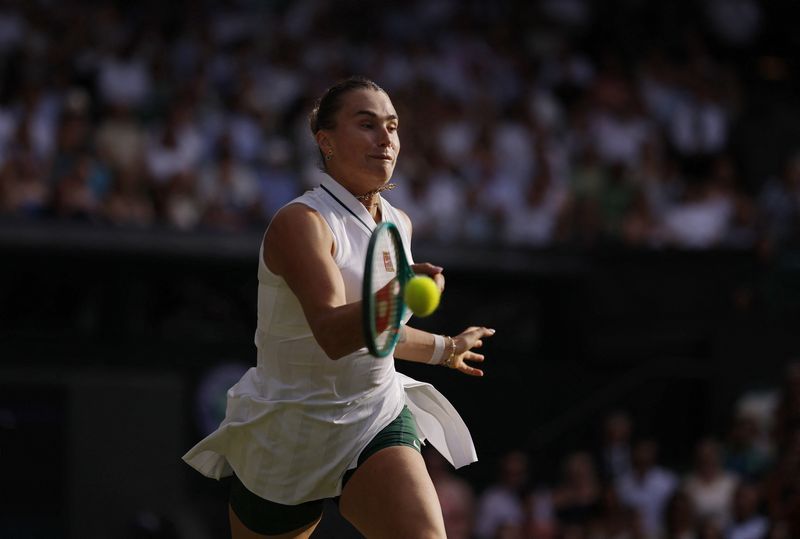
Naomi Osaka's resurgence on the professional tennis circuit reached a defining moment on Centre Court at Wimbledon when she dismantled world number one Aryna Sabalenka with a dominant 6-2 7-6(2) victory in the fourth round on Sunday. The 14th seed's commanding display not only delivered her most significant tournament win since returning to tour in 2024 following the birth of her daughter Shai, but fundamentally altered the complexion of the women's championship by eliminating the favourite just as three top seeds had already crashed out.
The match represented a collision between two of the sport's most formidable competitors, each possessing four Grand Slam titles and a history of commanding performances on hardcourts. Yet despite carrying the weight of expectations surrounding their first Grand Slam encounter in eight years, the opening set bore little resemblance to the blockbuster encounter the packed crowd anticipated. Sabalenka, bidding to progress beyond three consecutive semi-final appearances at the All England Club, appeared oddly disjointed as her explosive power game consistently misfired during a mere 32-minute opening set. Osaka moved through the gears with surgical precision, breaking her opponent twice while maintaining the aggressive intent that has characterised her return to competitive tennis.
The Japanese player's victory becomes particularly noteworthy within the context of recent Wimbledon developments. With defending champion Iga Swiatek succumbing in the third round on Saturday and second seed Elena Rybakina suffering the same fate, the pathway through the draw had suddenly opened considerably for Sabalenka. The top seed's hopes of finally capturing the grasscourt title after reaching three consecutive semi-finals appeared increasingly realistic following those departures, yet Sunday's performance suggested the pressure of expectation may have contributed to her struggles.
Sabalenka's desperation manifested throughout the contest in increasingly visible ways. During the opening set, she could be seen screaming in frustration as her typically dominant serve and baseline power yielded uncharacteristic errors. The second set evolved into a more competitive affair, with Sabalenka finding her rhythm and pushing Osaka in ways that momentarily suggested a potential comeback. Yet the composition demonstrated by Osaka proved decisive in the critical moments, particularly during the tiebreak where she neutralised Sabalenka's momentum with calm execution. The tiebreak triumph carried additional significance as it snapped an astonishing streak of 21 consecutive tiebreak victories that Sabalenka had accumulated across Grand Slam tournaments.
Osaka's performance revealed why her return to professional tennis has generated considerable anticipation. Her serve returns consistently disrupted Sabalenka's rhythm from the opening moments, positioning her opponent in reactive rather than offensive positions throughout extended rallies. The Japanese player demonstrated the mental fortitude required at the highest level, particularly in the second set where she absorbed pressure without wavering. Following a lost match point, Sabalenka's frustration boiled over in a way that captured her mental state, blasting a ball far beyond the stadium perimeter as she attempted to process the loss.
The significance of this victory extends beyond the immediate achievement of reaching the quarter-finals. For Osaka, advancing past the fourth round at Wimbledon for the first time in her career represents a personal milestone. More broadly, her triumph exemplifies the unpredictability that defines the women's game currently, with no dominant force emerging to claim consistent Grand Slam success. Her fashionable Japanese-inspired walk-on outfits have generated considerable commentary, yet increasingly it is the quality of her tennis that merits attention from observers and competitors alike.
Both finalists emerged from their professional journeys possessing four Grand Slam titles earned exclusively on hardcourts, a shared specialisation that made their respective performances on grass particularly intriguing. Born seven months apart, their career trajectories have diverged considerably, with Osaka capturing her major titles earlier in her career before stepping back from professional tennis. Sabalenka subsequently captured her first Grand Slam more recently, establishing herself as a formidable presence across multiple seasons. Their previous meeting at a Grand Slam occurred eight years earlier when Osaka defeated Sabalenka en route to the United States Open title, making Sunday's encounter their first direct collision at this level since that initial meeting.
Osaka's immediate reaction following her victory revealed the emotional weight she attached to the accomplishment. In her first appearance on Centre Court following the match, she described it as a genuinely fun encounter despite its competitive intensity, noting the particular significance of defeating someone who had previously defeated her in three consecutive meetings. The contrast between her measured demeanour on court and Sabalenka's explosive frustration illustrated different temperaments responding to the pressures inherent in elite professional tennis.
Sabalenka's post-match comments suggested the toll of the defeat, with the 28-year-old Ukrainian expressing an immediate desire to distance herself from the sport mentally. Her journey through three consecutive Wimbledon semi-finals had seemingly positioned her as the logical successor to the title, yet the vagaries of grasscourt tennis and Osaka's composed excellence proved decisive. The opening set's 32 minutes demonstrated how quickly momentum can shift when one competitor finds rhythm while another struggles with consistency.
Osaka's next challenge places her against tenth seed Karolina Muchova in the quarter-finals, continuing her unexpected run through a tournament that looked considerably different before Sunday's upset. The Czech player represents formidable opposition, yet Osaka's current form suggests she possesses the capacity to progress further. The broader implications for Wimbledon's conclusion remain compelling, with the field now featuring greater diversity among potential finalists than appeared likely following the early rounds.
For tennis observers across the Asia-Pacific region, Osaka's progress carries particular resonance. Her return to professional tennis following motherhood has generated international discussion about balancing family responsibilities with elite athletic pursuits, making her on-court achievements carry significance beyond traditional sporting metrics. The Centre Court victory against the world's top-ranked player represents a statement that her comeback trajectory continues ascending, with improved performances materialising in increasingly significant matches as the tournament progresses.

