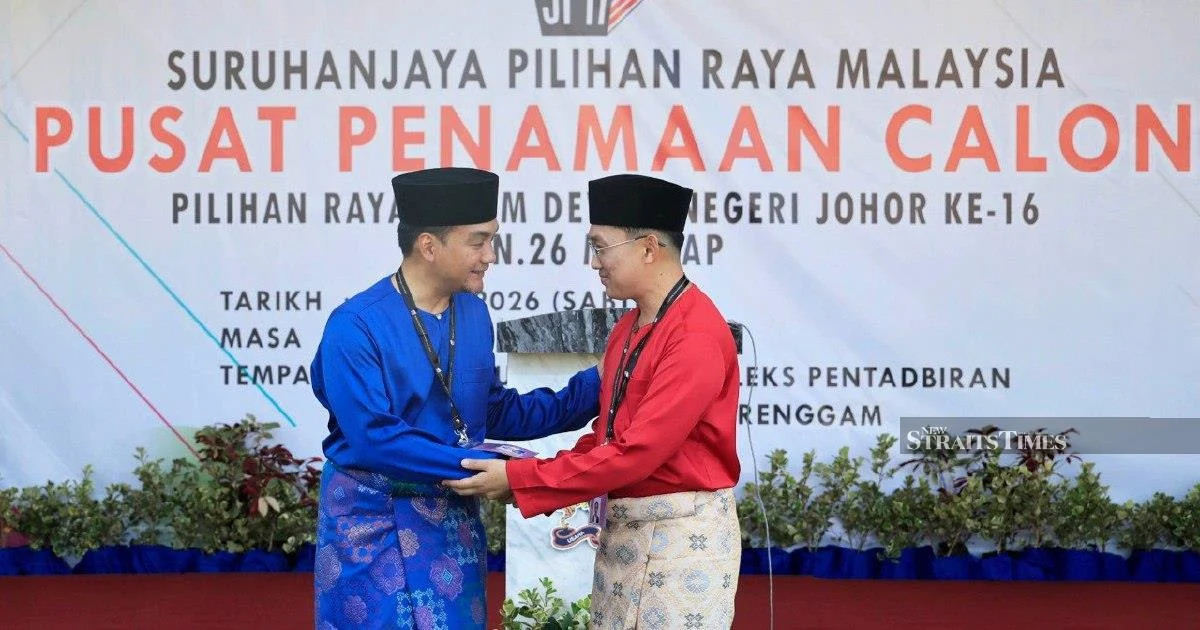
Caretaker Johor Menteri Besar Datuk Onn Hafiz Ghazi has struck a cautionary tone ahead of the state election scheduled for July 11, warning that the Machap contest represents far more uncertainty than his confidence in retaining office might suggest. Speaking in Simpang Renggam, he acknowledged that political contests in Malaysia's southern stronghold contain inherent unpredictability, a reminder that electoral outcomes remain far from assured regardless of incumbent advantage or polling strength. His remarks underscore a recognition that even established political figures cannot take their positions for granted in a landscape where voter sentiment can shift substantially between campaigns.
The Machap state seat contest exemplifies broader dynamics currently reshaping Johor's political terrain. As one of the state's competitive constituencies, it represents exactly the type of marginal battlefield where election outcomes frequently hinge on narrow margins and localised issues rather than statewide trends alone. Onn Hafiz's explicit acknowledgment of this uncertainty demonstrates political maturity and awareness that grassroots sentiment cannot be dismissed, even where an incumbent administration maintains structural advantages. His positioning reflects the prudent approach of a leader unwilling to project overconfidence in an electoral environment where complacency often proves costly.
The Johor election carries significance well beyond state boundaries, functioning as a crucial barometer for Malaysian politics broadly. State elections occurring outside the federal cycle often provide voters an opportunity to signal approval or disapproval of national government performance, effectively serving as mid-term assessments. Since the most recent state election, Malaysia's political landscape has witnessed considerable flux, including shifts in federal administration and changing coalitions. Johor, historically a Barisan Nasional stronghold with deep institutional advantages, nonetheless faces rising pressure from opposition parties seeking to erode the ruling coalition's traditional majorities.
Onn Hafiz's bid for a second term represents continuity in a state administration that has pursued various development initiatives and policy directions over the past election cycle. His caution about the Machap race specifically suggests awareness that individual constituencies can diverge from broader state-level patterns, a phenomenon witnessed repeatedly in Malaysian elections. Constituencies with particular demographic characteristics, recent controversies, or strong local personalities frequently produce results at odds with overall state outcomes, creating pockets of resistance or alternative preferences within predominantly aligned regions.
The July 11 election will determine not only Johor's state government composition but also reflect voter attitudes toward governance, development priorities, and the broader direction of national politics. Opposition parties have mounted increasingly sophisticated campaigns in recent years, leveraging social media, grassroots organising, and targeted messaging to challenge entrenched power structures. Johor, despite its Barisan Nasional heritage, has not proven entirely immune to these organisational advances, with select constituencies experiencing competitive contests that challenge historical voting patterns.
Campaigning dynamics in Johor's July 11 contest will likely emphasise economic development, infrastructure expansion, and bread-and-butter governance concerns that resonate with suburban and semi-urban voters. These constituencies constitute an increasingly influential voting bloc, capable of determining outcomes through mobilisation variations and strategic choices between competing parties. Onn Hafiz's campaign positioning would reasonably focus on achievements, future development plans, and institutional stability rather than taking voter support as automatic. His warning about contest unpredictability aligns logically with this strategic approach, neither complacent nor alarmist.
The electoral calendar and timing of the Johor election also merit consideration within the broader Malaysian political context. State elections occurring during periods of federal political transition can acquire magnified significance as voters potentially express views about national governance and direction through state-level ballots. Opposition coalitions frequently leverage such opportunities to test messaging, consolidate voter bases, and build momentum for eventual federal challenges. Similarly, the ruling coalition views state elections as opportunities to demonstrate continued electoral viability and public support for its vision.
Machap specifically carries characteristics relevant to understanding Johor's competitive terrain. As a constituency encompassing particular communities and demographic groups, it requires tailored campaign approaches and attention to locally salient issues rather than reliance on statewide narratives alone. This reality appears to inform Onn Hafiz's cautious framing, suggesting that even well-resourced incumbent administrations cannot assume victory in individual contests without sustained engagement and attention to local concerns. The explicitness of his warning indicates genuine recognition that multiple variables influence constituency-level outcomes.
Polling dynamics and electoral swings across Malaysian states have demonstrated increasing volatility compared to earlier periods, with voters displaying greater willingness to differentiate between state and federal choices. The Johor election will likely reflect this evolving voter behaviour, with some constituencies potentially diverging from overall state patterns. This fragmentation creates precisely the type of unpredictable environment that Onn Hafiz's remarks invoke, where national or regional advantages may prove insufficient to guarantee individual seat retention without rigorous local mobilisation and sustained attention to community priorities.
As campaigning intensifies ahead of July 11, the contest between ruling and opposition coalitions in Johor will probably emphasise governance competence, development trajectories, and vision for the state's future. Onn Hafiz's acknowledgment that anything can happen in the Machap race represents sensible political positioning rather than genuine pessimism, signalling to supporters the necessity of active participation and campaigning rather than assuming inevitable victory. Such messaging typically proves more effective than overconfidence in mobilising supporters and ensuring adequate turnout on polling day.
The election ultimately provides Malaysian voters an opportunity to assess their state administration's performance while simultaneously expressing views about national politics and governance direction. Onn Hafiz's careful framing respects both the significance of the electoral choice and the genuine uncertainty inherent in democratic contests, even where incumbent administrations maintain significant structural and organisational advantages. His remarks contribute to establishing a competitive rather than predetermined atmosphere for the July 11 contest.

