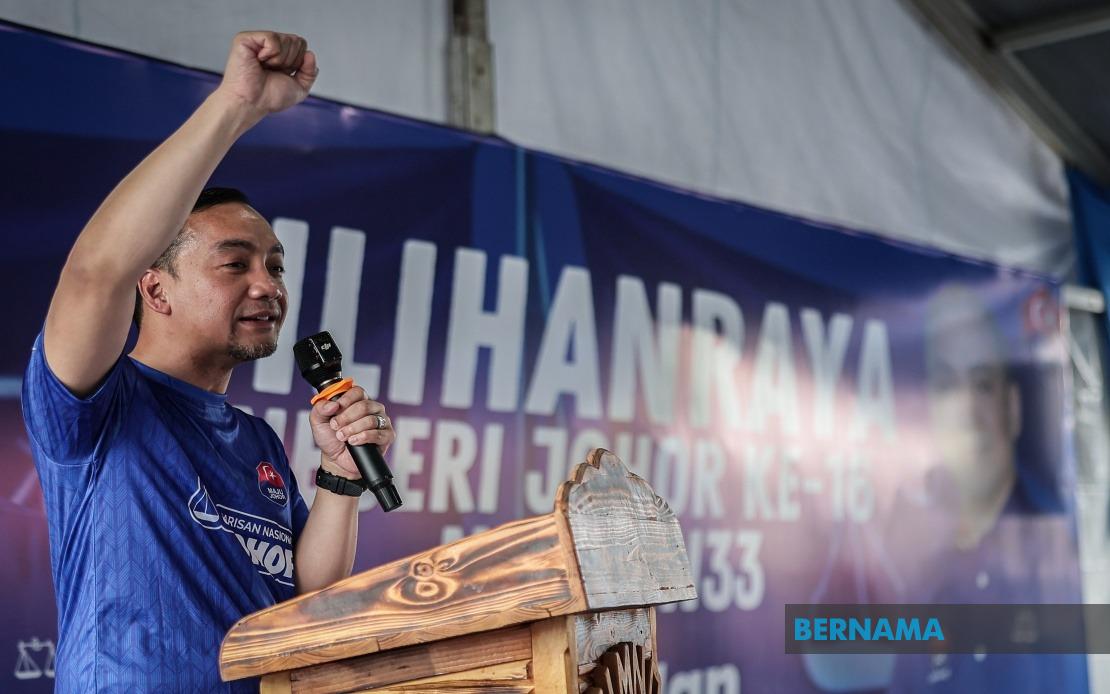
The Barisan Nasional coalition is banking on sustained momentum in two critical Johor state assembly contests, with party leadership expressing optimism that voter enthusiasm behind its Endau candidate will carry through to polling day on July 11. Datuk Onn Hafiz Ghazi, who chairs the coalition and serves as Johor's chief minister, told reporters in Mersing that the community's response to Alwiyah Talib has exceeded expectations during the campaign trail, setting a positive tone for the party's broader electoral push in the state.
Alwiyah, affectionately referred to as "Kak Awi" among constituents, represents a significant strategic move for BN in this contest. Her decision to return to the coalition after previously contesting under Perikatan Nasional signals the kind of political realignment that BN has been seeking to engineer across Malaysia's electoral landscape. Onn Hafiz characterised her homecoming as emblematic of the "Rumah Bangsa" framework promoted by UMNO president Datuk Seri Dr Ahmad Zahid Hamidi, a concept designed to position BN as an inclusive umbrella capable of accommodating diverse political talents regardless of their recent affiliations.
The Johor Menteri Besar praised Alwiyah's track record as a capable administrator who has consistently prioritised the welfare of her constituents, suggesting that her previous opposition alignment need not be an impediment to her effectiveness as a BN representative. This framing reflects an effort to neutralise potential voter hesitation about her party-switching by emphasizing continuity of service and competence over partisan loyalty. The messaging appears calibrated to present BN not as a rigid bloc but as a pragmatic governing coalition willing to welcome committed leaders from outside its traditional circles.
Alwiyah's electoral pedigree in Endau is formidable. She first captured the seat for BN during the 14th General Election before eventually transitioning to Bersatu and later standing as a Perikatan Nasional candidate in the 2022 Johor state election, when she retained the seat with a majority of 3,041 votes in a five-way contest. That result demonstrated her personal popularity in the constituency transcends party machinery, a valuable asset for BN as it attempts to reclaim seats lost to the opposition in recent electoral cycles. Her return thus represents not merely a recruitment of a single candidate but the retrieval of an established vote-getter with proven appeal among Endau voters.
The campaign event held in Endau, styled as "Santai ONN X ONN Bersama Menteri Besar Johor," underscores the personal-touch approach BN is deploying in these contests, with Onn Hafiz himself directly engaging voters and supporters at grassroots venues rather than relying solely on formal rally structures. This strategy acknowledges the shift toward hyper-local campaigning, where personal relationships and perceived accessibility matter as much as policy platforms. The presence of Mohd Youzaimi Yusof, BN's candidate for the adjacent Tenggaroh seat, also indicates a coordinated effort to strengthen the coalition's position across multiple constituencies simultaneously.
Onn Hafiz reported that the party apparatus in both Endau and Tenggaroh is functioning at full capacity and displaying strong commitment to victory. This assessment of internal readiness is significant because ground-level execution often proves decisive in close contests, particularly in rural and semi-rural constituencies where voter mobilisation and turnout operations can determine outcomes. The Menteri Besar's confidence in the machinery suggests BN believes it has the organisational resources deployed effectively across these pivotal seats.
The campaign environment itself, according to Onn Hafiz, has remained orderly and free of disruptive incidents, a factor he cited as positive for BN's prospects. Election campaigns characterised by civility and professional conduct tend to reinforce coalition narratives around stability and responsible governance, contrasting sharply with volatile electoral contests that may alienate moderate voters. BN's emphasis on campaign decorum thus serves both practical and symbolic purposes in its broader electoral messaging.
The timing of this optimism matters considerably. With early voting scheduled for July 7 and general polling on July 11, BN is attempting to consolidate support during the critical final week. Onn Hafiz's public expression of confidence is partly genuine assessment but also partly strategic messaging designed to create a perception of inevitable victory that may influence undecided voters and suppress opposition turnout. The invocation of Islamic language—"Insya-Allah, we pray that this momentum continues"—also grounds his electoral appeal in values resonant with Johor's predominantly Muslim electorate.
For Malaysian observers tracking BN's resurrection after its 2018 general election defeat and subsequent political rehabilitation, the Johor state contests represent a crucial test case. The ability to successfully reintegrate candidates from opposing coalitions while maintaining internal coherence has eluded Malaysian political alliances before. Alwiyah's candidacy thus tests whether BN can genuinely function as a flexible coalition adapted to contemporary electoral dynamics, or whether old divisions resurface once campaign messaging ends and governance pressures mount.
The broader implications extend beyond Johor's borders. If BN successfully retains or gains seats in contests like Endau, it will validate a strategic approach centred on absorbing talented opposition politicians and emphasising competence over partisan credentials. Conversely, if Alwiyah's return fails to translate into electoral victory or if voter scepticism about her party-switching depresses turnout in BN-leaning precincts, the coalition may face awkward questions about the credibility of its unity messaging and the depth of voter commitment to its comeback narrative.

