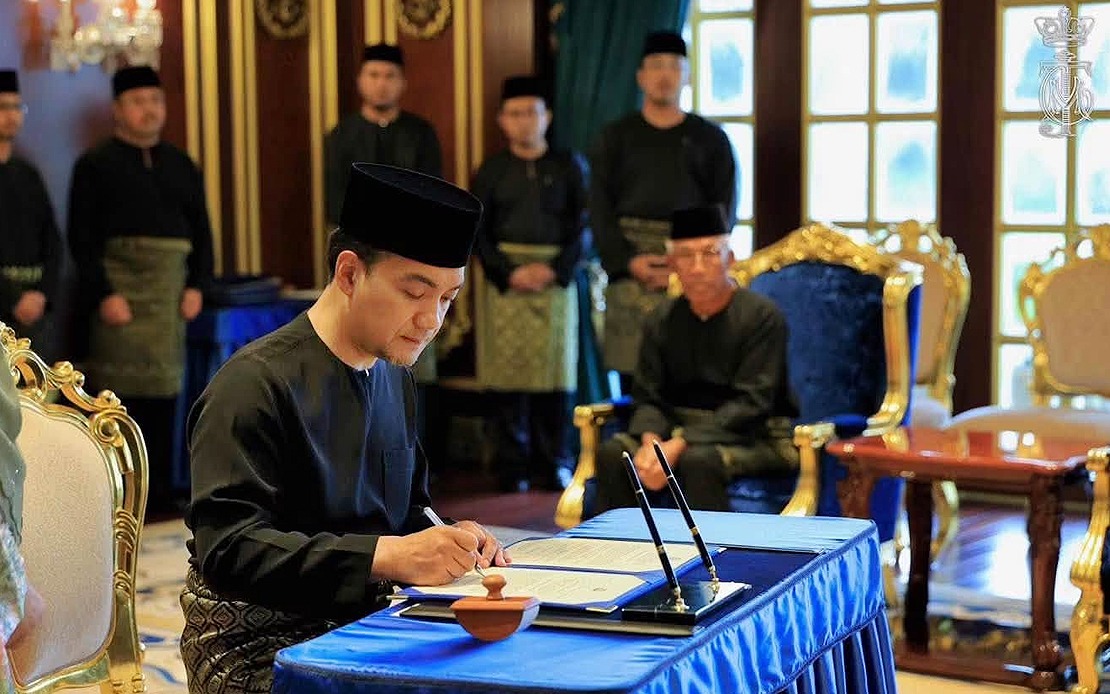
Datuk Onn Hafiz Ghazi has begun his second term as Johor Menteri Besar following a decisive performance by Barisan Nasional in the state's recent election, building momentum from a substantial electoral mandate that positions him to advance the state's development priorities for the coming years. The 48-year-old leader took his oath of office before the Regent of Johor, Tunku Mahkota Ismail, at Istana Bukit Serene, formally commencing his next chapter in managing Southeast Asia's most economically dynamic state.
Onn Hafiz's reappointment comes after BN captured 48 of the 56 state assembly seats, a significant improvement from the 40 seats the coalition won during the 2022 Johor state election. This expanded parliamentary majority provides the Menteri Besar with considerably greater legislative room to pursue his administration's agenda without the constraints that often accompany narrower electoral victories. The stronger backing from voters reflects public confidence in his economic management and governance approach during his first term.
The politician carries into office a lineage with deep roots in Malaysia's political establishment that few contemporary leaders can match. As the great-grandson of Datuk Onn Jaafar, UMNO's founder and Johor's seventh Menteri Besar, and grandson of the late Tun Hussein Onn, Malaysia's third Prime Minister, Onn Hafiz represents a continuation of a family tradition stretching back to the nation's independence era. This genealogical connection to Malaysia's formative political moments shapes public perceptions of his leadership and carries both expectations and historical resonance across the state.
Born on March 2, 1978, Onn Hafiz's path to high office diverged from the traditional political trajectory followed by many predecessors. After completing early education at the Royal Military College, he pursued tertiary studies at the University of Hertfordshire in the United Kingdom, where he obtained a degree in accounting. Rather than entering politics directly, he spent over a decade accumulating corporate experience that would later inform his administrative philosophy and approach to state governance.
His professional background encompasses roles at PricewaterhouseCoopers from 2001 to 2004, followed by various senior positions in the corporate sector through 2013. He served as director of Chin Well Holdings Berhad and later as chief executive officer of KMB Sdn Bhd, exposure to international audit standards and corporate efficiency frameworks that contrasts with the purely political backgrounds of many state leaders. This business-world immersion has cultivated an administrative style emphasizing operational efficiency, fiscal discipline, and investment attraction—qualities increasingly valued in competitive Southeast Asian governance.
Onn Hafiz's entry into formal politics accelerated during the 2010s as he established himself within UMNO's organizational structure. Between 2012 and 2018, he participated in UMNO Youth activities while leading the Sembrong division's youth wing, simultaneously serving as political secretary to the defence minister from 2013 to 2018. These assignments provided him with exposure to federal-level governance and defence policy considerations relevant to a state bordering Singapore. His election as Layang-Layang assemblyman in 2018 marked his first successful electoral contest, validating his political positioning within Johor's constituency landscape.
Following his 2018 parliamentary victory, Onn Hafiz was appointed chairman of the Johor Tourism, Youth and Sports Committee, a portfolio that allowed him to shape sectoral development during a critical period for the state's post-pandemic recovery. The position provided platform to demonstrate administrative capability while building relationships across state institutions and federal agencies. His transition to contesting the Machap state seat in 2022 proved successful, paving the way for his appointment as Johor's 19th Menteri Besar after BN formed the state government, succeeding Datuk Hasni Mohammad.
Since assuming office on March 15, 2022, Onn Hafiz has anchored his administration's strategic direction around the "Maju Johor 2030" blueprint, a comprehensive long-term development framework prioritizing economic diversification and investor attraction. This vision reflects acknowledgment that Johor's competitive position within the ASEAN region requires sustained focus on infrastructure development, sectoral modernization, and institutional efficiency. The agenda's emphasis on economic expansion resonates with regional development patterns observed across fast-growing Southeast Asian jurisdictions.
Within UMNO's hierarchical structure, Onn Hafiz has consolidated his organizational standing by serving as chairman of the Johor UMNO Liaison Committee and chief of the Simpang Renggam division since 2023, having previously held the deputy chief position from 2018 to 2023. This progression through party positions reflects his influence within UMNO's state machinery and suggests potential trajectory toward higher national offices. His organizational roles provide levers for translating electoral mandates into policy implementation while managing competing factional interests within the party.
The electoral outcome delivering 48 seats to BN demonstrates sustained public confidence in the coalition's governance model after a period of political volatility that characterized Malaysian politics in preceding years. For Johor specifically, the result validates an economic management approach centered on investment promotion and infrastructure development. The state's geographical proximity to Singapore and role as a manufacturing and logistics hub throughout Southeast Asia require leadership capable of navigating complex cross-border relationships while competing for regional capital flows.
Onn Hafiz's family background, while providing historical prestige, also establishes implicit expectations regarding institutional integrity and administrative standards. The lineage connecting him to Datuk Onn Jaafar's anti-colonial leadership and Tun Hussein Onn's stewardship during Malaysia's early independence years creates public reference points for evaluating performance. Johor voters effectively renewed a mandate to a leader positioned as both product of contemporary corporate management traditions and inheritor of established political-historical legitimacy.
Looking forward, the Menteri Besar's second term will be measured against ambitious development targets outlined in the Maju Johor 2030 framework. With expanded legislative support and a strengthened mandate, his administration faces opportunity to pursue medium-term projects addressing sectoral competitiveness, workforce development, and infrastructure modernization. The expanded BN majority simultaneously creates responsibility to translate electoral confidence into tangible improvements in service delivery and economic opportunity across Johor's constituencies. The coming years will reveal whether the corporate efficiency frameworks that shaped his early career translate effectively into sustained improvement of public-sector performance and citizen welfare outcomes.

