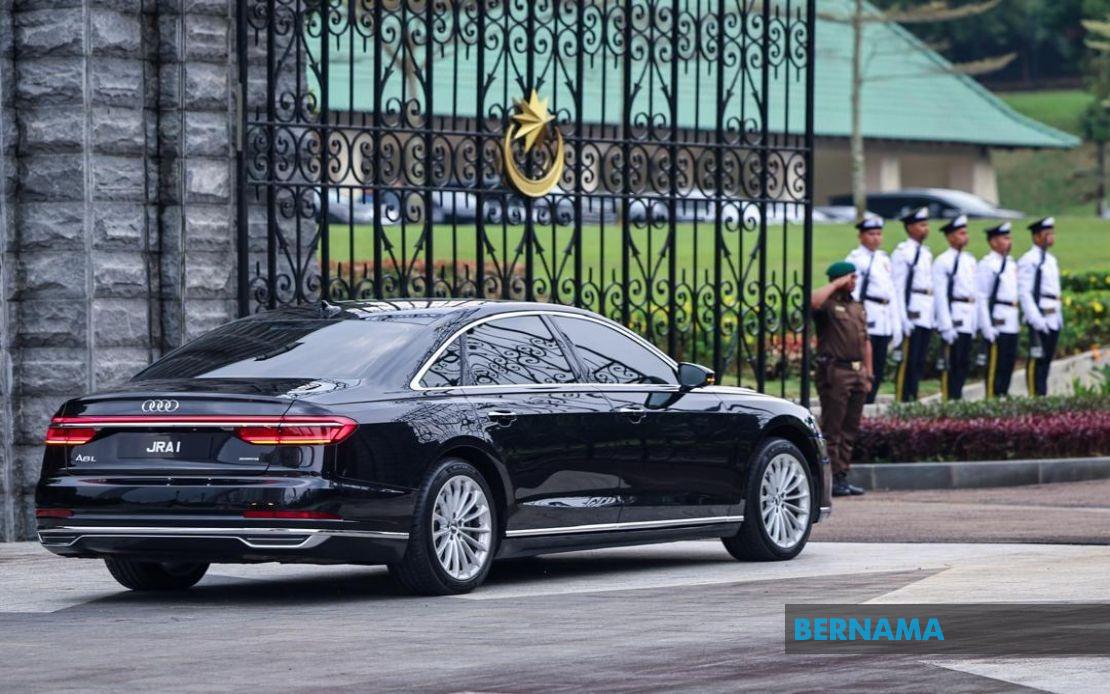
Datuk Onn Hafiz Ghazi, the Machap assemblyman and Johor Barisan Nasional chairman, pulled up at Istana Bukit Serene in Johor Bahru on the afternoon of July 12 to be sworn in as the state's newest Menteri Besar. The vehicle entered the palace grounds at approximately 3.40 pm, marking the formal culmination of what had been an unusually swift transition following the previous day's elections. News crews positioned themselves throughout the compound from midday onwards, capturing the arrival of a political figure whose appointment had been virtually assured once the ballot results became clear.
The sequence of events throughout the afternoon reflected the carefully choreographed nature of vice-regal proceedings. Onn Hafiz's motorcade departed from the official Menteri Besar residence in Saujana at 3.35 pm, giving observers just a five-minute window between the former residence and the palace gates. This tight timing suggested that palace officials and government handlers had coordinated the movements with precision to ensure the ceremony would proceed without delays. The presence of security personnel, government functionaries, and assembled media representatives underscored the significance of the occasion within Malaysia's constitutional framework, where the swearing-in of a state chief minister represents a pivotal moment in the transfer of executive authority.
The palace administration had imposed specific restrictions on media coverage, limiting journalists to designated areas around the Mahkota gate of Istana Bukit Serene. Such protocols are standard practice when sensitive constitutional ceremonies take place, balancing the public's right to information with the formal dignity that palace proceedings demand. The restriction meant that while the broader public could eventually learn of the swearing-in through official channels, the immediate visual documentation of the ceremony itself remained limited to approved vantage points. These constraints reflected both traditional protocol and the practical management of large gatherings at sensitive state venues.
Onn Hafiz's elevation to the menteri besar position had become inevitable following the Barisan Nasional coalition's extraordinary performance in the 16th Johor State Election held on July 11. The coalition secured 48 of the 56 state assembly seats available, a commanding supermajority that left little room for political uncertainty or negotiation. This result represented a particularly strong endorsement in Johor, one of Malaysia's most politically significant states and a traditional BN stronghold. The magnitude of the victory meant that choosing the state's chief minister was largely a formality, with the appointee certain to command overwhelming support within the state legislature.
The swiftness with which the swearing-in followed the election results illustrated how Malaysia's constitutional monarchy and parliamentary systems interact during moments of political transition. Unlike some Westminster-derived systems where a gap may exist between electoral victory and formal assumption of office, Malaysia's procedures generally move quite rapidly once electoral results become clear. The palace's role in facilitating this transition reflects the constitutional position of state rulers as custodians of the constitutional order, responsible for ensuring that elected representatives are properly installed according to established procedures and protocols.
For Malaysian political observers, particularly those tracking developments in Johor, the swearing-in ceremony represented validation of the electorate's confidence in the Barisan Nasional's governance platform. The coalition's performance in Johor carried implications beyond the state itself, signalling voter sentiment about national governance at a time when Malaysia's political landscape remained in flux. Johor's status as a major economic centre and population hub meant that its electoral verdict resonated throughout the broader political system, offering insights into urban and semi-urban voter preferences that could influence subsequent political calculations at the national level.
The ceremonial aspects of the day also highlighted the continuing importance of traditional institutional frameworks within Malaysia's contemporary political system. Despite the modern electoral mechanisms through which Onn Hafiz had emerged as BN's successful candidate in his constituency and subsequently the coalition's choice for menteri besar, his formal assumption of office required participation in age-old rituals centred on the palace and the state ruler. This blend of democratic and monarchical elements remains fundamental to how Malaysia's federal and state systems operate, with elected representatives ultimately deriving their authority through both popular mandate and vice-regal appointment.
The assembly of media representatives and officials at the palace reflected the broader ecosystem of political communication and documentation that surrounds significant state events. While the immediate ceremonial aspects remained restricted to designated areas, the presence of numerous observers ensured that the event would be recorded, reported, and disseminated through various channels reaching Malaysian audiences. This documentation function serves important purposes beyond mere novelty value, creating official records of constitutional transitions that contribute to the historical record of Malaysian governance and provide contemporaneous accounts for future analysis and reference.
For residents of Johor and Malaysians interested in state-level politics, the swearing-in ceremony concluded a chapter defined by electoral competition and formally opened a new phase under Onn Hafiz's leadership. The incoming menteri besar faced the immediate tasks of cabinet formation, administrative reorganisation, and articulation of policy priorities for the state government's coming term. The overwhelming mandate provided by the electoral results offered substantial room for initiative but also implicit expectations that the administration would deliver tangible benefits justifying the voters' confidence expressed through their ballot choices.

