Johor's political leadership has undergone a significant administrative restructuring, with Menteri Besar Datuk Onn Hafiz Ghazi framing the changes as a strategic renewal designed to maintain momentum while injecting fresh perspectives into governance. The reshuffle of the State Executive Council represents the latest chapter in Johor's ongoing efforts to balance continuity with institutional evolution, a pattern increasingly common across Malaysian state governments as they navigate post-election consolidation and changing political circumstances.
Onn Hafiz's measured response to the reshuffle demonstrates the delicate political choreography required when removing experienced officials from their posts. By emphasising that the structural changes do not diminish the legacy of departing team members, the Menteri Besar sought to preserve both their dignity and the institutional memory they accumulated during their 2022-2026 tenure. This acknowledgment serves a crucial function in maintaining party cohesion and preventing potential resentment among senior figures who might otherwise feel sidelined, a concern that has historically triggered factional tensions within state administrations across Malaysia.
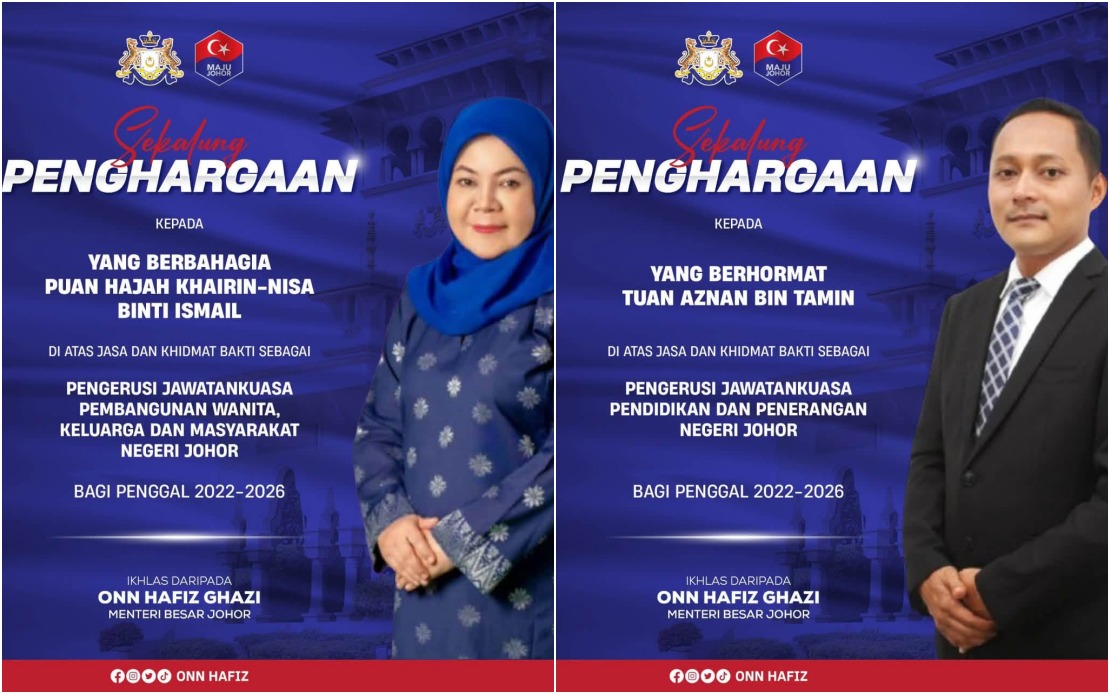
The four assemblymen who stepped down from their positions—Datuk Zahari Sarip, K. Raven Kumar, Aznan Tamin, and Khairin-Nisa Ismail—represented a cross-section of Johor's political establishment. Rather than characterising their departure as a demotion, Onn Hafiz reframed their contributions as foundational to the state government's achievements, suggesting that their future roles, whatever form they take, remain valuable to Johor's development trajectory. This approach attempts to transform what could be perceived as exclusion into a transition, preserving political relationships that may prove important in future legislative sessions or community engagement initiatives.
The specific composition of Johor's new executive council reflects both strategic continuity and calculated change. Six assemblymen retained their existing portfolios, signalling that proven performers in key ministerial areas would continue their work uninterrupted. This retention of institutional knowledge prevents disruption to ongoing policy implementation and administrative processes, particularly important in sectors requiring sustained effort and expertise. Portfolio continuity also reassures stakeholders and the public that state government operations will maintain stability despite the broader structural reorganisation.
The introduction of four new faces to the executive council represents an infusion of different perspectives and energy into the administration. In Malaysian state politics, such appointments often serve multiple purposes simultaneously: they reward loyal party members with ministerial opportunities, they broaden the geographic or demographic representation within the executive, and they signal commitment to renewal without wholesale abandonment of experienced governance. For the newly appointed assemblymen, their elevation to the executive council represents a significant career advancement and enhanced visibility within state politics, potentially positioning them for greater roles in future administrations.
The formal swearing-in ceremony before Tunku Mahkota Ismail at Istana Bukit Serene underscored the constitutional dimension of Johor's executive reshuffle. This ceremonial element, involving the state's Regent, places the administrative changes within a framework that transcends partisan politics, connecting them to Johor's institutional traditions and constitutional governance structures. Such formal proceedings reinforce the principle that while elected officials come and go, the machinery of state governance operates according to established procedures and respect for hereditary monarchy.
Onn Hafiz's emphasis on teamwork and collective effort to overcome challenges reflects an understanding that state governance requires cooperation across different personality types, experience levels, and political factions. By highlighting the previous team's demonstration of unity in facing difficulties, he implicitly commends their ability to subordinate individual ambitions to collective state interests—a quality he presumably expects the new team to emulate. This framing transforms the reshuffle from a zero-sum political calculation into a story about institutional capability and adaptive management.
For Malaysian observers monitoring state-level politics, Johor's restructuring carries broader implications about how states manage political transitions during election cycles and inter-election periods. The balance between retaining experienced administrators and introducing new talent reflects contemporary challenges in Malaysian governance: maintaining institutional continuity while responding to electoral mandates and demographic shifts. Johor's approach—neither wholesale replacement nor complete stasis—represents a middle path that many state governments find pragmatic.
The significance of such reshuffles extends beyond administrative mechanics to encompass questions about political inclusion, meritocracy, and the distribution of power within state governments. When assemblymen lose their executive council positions, questions inevitably arise about whether their departures reflect genuine performance assessments, political manoeuvring, or simply the natural cycle of power rotation. Onn Hafiz's public appreciation of the departing members represents an attempt to frame these decisions as dignified transitions rather than humiliating removals, thereby maintaining the morale and loyalty of the broader political coalition.
The timing of the reshuffle, occurring approximately midway through a five-year term, provides an opportunity to recalibrate state government priorities and approach major development initiatives with fresh leadership perspectives. Johor, as Malaysia's second-largest state by area and a significant economic powerhouse with major port facilities and manufacturing sectors, requires consistent administrative competence across multiple complex portfolios. The reshuffle thus carries economic significance beyond its political dimensions, affecting how state government responds to business concerns, infrastructure development, and fiscal management.
Looking forward, the integration of new executive council members will depend partly on their ability to establish working relationships with their predecessor incumbents and with other state officials across the bureaucracy. Malaysian state governments function through relationships and informal networks as much as through formal hierarchies, meaning that the reshuffle's ultimate success depends on whether the new team can navigate these relational dynamics effectively. The precedent set by Onn Hafiz's gracious treatment of departing members may facilitate smoother cooperation across these internal divisions.
As Malaysian state politics continues evolving, reshuffles like Johor's provide insight into how elected officials balance competing pressures: the desire to reward loyal supporters with positions, the need to maintain institutional competence, the imperative to manage ambitious politicians' expectations, and the requirement to appear committed to good governance and merit-based advancement. Johor's particular approach—honouring past contributions while embracing administrative renewal—offers a template that other states facing similar transitions might observe with interest.

