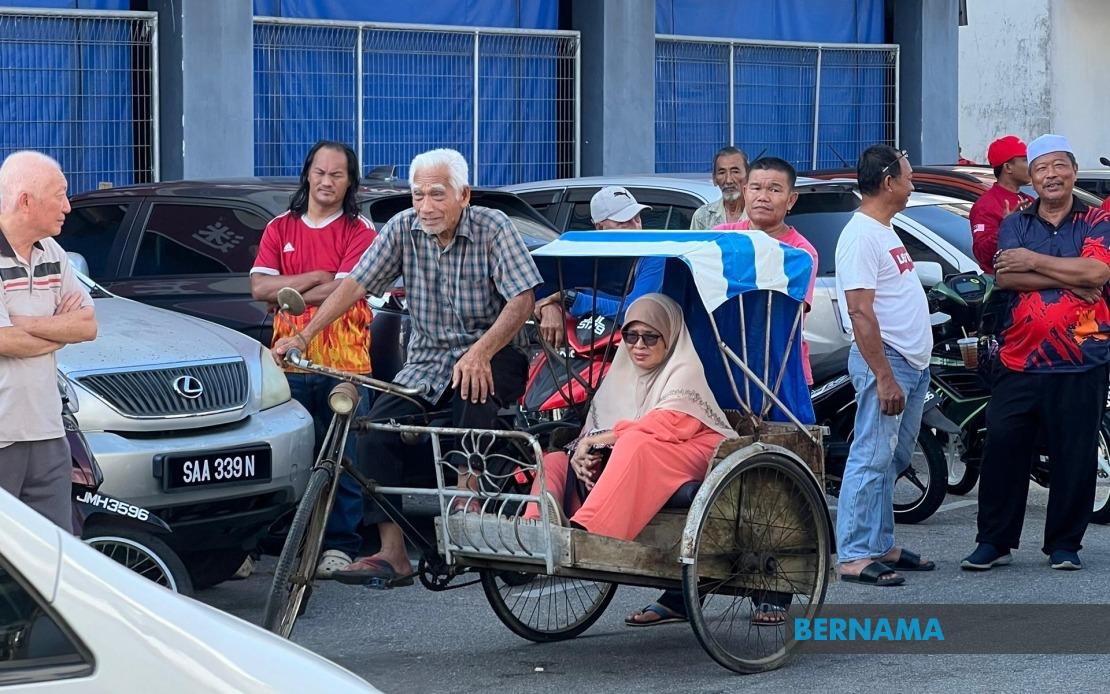
Abdul Razak Pelangga, an 86-year-old imam, pedalled his trishaw nearly a kilometre through scorching heat on July 5 to fulfil a simple but heartfelt wish—enabling his wife to see Prime Minister Datuk Seri Anwar Ibrahim in person during a campaign breakfast stop in Batu Pahat. The determined Johorean cycled from his home in Kampung Parit Bugis to Kedai Kopi Hailam Sri Medan, where Anwar was conducting a meet-and-greet session as part of the PMX Meet-and-Greet Programme for the Senggarang state constituency ahead of Johor's state election.
Razak's choice of transport reflected both practical wisdom and emotional attachment to his community. Although he possessed alternatives—a car or motorcycle—he deliberately selected the humble trishaw to sidestep the parking headaches that inevitably plague such high-profile visits. For an 87-year-old man, this decision underscored not merely convenience but also a deeper connection to his neighbourhood and its traditional modes of transport. The gesture illustrated how ordinary Malaysians sometimes navigate the logistical challenges of political engagement through creative problem-solving rooted in local knowledge.
The imam's motivation stemmed from a personal encounter with Anwar that predated his ascent to the highest office. Years earlier, before assuming the premiership, Anwar had visited Masjid Raudhatul Jannah Parit Bugis to perform congregational prayers. Razak, leading that prayer service, remembered the interaction vividly—a friendly exchange, handshakes, and warm greetings that left an enduring impression. When news broke that the Prime Minister would be stopping in the small town, Razak seized the opportunity to share that cherished memory with his wife, Jamilah Samsudin, 64, whom he had recounted the story to many times over the years.
The couple's pilgrimage to the coffee shop reflects a broader pattern of civic enthusiasm among older voters in Malaysia. For many in Razak's generation, direct contact with national leaders carries symbolic weight beyond mere spectacle. Television broadcasts and news coverage maintain distance; proximity, even observing from a crowd, transforms an abstract political figure into a tangible presence. Though the throng of attendees prevented a face-to-face conversation, the experience of witnessing Anwar from a near vantage point satisfied the couple's primary objective. Razak later recounted to media that both he and his wife felt genuinely elated by the outing, notwithstanding the physical exertion and climatic hardship.
Anwar spent approximately 50 minutes at the Senggarang coffee shop, engaging with local residents and absorbing community sentiment during what amounted to a crucial phase of the state electoral campaign. The presence of Pakatan Harapan Communications Director Datuk Fahmi Fadzil, who simultaneously holds the portfolio of Communications Minister, underscored the formal nature of the engagement. Such breakfast sessions, seemingly informal and intimate in scale, constitute a deliberate strategy to humanise political leadership and reinforce grassroots connections—particularly vital in smaller towns where media saturation differs markedly from urban centres.
Razak's personal narrative acquired additional poignancy through the timing of the election itself. The polling date, set for July 11, coincided precisely with his 87th birthday. This numerical alignment proved not merely coincidental in his mind but rather a meaningful convergence of civic participation and personal milestone. He expressed genuine enthusiasm about exercising his franchise on such a date, describing it as somehow more significant than the numerous times he had voted previously. For a man of his age and disposition, fulfilling electoral responsibility on one's birthday carries a ceremonial quality—a way of marking life's passage through engagement with democratic institutions.
The Johor state election represented a consequential political moment for the coalition government. As the 16th such election in the state, it offered voters an opportunity to assess Anwar's administration and reinforce or modify their mandate for Pakatan Harapan's leadership. Scheduled polling on July 11 followed early voting windows on July 7, allowing flexibility for citizens unable to attend on the primary election day. Smaller constituencies like Senggarang, though less prominent in national media coverage than urban battlegrounds, hold strategic importance in aggregate seat calculations and often demonstrate distinctive voting patterns reflecting local concerns and personalities.
Abdul Razak's trishaw journey encapsulates several dimensions of Malaysian political culture often overlooked in commentary focused on strategy, polling, and national narratives. Older voters, particularly those embedded in religious leadership roles like imam positions, frequently demonstrate strong civic commitment rooted in long personal histories with Malaysian politics. The willingness to endure physical discomfort—pedalling through heat, navigating crowds—for a momentary glimpse of national leadership suggests that political participation extends beyond rational cost-benefit analysis. Instead, it encompasses emotional investment, historical memory, and the human desire to maintain connection across generational and institutional hierarchies.
The imam's story also reflects continuities in Malaysian society despite rapid modernisation. Trishaws, increasingly rare in cities, remain functional transport in smaller towns, operated by individuals maintaining traditional livelihoods. Razak's choice to utilise this vehicle, rather than dismissing it as outmoded, demonstrates pragmatic adaptation. Similarly, his willingness to share his earlier mosque encounter with Anwar suggests that informal political relationships, built through religious institutions and community structures, retain meaningful relevance even as formal electoral campaigns intensify. These personal threads weave through Malaysia's political fabric often invisibly, yet substantially influence how citizens engage with democratic processes.
Beyond the individual narrative, Razak's participation also highlights the significance of state elections in sustaining localized political engagement. While federal elections dominate national discourse, state-level contests activate community-based mobilisation and enable candidates to conduct retail politics in manner infeasible during national campaigns. A Prime Minister stopping for breakfast in a small Johor town, mingling with residents, and drawing enthusiasts like Razak represents political theatre crafted precisely for such moments. The symbolism works bidirectionally—leaders demonstrate accessibility, while constituents affirm their stake in governance through attendance and participation.
The election cycle, commencing with early voting on July 7 and culminating on July 11, provided a compressed timeline for campaigning and community engagement. For constituencies like Senggarang, such brevity intensified the concentration of political activity and elevated the impact of each public appearance. Anwar's breakfast visit, captured in media reports and experienced directly by residents like Razak, functioned simultaneously as campaign event, photo opportunity, and authentic human encounter—the latter elevating its significance beyond pure electoral calculation.
As Razak prepared to cast his vote on his birthday, he embodied a particular vision of democratic citizenship—one grounded in personal relationships, historical continuity, and genuine commitment despite advancing age. His trishaw journey, unremarkable to most observers, represented a deliberate affirmation that Malaysian democracy remains, at its foundation, a participation of individuals making conscious choices to engage with their political system. Whether his vote would prove consequential in the broader electoral outcome remained uncertain, but his presence at the polls would constitute a visible assertion of belonging within Malaysia's democratic community—an assertion that, for an 87-year-old man, carried both practical and spiritual significance.

