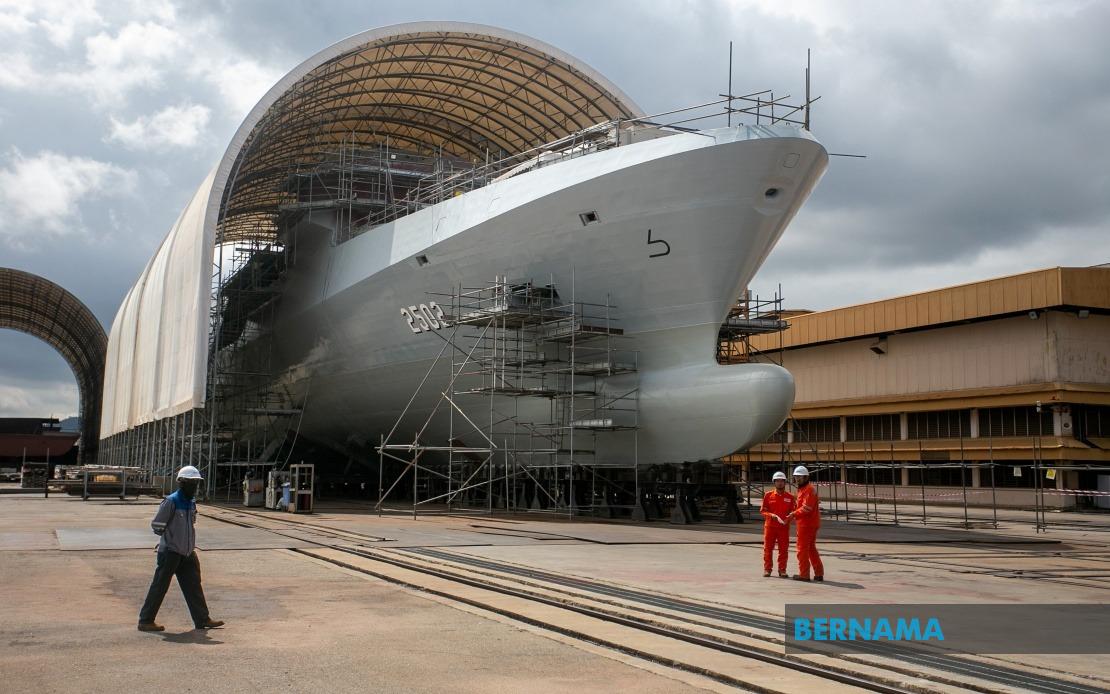
The Ministry of Defence has pushed back against parliamentary criticism over the RM571.9 million payment made to Norway's defence contractor for the Naval Strike Missile system destined for Malaysia's Littoral Combat Ship fleet, asserting that disbursement occurred only after tangible completion of manufacturing and testing obligations. In a written response tabled in Parliament, MINDEF clarified that the Norwegian supplier had fulfilled all manufacturing requirements and successfully completed the Royal Malaysian Navy's rigorous testing protocol before funds changed hands, fundamentally distinguishing the transaction from an advance payment made without corresponding deliverables or verification.
The controversy centres on allegations that Malaysia released the full contracted amount prematurely and that the procurement agreement lacked adequate protective clauses for the government's interests. Parliamentarian Hassan Abdul Karim from Pasir Gudang had questioned whether the payment structure exposed Malaysia to undue financial risk, particularly given the subsequent complications arising from Norway's revocation of the export licence. MINDEF's response directly addresses these concerns by emphasising that contractual language explicitly permits government action against non-performance or breach of obligations, contradicting claims that the agreement left Malaysia defenceless.
The broader context of this dispute involves the troubled history of the LCS programme itself, which has faced multiple delays and cost escalations since its inception. The introduction of the NSM system represented an upgrade to the platform's anti-ship capabilities, and the Norwegian supplier's involvement positioned Malaysia to acquire advanced military technology from a NATO-aligned nation with strong credentials in maritime defence systems. However, the subsequent revocation of Norway's export licence has created an unprecedented complications layer, transforming what appeared to be a straightforward procurement transaction into a complex diplomatic and contractual entanglement.
MINDEF has emphasised that the export licence revocation falls beyond the control of both the Malaysian government and the Norwegian supplier, positioning it as an external force majeure event rather than evidence of poor contract negotiation or supplier default. This characterisation is strategically important because it distinguishes between two categories of contractual risk: those within the parties' direct control and those dependent on third-party governmental decisions. By framing the situation this way, the ministry attempts to shield itself from criticism regarding contract weakness while simultaneously acknowledging that unforeseen circumstances have disrupted the procurement arrangement.
Regarding the path forward, MINDEF has indicated that it is actively invoking available contractual mechanisms to protect Malaysia's financial interests and recover the RM571.9 million alongside any associated damages claims. This suggests Malaysia is pursuing legal remedies through arbitration or international courts rather than accepting the loss as sunk cost. The sophistication of modern defence procurement contracts typically includes dispute resolution clauses specifying jurisdiction and procedure, and Malaysia appears positioned to test whether Norwegian law or international convention frameworks will govern this dispute.
Parliamentarian Mohd Kurniawan Naim Moktar raised concerns about the implications for the Royal Malaysian Navy's operational readiness in the absence of the NSM system. MINDEF's response addressed this dimension by asserting that existing naval assets and weapons systems remain sufficient to maintain Malaysia's maritime defence posture and sovereignty protection in the interim. This reassurance is politically significant given Malaysia's substantial maritime boundary and the importance of credible deterrence in the South China Sea environment, where numerous claimant states and major powers maintain active military presences.
The defence ministry has disclosed that the Royal Malaysian Navy is simultaneously conducting evaluation and assessment of alternative missile systems that could potentially fulfil the NSM role. This parallel procurement process suggests Malaysia is pursuing a contingency strategy rather than banking on resolution of the Norwegian export licence issue. The search for substitutes could involve systems from allied nations or neutral suppliers, introducing another layer of diplomatic complexity given Malaysia's non-aligned foreign policy traditions and the geopolitical sensitivities surrounding defence partnerships in Southeast Asia.
For Malaysian defence analysts and policy observers, the NSM episode illuminates several substantive procurement challenges that extend beyond this single transaction. The vulnerability to third-party export controls demonstrates how defence acquisitions from developed nations carry embedded geopolitical risks that contract language alone cannot fully mitigate. Norway's decision to revoke the export licence likely reflected political and diplomatic considerations rather than technical or quality concerns, highlighting how defence relationships operate within broader international relations contexts.
The financial stakes are substantial in Malaysia's defence budget context. The RM571.9 million represents a significant capital outlay for a naval modernisation programme already constrained by competing budgetary demands. Recovery of these funds through international legal proceedings could take years and may ultimately yield only partial restitution. This protracted timeline creates budgetary uncertainty and potentially delays other planned military capability enhancements that Malaysia's armed forces require to address evolving regional security challenges.
The NSM situation also raises questions about Malaysia's procurement governance and defence industrial policy frameworks. As a maritime nation with substantial exclusive economic zone interests and active fishing and shipping industries dependent on secure sea lanes, Malaysia has legitimate requirements for credible naval deterrence. Yet the structural dependency on imports for advanced weapons systems creates vulnerabilities that procurement contracts can only partially address. Building indigenous or regional defence industrial capacity remains a longer-term strategic objective that this episode may reinvigorate in policy discussions.
MINDEF's parliamentary response carefully navigates between accountability for the procurement decision and the reality that unforeseen external events have disrupted implementation. The ministry's emphasis on contractual compliance and available remedial mechanisms frames the situation as responsive governance within constrained circumstances rather than negligent oversight. Nonetheless, opposition parliamentarians may continue scrutinising whether Malaysia adequately anticipated and provided for export control risks in the initial negotiations, a fair question given the post-Cold War regulatory environment in which Western nations increasingly use export restrictions as policy tools.

