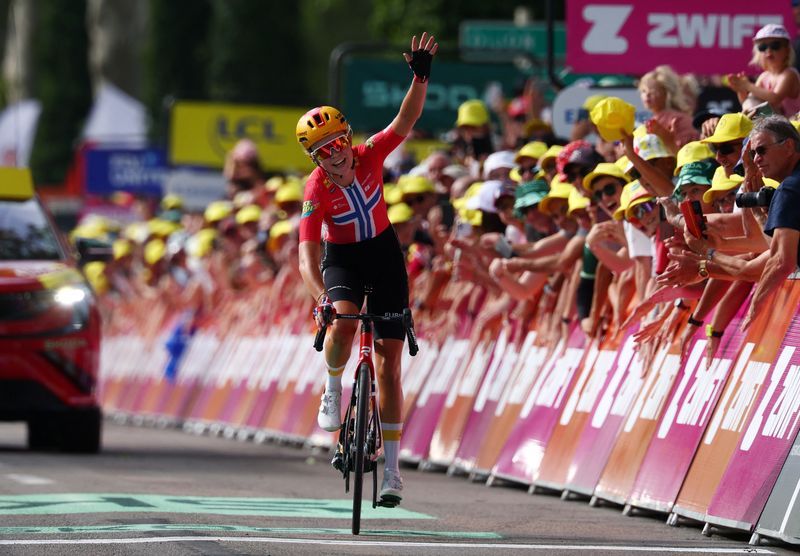
Sigrid Haugset etched her name into cycling history on Monday when the 27-year-old Norwegian crossed the finish line in Poligny to claim a stunning solo victory at the Tour de France Femmes. The triumph marked a watershed moment for Scandinavian cycling, with Haugset becoming the first Norwegian ever to win a stage in this premier women's cycling competition. Beyond the stage victory, she seized the race's coveted yellow jersey, displacing reigning leader Lorena Wiebes of the Netherlands and establishing herself as a serious contender for overall honours.
Haugset's performance on the 156.5-kilometre stage demonstrated a rare combination of tactical awareness and raw physical determination. Riding for Uno-X Mobility, she orchestrated her attack during the demanding climb to Col de la Savine, breaking away from the main bunch when conditions were at their most punishing. Her Belgian pursuer, Lotte Kopecky, proved to be her closest threat, mounting a determined chase that saw her gradually narrow the gap as the race headed toward its conclusion. Yet despite the mounting pressure and the creeping exhaustion that threatened to overwhelm her in the final kilometres, Haugset summoned reserve strength to extend her advantage, ultimately finishing one minute and 24 seconds clear of her rival.
The significance of Haugset's yellow jersey acquisition extends beyond mere statistics. She now holds an overall lead of two minutes and 22 seconds over Kimberly Le Court of Mauritius, positioning herself as the woman to beat in the coming stages. For a rider from a nation with a modest track record in women's professional cycling, this represents genuine breakthrough territory. Norwegian cycling has produced accomplished riders over the decades, but few have managed to perform at this rarefied level of international competition, making Haugset's achievement all the more remarkable.
In a candid post-race interview, Haugset struggled to fully process what she had accomplished. "I never thought it was possible, it's unreal," she reflected, her voice still carrying the emotional weight of the moment. She also revealed the mental battle that accompanied the physical exertion, noting that she had entertained doubts about whether she could hold off Kopecky's charge. The prospect of defending a second-place finish might have satisfied many riders, but Haugset found additional motivation in the thought of supporters back home. "I thought of everyone cheering from home and I had to give it all," she explained, suggesting that the occasion transcended personal ambition to encompass a broader sense of national pride.
The stage itself proved dramatic and treacherous, introducing genuine climbing to the race for the first time. As the peloton tackled the category-one ascent to Col de la Faucille, several high-profile riders found themselves on the ground following a substantial crash. The incident claimed the reigning world champion Magdeleine Vallieres and Demi Vollering, the former Tour de France winner, among its casualties. However, the severity of the crash did not escalate, with all affected riders remounting relatively quickly. The peloton subsequently remained compact through the remainder of the 11.4-kilometre climb, with no breakaway attempts succeeding in the turbulent conditions.
Haugset's ascent to the lead unfolded gradually rather than explosively. The attack came as the race navigated the subsequent climb to Col de la Savine, where the Norwegian found the perfect opportunity to distance herself from her rivals. Kopecky's response came shortly after the race's midpoint, but by then Haugset had secured sufficient momentum to maintain her advantage as the course traversed the border into France. The pre-stage leader Wiebes found herself in considerable difficulty, trailing Haugset by approximately 13 minutes as the race entered its final 20 kilometres, while her chief competitors for overall victory, Le Court and Vollering, sat comfortably within the main peloton, more than two minutes adrift of the leading pair.
The final kilometres developed into a fascinating contest between Haugset's fading reserves and Kopecky's relentless pursuit. With roughly ten kilometres remaining, the Belgian had clawed back the deficit to just ten seconds, suggesting a possible late reversal of fortune. Yet Haugset's response proved decisive. Drawing on reserves she may not have known she possessed, the Norwegian opened up fresh daylight between herself and Kopecky, establishing a gap of nearly a minute with just three kilometres to run. This proved sufficient, and despite Kopecky's continued efforts, she could not bridge the distance before the finish.
Rather than celebrate in the conventional fashion, Haugset crossed the line with arms still planted on the handlebars, a physical manifestation of just how thoroughly the effort had extracted every ounce of her energy. Asked later about the uncharacteristic lack of celebration, she offered a rueful smile and explained that her body simply would not cooperate. "I know my boyfriend will be so angry at me for not celebrating, but I could not even lift my arms off the bike," she said, capturing the surreal exhaustion that accompanies the absolute limits of human endurance.
For Southeast Asian cycling enthusiasts and sports observers more broadly, Haugset's victory offers a reminder of how major international cycling events continue to showcase emerging talent from unexpected quarters. While the Tour de France Femmes has long been dominated by traditional cycling powerhouses in Western Europe, the increasing professionalization and global reach of women's cycling means that riders from smaller nations can now genuinely compete for victories at the sport's highest level. The race now moves into its second week with Haugset in the position of authority, holding the jersey that every other competitor aims to capture. The remaining stages will reveal whether her breakthrough represents a sustainable competitive advantage or a momentary flash of brilliance.

