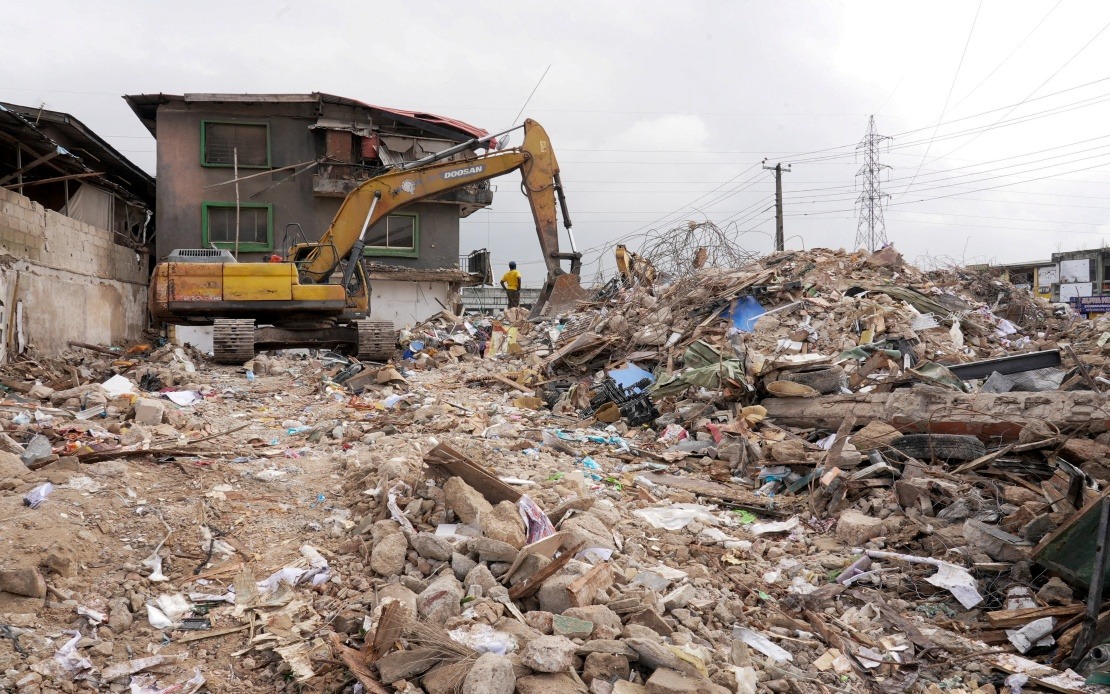
A three-storey shopping complex in Alakija, a satellite township along Lagos's busy Lagos-Badagry Expressway, collapsed on Thursday morning, claiming nine lives and leaving 27 others injured. The structure gave way as merchants and customers began their trading activities, trapping occupants beneath tonnes of concrete and metal. Emergency responders concluded rescue operations early Friday after exhaustive excavation efforts, according to officials from the Lagos State Emergency Management Agency.
The catastrophic failure triggered a rapid mobilization of rescue personnel across multiple agencies, who worked methodically through Thursday night and into Friday to locate survivors buried in the debris field. Olufemi Oke-Osanyintolu, permanent secretary of the Lagos State Emergency Management Agency, confirmed that rescue teams operated continuously throughout the ordeal, employing specialized equipment and manual labour to free trapped individuals. The coordination demonstrated the scale of the emergency, with responders from various government departments and private sector partners combining resources.
Among those brought to safety were shopkeepers conducting regular commerce, their customers, and neighbouring residents who found themselves suddenly engulfed by collapsing masonry. The injured sustained injuries ranging from minor lacerations to severe trauma, with all requiring hospitalization for comprehensive medical assessment and treatment. Beyond the commercial occupants, the broader community in Alakija experienced disruption, as rescue operations commandeered local access routes and diverted resources to the disaster site.
Participation from China Civil Engineering Construction Corporation, a firm engaged in a railway development project operating in the vicinity, augmented the rescue efforts with additional heavy machinery and trained personnel. This inter-organizational cooperation proved critical in accelerating the extraction of trapped individuals, illustrating how infrastructure projects can mobilize resources during emergencies. The involvement of the private sector underscores the reality that disaster response in Lagos often depends on collaboration across institutional boundaries.
Investigators have initiated a formal inquiry into the structural failure, though preliminary findings have not yet been disclosed. Authorities indicated that determining the precise cause remains an active process, with forensic engineering assessments ongoing. Lagos State officials have announced that investigations will examine multiple potential contributing factors to establish accountability and prevent recurrence.
For Malaysian readers and Southeast Asian observers, this incident reflects a recurring challenge that extends across developing nations in the region. Building collapses in Nigeria stem from patterns that resonate uncomfortably across the Global South: deteriorating infrastructure, inadequate enforcement of construction standards, corner-cutting by developers prioritizing profit margins, and the prevalence of inferior materials in supply chains. Experts consistently attribute such failures to ageing structures that lack proper maintenance, systematic circumvention of building codes by contractors and developers, and widespread use of materials that do not meet engineering specifications.
The Alakija collapse joins a depressingly long roster of similar incidents across Nigeria, where structural failures kill dozens annually. The frequency suggests systemic rather than isolated failures—that is, problems embedded in how construction is conceived, regulated, and executed rather than anomalous incidents. In Lagos particularly, rapid urbanization without corresponding strengthening of oversight mechanisms creates conditions where buildings rise quickly but without adequate safeguards, and where enforcement remains inconsistent or corrupted.
For Malaysia, which has experienced its own building-related disasters and safety lapses, the Lagos incident offers sobering perspective on the consequences of regulatory complacency. While Malaysia's Construction Industry Development Board and local authorities maintain stricter oversight than exists in many African nations, vigilance remains essential. The proliferation of high-rise residential and commercial development across Malaysian cities, from Kuala Lumpur to Johor Bahru, means that failures in oversight, materials testing, or contractor accountability carry enormous human consequences.
The broader Southeast Asian construction sector, characterized by competition, tight margins, and varying regulatory environments across member nations, faces similar risks. As development accelerates and investment pours into infrastructure—from Singapore to Vietnam to Indonesia—the institutional capacity to police building standards must expand proportionally. Regulatory bodies in the region should regard Nigeria's repeated collapses not as distant African problems but as cautionary tales about what inadequate oversight enables.
The Lagos State government will likely launch reforms following this incident, as it has following previous collapses. Such responses typically include renewed enforcement pledges, threats of prosecution for culpable contractors, and public promises of stricter inspections. The challenge lies in translating these pronouncements into sustained institutional change—ensuring that inspectorates receive adequate funding, that penalties create genuine deterrence, and that political pressure does not compromise investigations or enforcement.
For families of the nine deceased and the 27 injured survivors, investigations into cause offer limited consolation. The tragedy underscores why building safety transcends technical matters of engineering and materials; it reflects broader questions about governance, accountability, and whether development can proceed safely when profit incentives outweigh public protection. In Lagos, as across rapidly urbanizing cities in the developing world, that balance remains precariously tilted toward speed and economics at the expense of structural integrity and human safety.

