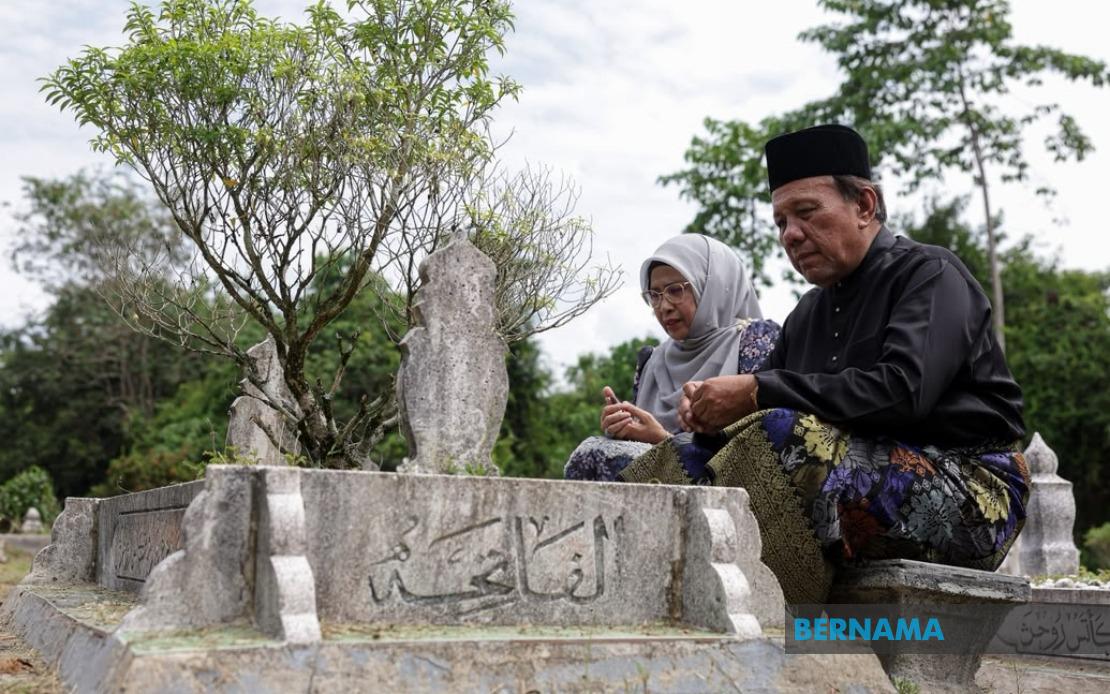
Datuk Ismail Lasim wasted little time honouring his family after stepping into one of Malaysia's most significant state leadership positions. Within hours of taking the oath as Menteri Besar of Negeri Sembilan on August 2, the newly elected political leader made a pilgrimage to Tebing Tinggi Muslim cemetery in Kuala Pilah, accompanied by his wife Datin Noraishah Othman, to pay his respects at the graves of his late parents.
Ismail's decision to visit the cemetery while dressed in traditional Malay formal attire underscored the cultural and personal significance of the moment. The gesture reflected a common practice among Malaysian Muslim leaders to seek spiritual guidance and acknowledge familial bonds during major life transitions. His father, the late Lasim Yaman, passed away on March 5, 2020, at the advanced age of 97, while his mother, the late Bedah Othman, had died several years earlier on September 16, 2014.
The swearing-in ceremony itself took place at Istana Besar Seri Menanti before Tuanku Muhriz Tuanku Munawir, the Yang di-Pertuan Besar of Negeri Sembilan. This formal investiture marked the culmination of electoral processes that had unfolded the previous day across the state's constituencies. Ismail's personal mandate came through his decisive victory in the Juasseh state seat, one of 40 constituencies contested in the election.
The 16th Negeri Sembilan state election delivered a decisive outcome that reshaped the state's political landscape. Barisan Nasional emerged as the dominant force, securing 18 of the 40 available seats. Perikatan Nasional, the opposition coalition, managed to win seven seats, leaving the remaining 15 seats distributed among other parties or independent candidates. These results positioned both major coalitions to collaborate in forming government, together commanding a comfortable two-thirds supermajority.
For Malaysian observers and political analysts, the configuration of Negeri Sembilan's new government carries implications beyond the state level. The state has historically served as a bellwether for broader peninsular Malaysian political trends, and the strength of Barisan Nasional's performance here suggests continued resilience for the federal coalition that governs Malaysia. The two-thirds majority achieved through cooperation between Barisan Nasional and Perikatan Nasional provides the state administration with substantial legislative flexibility, enabling significant policy initiatives without vulnerability to defections or procedural obstruction.
Ismail Lasim's elevation to the Menteri Besar position represents another transition within Negeri Sembilan's political hierarchy. As the chief executive of the state, he now bears responsibility for administrative functions, development planning, and representation of state interests in federal forums. The role demands navigation of complex federal-state relations, especially regarding resource allocation, infrastructure projects, and coordination on matters affecting the state's 1.1 million residents.
The state's political configuration, with Barisan Nasional and Perikatan Nasional governing jointly, mirrors arrangements in several other Malaysian states and reflects broader shifts in the country's coalition politics. These arrangements sometimes generate tensions as coalition partners pursue competing interests, yet they also demonstrate the flexibility and pragmatism embedded within Malaysian democratic governance structures. How Negeri Sembilan's government manages this partnership will offer lessons relevant to policymakers in other states navigating similar configurations.
Negeri Sembilan's economy depends significantly on manufacturing, particularly electronics and automotive components, alongside palm oil production and tourism. The new state administration's capacity to attract investment, maintain infrastructure competitiveness, and manage environmental concerns will shape the state's economic trajectory over the coming years. These concerns take on heightened importance given competition from neighbouring states and global economic pressures on Malaysia's traditional industries.
The personal moment captured in Ismail's cemetery visit, while perhaps appearing routine to casual observers, carries weight within Malaysian cultural and political contexts. The practice of paying respects at parents' graves before assuming major office reflects values of filial piety deeply embedded in Malay-Muslim tradition. For political figures in Malaysia, such gestures often resonate with constituents and contribute to perceptions of authenticity and grounding in cultural values, qualities that can enhance political legitimacy and public confidence.
As Negeri Sembilan's new Menteri Besar settles into his duties, the state faces various challenges and opportunities typical of Malaysian states in the 2020s: managing post-pandemic economic recovery, addressing skills mismatches in the labour market, improving educational outcomes, and balancing development with environmental sustainability. Ismail's experience and political approach to these issues will become clearer as his administration announces policy priorities and implements initiatives during his tenure.
The formation of Negeri Sembilan's government following the August 1 election represents the continuation of Malaysia's democratic processes at the state level. With its clear electoral mandate and supermajority support, the new administration begins its work with substantial political capital, though the management of coalition partnerships and delivery on voter expectations will ultimately determine public satisfaction and political sustainability.

