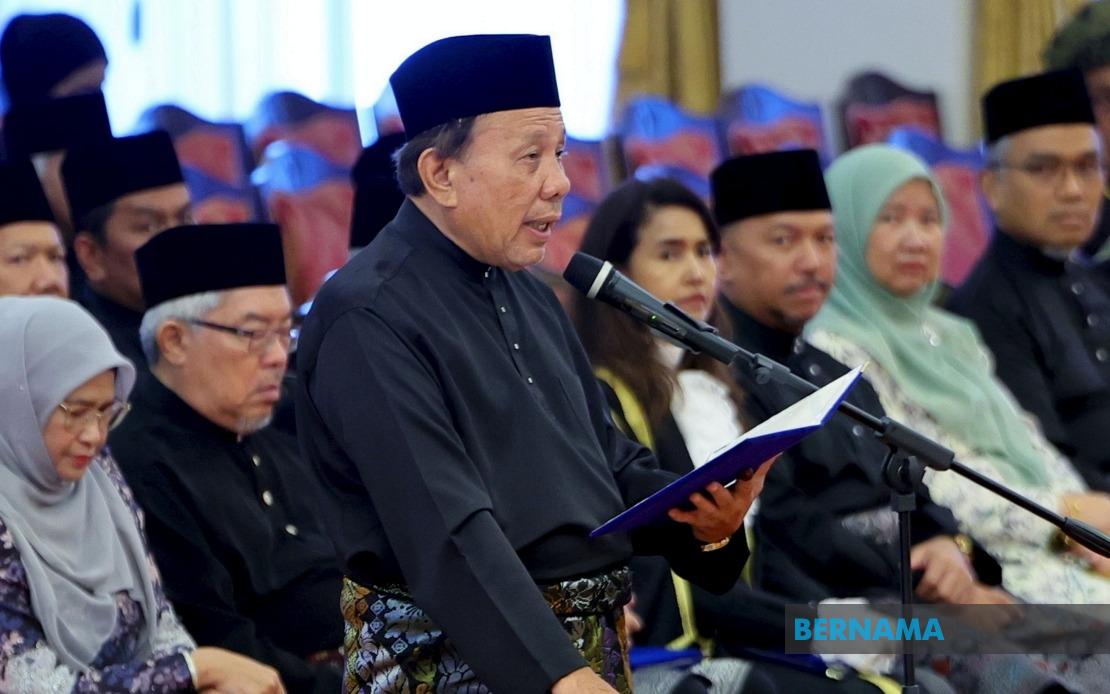
Datuk Ismail Lasim has taken office as Negeri Sembilan's new Menteri Besar following the 16th State Election, committing himself to an administration rooted in fairness, transparency and effectiveness. Speaking during his swearing-in ceremony at Istana Besar Seri Menanti before Yang Dipertuan Besar Tuanku Muhriz Tuanku Munawir, Ismail acknowledged the substantial responsibility accompanying his electoral mandate and pledged to honour the public confidence invested in his leadership.
The incoming Menteri Besar framed his appointment not merely as an honour but as a solemn obligation to demonstrate that a government holding the people's mandate must labour diligently, remain receptive to community concerns, and execute its duties with equity and openness. His remarks underscore a commitment to collaborative governance with state leadership, emphasizing a government model centred on listening to constituents, delivering services effectively, and advancing both collective prosperity and individual welfare across Negeri Sembilan.
Ismail's inaugural address placed particular emphasis on constitutional deference and institutional respect. He committed to preserving the sovereignty and dignity of the Yang Dipertuan Besar, defending both the Federal Constitution and Negeri Sembilan's state constitution, and heeding the counsel, directives and wisdom of the royal institution in conducting state affairs. This framing aligns with Malaysia's constitutional monarchy framework, where executive authority operates within carefully defined parameters of royal guidance and parliamentary principle.
The new administrator demonstrated acute awareness of Negeri Sembilan's distinctive cultural and legal heritage, specifically referencing Adat Perpatih—the state's customary law system. Built upon foundations of consensus-building, equitable treatment, social cohesion and sagacity, this traditional framework has shaped governance structures across the state for generations. Ismail committed to preserving these inherited values and transmitting them to subsequent generations, suggesting policy formulation grounded in the state's particular historical and cultural context rather than uniform national approaches.
Economic revitalization emerged as a central pillar of the new administration's agenda. Ismail outlined intentions to fortify the state's productive capacity through strategic investment attraction, employment creation and enhanced living standards for residents. Complementing these economic objectives, he pledged sustained investment in foundational social sectors including education, health services, residential development, agricultural productivity and community welfare programmes, reflecting an understanding that broad-based advancement requires simultaneous attention to market dynamics and human development.
A noteworthy aspect of Ismail's vision involves reconceptualizing progress beyond conventional metrics. Rather than measuring advancement principally through infrastructure deployment and GDP expansion, he advocated for evaluating success by examining population welfare, inter-community harmony, institutional robustness and public confidence in governmental legitimacy. This perspective gains particular relevance in Southeast Asian contexts where rapid industrialization has sometimes generated uneven outcomes, leaving rural and marginalised populations disconnected from development narratives.
The Menteri Besar stressed institutional fortitude and professional competence as prerequisites for operational success. He pledged to cultivate values of confidence-building, ethical conduct, organisational efficiency and procedural openness throughout state administration. Simultaneously, he committed to ensuring that Negeri Sembilan's civil service personnel maintain elevated standards of dedication, technical proficiency and conscientious commitment to public interest—elements foundational to effective governance delivery across Malaysian jurisdictions.
Ismail articulated commitment to inclusive and equilibrated development trajectories, explicitly acknowledging that advancement must reach all demographic groups across both metropolitan and provincial territories. This phraseology addresses longstanding regional disparities within Malaysian states, where urban agglomerations typically capture disproportionate shares of investment and infrastructure resources. The emphasis on comprehensive inclusion signals potential reorientation toward more balanced territorial development.
The incoming administrator highlighted the necessity of institutional cohesion and receptive leadership. He pledged to facilitate dialogue across diverse constituencies, create space for thoughtful critique and opposing perspectives, and pursue decisions prioritizing long-range state interests and intergenerational welfare. This deliberative governance model contrasts with increasingly polarized political environments across the region, positioning Negeri Sembilan potentially as a laboratory for consensual decision-making methodologies.
Ismail committed to cultivating robust interconnections among the royal establishment, state governmental apparatus, federal authorities, professional civil servants, commercial enterprises, community organisers and ordinary residents. This integrative perspective recognises that sustainable governance requires functional relationships across public and private institutions and between state and non-state actors—a framework increasingly acknowledged across Southeast Asian policy discussions.
Acknowledging his predecessor Datuk Seri Aminuddin Harun's contributions, Ismail positioned the transition as continuity rather than rupture. He suggested that institutional frameworks, developmental achievements and accumulated expertise established during the prior administration would serve as foundations upon which his government would construct enhanced progress and collective affluence. This narrative of institutional continuity reflects mature governance transitions, particularly significant in Malaysian state-level politics where factional contests frequently dominate transitions.
The swearing-in ceremony itself, conducted within traditional constitutional protocols before the Yang Dipertuan Besar, reaffirmed Negeri Sembilan's commitment to institutional procedure and hierarchical respect. Such ceremonial adherence to constitutional form carries symbolic weight in Malaysian democracy, underscoring that electoral outcomes operate within juridical frameworks transcending individual political actors or factional interests.

