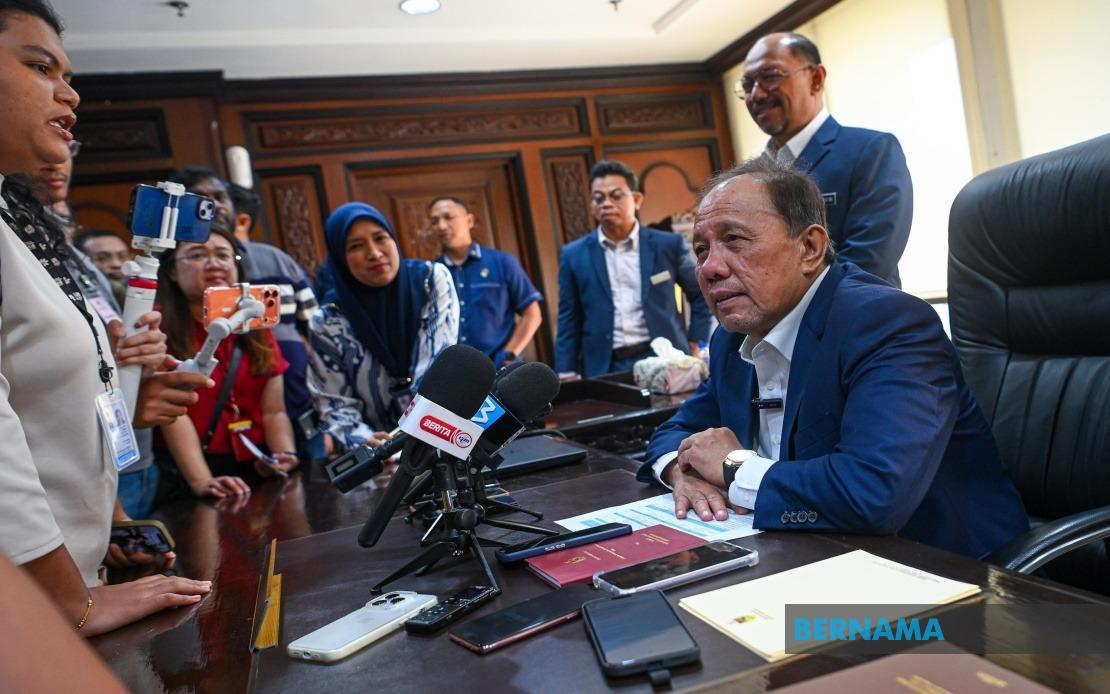
The Negeri Sembilan government is exploring a structural reorganisation of its cabinet by introducing Deputy Executive Council positions for several critical portfolios, according to newly sworn-in Menteri Besar Datuk Ismail Lasim. Speaking at Wisma Negeri in Seremban on his first day in office, Ismail explained that the proposal reflects an innovative approach to strengthening state administration in light of the recent electoral outcome and the coalition's desire to distribute responsibilities more effectively across the government structure.
The creation of these additional positions would serve to address what Ismail characterised as a limitation in the current number of available Exco posts, which cannot accommodate all worthy candidates from the ruling coalition's component parties. By establishing Deputy Exco roles, the government aims to recognise and utilise talented state assemblymen from Barisan Nasional, PAS, and Parti Wawasan Negara without expanding the main cabinet beyond its intended size. This approach represents a middle ground between offering full cabinet positions and sidelining capable legislators from the coalition.
While the proposal has been approved in principle, several details remain unresolved, including the precise number of Deputy Exco appointments that will be made and which specific portfolios will receive this dual-layer arrangement. Ismail noted that the finalisation of Senior Exco positions has also been delayed, though the government possesses the constitutional authority to create such roles. The Menteri Besar's office indicated that the complete cabinet configuration, encompassing both main Exco and Deputy Exco assignments, would be unveiled by the following Friday, with Monday given as an absolute deadline should any procedural delays arise.
The electoral context underpinning these administrative decisions provides important perspective for understanding the government's structural choices. In the recently concluded Negeri Sembilan state election, the combined Barisan Nasional and Perikatan Nasional coalitions secured a commanding two-thirds supermajority with 25 seats, comprising 18 for BN and seven for Perikatan Nasional. The opposition Pakatan Harapan retained 11 seats, leaving the government with substantial legislative muscle but also requiring internal management of multiple coalition partners' interests and expectations regarding cabinet representation.
Ismail, the 67-year-old assemblyman representing Juasseh, formally commenced his duties at the Menteri Besar's office at 9 am on his declaration day, receiving a ceremonial welcome from State Secretary Datuk Mohd Zafir Ibrahim and senior departmental officials. His swearing-in ceremony had taken place two days earlier at Istana Besar Seri Menanti before the Yang Dipertuan Besar Negeri Sembilan, Tuanku Muhriz Tuanku Munawir, marking the formal transition of state leadership and the commencement of what Ismail framed as a renewed administration focused on operational efficiency and inclusive governance structures.
The decision to create Deputy Exco positions carries broader implications for state governance architecture in Malaysia's federal structure. Southeast Asian observers have noted that Malaysian state governments frequently experiment with administrative innovations to balance coalition management with effective service delivery, and Negeri Sembilan's approach may establish a template for other states managing multi-party coalitions. The deputy positions would allow the government to recognise coalition partners' contributions and reward capable legislators without inflating the main cabinet to unwieldy proportions, addressing a recurring tension in coalition politics.
For Malaysian stakeholders invested in state-level governance, the timing of these decisions matters considerably. The immediate post-election period represents a critical window when cabinets are formed and governmental priorities are established. By taking this deliberative approach rather than rushing to announce appointments, Ismail's administration signals an intention toward careful, considered governance rather than reactive political management. However, the extended timeline for announcements also creates uncertainty that component parties and supportive assemblymen must navigate during crucial early weeks when momentum and initial policy direction are established.
The inclusion of PAS and Parti Wawasan Negara in the appointment pool reflects the complex coalition arithmetic that characterised the recent Negeri Sembilan election. These partners, while smaller numerically than Barisan Nasional, have bargaining power and expectations regarding portfolio allocation and administrative recognition. The deputy positions represent one mechanism for acknowledging their contributions while maintaining BN's numerical dominance and policy influence over major portfolio assignments, a delicate balancing act that Ismail's administration must execute successfully to maintain coalition cohesion throughout its five-year term.
For Malaysian readers and regional observers, the evolution of Negeri Sembilan's administrative structure under Ismail's leadership offers a case study in how state governments adapt their institutional frameworks to contemporary political realities. The shift toward deputy positions suggests recognition that traditional cabinet structures may be insufficiently flexible to accommodate the demands of modern coalition governance, where multiple parties require recognition and opportunities for their members while maintaining functional decision-making capacity. As other Malaysian states monitor Negeri Sembilan's experiment, the success or challenges of this approach may influence how governments elsewhere structure their administrations during future coalition negotiations.

