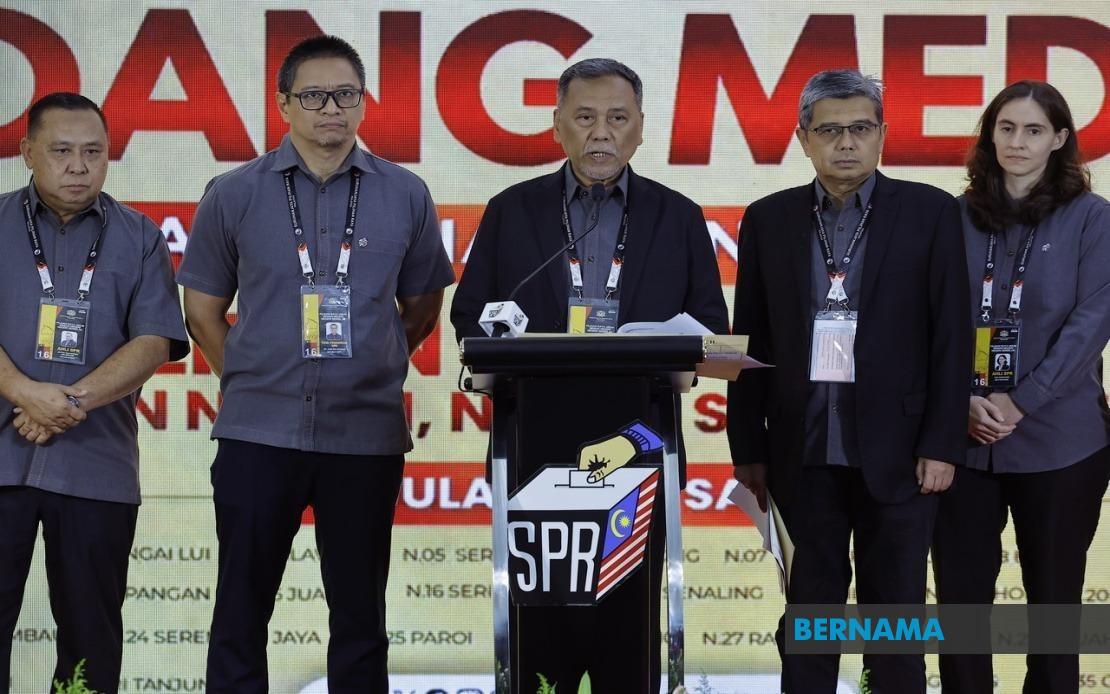
The Negeri Sembilan state election is shaping up to be a fragmented contest, with the Election Commission confirming on July 18 that 103 candidates have met eligibility requirements to compete across the state's 36 legislative seats. The approval comes after nomination centres across eight locations processed submissions until 10 am that morning, with EC chairman Datuk Seri Ramlan Harun overseeing the verification process that will determine the shape of polling day on August 1.
The distribution of candidates reveals a clear hierarchy among Malaysia's political coalitions, with Pakatan Harapan establishing a commanding presence by fielding the maximum possible 36 candidates—one for every available seat. This comprehensive coverage contrasts sharply with Barisan Nasional's more selective approach, which has put forward 25 candidates, effectively ceding eleven seats to either opposition parties or independent contenders. Bersatu's decision to contest 24 seats signals the party's determination to maintain relevance in state politics despite recent national difficulties, while Perikatan Nasional, the coalition Bersatu anchors, has limited itself to eleven candidates, suggesting internal coordination on seat allocation.
What distinguishes this election from many others is the prevalence of multi-cornered contests, which complicate vote calculus and can produce unexpected outcomes. The EC confirmed that 21 of the 36 seats will feature three-way battles, meaning more than half the state legislature will be decided in fragmented races where vote-splitting becomes a critical strategic consideration. Beyond these three-cornered fights, eleven seats will see straight contests between two candidates, while four seats—Nilai, Sri Tanjung, Jeram Padang, and Rahang—will feature even more complex scenarios with four or five candidates competing. This fractured landscape benefits neither the ruling coalition nor the opposition uniformly; instead, it creates pockets of vulnerability where traditional voting patterns may collapse under pressure from unexpected challengers.
Smaller political entities have also seized the opportunity to contest, adding further complexity to the electoral mathematics. Barisan Jemaah Islamiah Se-Malaysia, the Malaysian Orang Asli Party, and the Socialist Party of Malaysia each fielded single candidates, presumably targeting specific constituencies where they believe they have support or wish to make political statements. Four independent candidates rounded out the field, reflecting the diverse ideological landscape within Malaysian politics and the willingness of individuals to contest outside formal party structures. These minor players, while unlikely to determine overall outcomes, can influence results in closely-contested seats by fragmenting the vote.
The demographic profile of the candidate pool offers insights into how Malaysia's political parties approach representation. The 103 candidates include 94 men and nine women, a ratio that continues the persistent underrepresentation of female candidates in Malaysian electoral contests despite growing calls for greater gender balance. The age range spans from a 23-year-old Bersatu contender in Sri Tanjung to a 70-year-old Pakatan Harapan candidate in Gemencheh, indicating that while some parties are attempting to inject youth into their lineups, experience remains valued across the political spectrum. The concentration of youth candidacy in Bersatu's ranks may reflect the party's positioning as a comparative newcomer seeking to differentiate itself, though the party structure itself skews toward established politicians.
The electoral process unfolds against the backdrop of a state assembly that was dissolved on June 5, creating a window for political manoeuvring and campaign activity. The EC has scheduled early voting for July 28, allowing military personnel, their spouses, and police officers to cast ballots before the general election. This advance voting mechanism recognises the logistical challenges these uniformed groups face during standard polling days and represents an attempt to boost participation among these constituencies, which collectively number over 22,000 of the approximately 889,490 eligible voters across Negeri Sembilan.
The overall electorate presents a substantial challenge for all contesting parties in terms of campaign reach and resource allocation. The 889,490 voters comprise 867,151 ordinary voters who will participate on August 1 itself, supplemented by the military and police contingents accessing early voting. For regional context, Negeri Sembilan remains a compact and manageable electoral theatre compared to larger states like Selangor or Johor, yet it remains significant enough that results will carry implications for national political trajectory. A Pakatan Harapan victory would further consolidate the coalition's hold on peninsular state governments, while a Barisan Nasional resurgence would signal that the traditional ruling coalition maintains viability despite national setbacks.
The three-cornered contest dynamic deserves deeper analysis for Malaysian political observers, as it represents a departure from the binary contests that have characterised much of Malaysian electoral history. When three parties genuinely compete for a seat, the mathematics favour fractured mandates and potentially volatile representational outcomes. In seats where Pakatan Harapan, Barisan Nasional, and Bersatu all field candidates, the vote distribution becomes critically dependent on which coalition attracts the centre of the political spectrum. Bersatu's positioning as a Malay-Muslim-centric party could either siphon Barisan Nasional votes or absorb PAS voters in Perikatan Nasional-aligned constituencies, creating unpredictable results.
From a Southeast Asian perspective, the Negeri Sembilan election exemplifies the increasing complexity of Malaysian electoral politics, where multiparty competition has replaced the relatively straightforward two-bloc systems of earlier decades. The proliferation of smaller parties and independent candidates, while democratically healthy in principle, creates tactical challenges for voters attempting to express coherent preferences and for parties attempting to build majorities. The Election Commission's management of this expanded field demonstrates institutional capacity, yet the fractured results may produce legislatures that require more complex coalition-building among elected representatives.
The stakes for Negeri Sembilan's governance extend beyond immediate political theatre, as the state serves as an economic and administrative hub with connections to the Klang Valley and broader Selangor region. A hung assembly or razor-thin majority would complicate policy implementation and economic planning, potentially affecting investor confidence in the state's stability. Conversely, a decisive victory by any coalition would provide a clear mandate for developmental initiatives and allow longer-term strategic planning. The August 1 polling day will determine not merely which party controls the state government, but whether that government enters office with sufficient parliamentary support to govern effectively.

