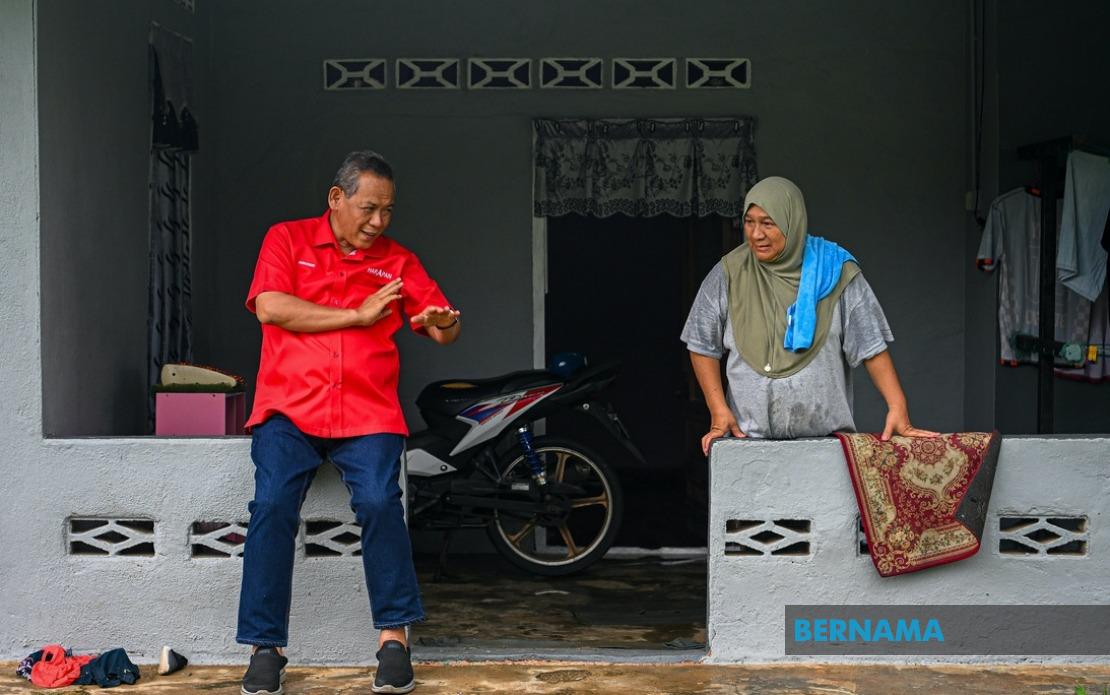
Pakatan Harapan's strategy for the Negeri Sembilan state election centres on positioning Menteri Besar Datuk Seri Aminuddin Harun as a symbol of transparent governance and effective public administration. As the coalition prepares voters to head to the polls on August 1, party leadership is emphasising that nearly two terms under Aminuddin's stewardship have been marked by an absence of major controversies and a demonstrated commitment to ethical conduct in state affairs—a notable contrast to the troubled administrations that preceded the coalition's rise to power in 2018.
Datak Seri Amirudin Shari, who serves as both the PH election director and Selangor Menteri Besar, articulated this core message during early campaigning. Speaking to journalists in Seremban, Amirudin stressed that feedback from grassroots operatives indicated strong support for Aminuddin's brand of service-focused leadership. The emphasis on integrity and accountability, he suggested, had struck a chord with ordinary voters who were increasingly weary of political scandals and administrative mismanagement. This messaging reflects a deliberate attempt to differentiate PH from opposition parties while simultaneously reminding voters of the coalition's broader reform agenda at the federal level.
Amirudin noted that despite initial observations suggesting lukewarm public enthusiasm—evident in smaller turnouts at campaign rallies—the data collected by party workers on the ground painted an encouraging picture. Voters encountered during door-to-door canvassing and community engagements expressed no significant grievances with Aminuddin's administration. The absence of corruption allegations, he emphasized, stood in marked contrast to the baggage carried by other political contenders. This granular understanding of voter sentiment, derived from networks of party volunteers rather than large public gatherings, informed PH's confidence that victory was within reach.
The coalition's strategic positioning rests heavily on Aminuddin's dual credentials as menteri besar and Member of Parliament for Port Dickson. His credibility extends beyond state-level governance to encompass a recognized presence in federal politics. This visibility has allowed PH to build a campaign narrative that connects Aminuddin's local effectiveness with the broader reformist agenda championed by Prime Minister Datuk Seri Anwar Ibrahim at the national level. Amirudin indicated that Anwar's involvement in the campaign would further amplify this message, drawing on the Prime Minister's popularity and the tangible progress achieved under his administration.
Experience from the Johor state election provided a useful template. Amirudin recalled that public confidence in Anwar's leadership had demonstrably boosted support for PH candidates in that contest. A similar dynamic, the coalition hopes, will manifest in Negeri Sembilan, where the alignment between federal and state governance priorities could persuade voters that continuity under PH represents the safest path forward. This multi-level political strategy seeks to create a coherent narrative: that voting for Aminuddin and his party ensures not only competent local administration but also harmonious coordination with the federal government.
PH's organisational capacity constitutes a second pillar of its electoral strategy. Amirudin highlighted the coalition's well-developed grassroots machinery as a decisive advantage. In Malaysian state elections, ground-level mobilisation—encompassing volunteer networks, community outreach programmes, and voter registration drives—often determines outcomes as much as headline policy platforms do. A robustly organised party structure allows for rapid response to emerging campaign issues, efficient targeting of swing voters, and effective turnout operations on polling day. PH's institutional depth, accumulated during earlier electoral contests, positions it to execute such logistical challenges more effectively than some rivals.
The manifesto unveiled at the campaign's outset was designed to blend continuity with progressive ambition. Rather than presenting a wholesale departure from existing policies, PH anchored its vision in demonstrated achievements while proposing new initiatives intended to strengthen the state's economy and improve living standards. This balanced approach appealed to constituencies with different preferences: those satisfied with the status quo could view the manifesto as a pledge of stability, whilst those seeking change found promises of fresh momentum and expanded opportunities. The manifesto thus functioned as a political document attempting to unite a coalition's diverse supporters behind a single banner.
The electoral landscape in Negeri Sembilan reflects a three-way contest with distinct implications for regional politics. In the 2023 state election, PH secured 17 seats, Barisan Nasional claimed 14, and Perikatan Nasional obtained five—a distribution that left PH with a comfortable but not overwhelming majority. This outcome underscored that opposition parties retained substantial support and that complacency could prove costly. A total of 889,490 registered voters are eligible to participate, a figure encompassing 867,151 ordinary voters alongside 16,884 military and police personnel voting early on July 28. These numbers suggest a reasonably engaged electorate, though voter turnout rates would ultimately determine whether PH's organisational advantages translated into electoral dividends.
The timing of the election adds another layer of complexity. The state legislative assembly was dissolved on June 5, setting early voting for July 28 and main polling for August 1. This schedule placed the election campaign during a period of heightened political activity at the federal level, allowing Anwar and other national figures to maintain elevated public profiles that could benefit PH. Simultaneously, the compressed campaign period demanded that parties execute their ground operations with precision, rewarding those with superior preparation and volunteer networks.
For Malaysian observers tracking the trajectory of post-2018 reform politics, the Negeri Sembilan contest carries significance beyond state-level governance. A decisive PH victory would reinforce the narrative that voters reward clean, competent administration and that fatigue with corruption allegations remains a dominant electoral concern. Conversely, substantial gains by opposition parties would suggest either that voter appetite for reform had cooled or that PH's messaging had failed to resonate in constituencies where economic anxiety or communal divisions overshadowed national reform narratives. The result would offer important clues about the political mood heading toward the next federal election cycle.
Amirudin's campaign messaging ultimately rested on a straightforward proposition: that governance quality matters, that voters notice when administrations avoid scandal, and that rewarding competence with a fresh mandate represents the rational course. Whether this appeal would prove sufficient against opposition campaigns emphasising alternative visions of development, or populist promises of immediate material relief, would depend on factors ranging from voter perception of the national economy to the effectiveness of competing campaign strategies. The August 1 polling would provide a definitive answer.

