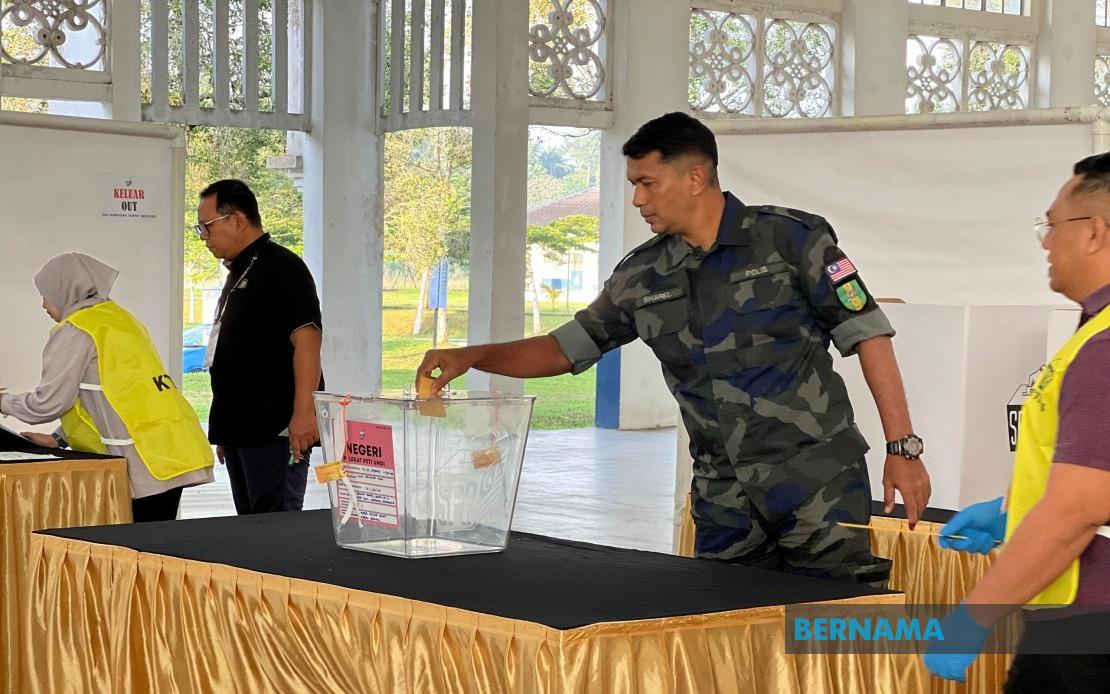
Over 24,000 members of Malaysia's security forces and their dependents exercised their electoral right in advance of the main polling day for Johor's 16th state election. The early voting window, which took place on July 7, allowed 24,751 eligible voters comprising armed forces and law enforcement personnel to cast their ballots at 64 designated polling centres distributed throughout the state. This arrangement reflects a longstanding practice in Malaysian electoral systems that accommodates the operational requirements of essential services, ensuring that security personnel can participate in the democratic process despite potential deployment or duty commitments during the main election day.
The composition of early voters reveals the significant representation of state security agencies in this portion of the electoral roll. The Malaysian Armed Forces contingent totalled 12,041 individuals including both uniformed service members and their spouses, while the Royal Malaysia Police contributed 12,067 in-person votes. An additional 643 police personnel cast their votes by post, demonstrating alternative voting arrangements for those unable to physically attend polling stations. The General Operations Force, which maintains a distinct identity within Malaysia's security apparatus despite coordination with police, also participated through the PDRM framework, reflecting the integrated nature of domestic security operations.
Logistically, the election commission coordinated simultaneous opening of polling centres at 8 am across all 53 police facilities and 11 military installations designated for early voting. The staggered closure system, ranging from noon to 6 pm depending on voter distribution, acknowledges practical realities of electoral administration in constituencies with vastly different registered populations. Tenang Police Station in Tenang constituency managed merely six early voters, permitting an early afternoon closure, whilst Muar District Police Headquarters, Kahang Police Station and Johor Bahru Utara district headquarters maintained operations until the 6 pm deadline to accommodate larger voter concentrations. This flexible approach balances electoral integrity with resource efficiency.
The police force mounted a substantial operational deployment to oversee the early voting process, committing 3,565 personnel across multiple operational categories. This contingent included 647 commissioned and warrant officers directing overall operations, 2,806 enlisted rank-and-file personnel handling ground-level security and administration, and 112 civilian staff providing essential logistical support. Their multifaceted responsibilities extended beyond merely supervising voters; the security framework encompassed physical protection of polling venues, secure transportation of ballot boxes, traffic management to facilitate voter access, proactive crime prevention patrols throughout the state, staffing of operations rooms for real-time coordination, and surveillance of strategically important locations to prevent electoral interference.
The custodial arrangements for early ballots underscore the stringent protocols governing Malaysian elections. All sealed ballot boxes from early voting remained secured at designated police stations pending the conclusion of ordinary polling scheduled for Saturday, July 11. This compartmentalisation prevents premature ballot exposure and maintains the integrity of the electoral count, allowing tallying of all votes simultaneously at close of the main poll rather than creating disparate vote counts that might theoretically influence voter behaviour during ordinary polling. Such procedures reflect international best practices in electoral administration and Malaysian authorities' commitment to transparency and security in the democratic process.
The broader context of the 16th Johor state election illuminates the significance of this early voting phase. A total of 172 candidates had registered to contest the 56 state assembly seats available, offering voters across diverse constituencies a range of political choices. The eligible voting population for the state exceeded 2.7 million registered citizens, representing one of Malaysia's largest electoral cohorts. The main election scheduled for July 11 would determine the composition of Johor's state government and legislative representation for the coming term, making this early voting mechanism an important component of ensuring comprehensive participation despite occupational constraints on security force members.
The early voting arrangement carries particular significance for Malaysian electoral democracy, as it addresses a practical challenge inherent in maintaining essential security services during polling periods. Military and police personnel cannot simply absent themselves from duty stations for electoral participation without compromising the continuous operations necessary for national security and public order. By establishing this advance voting window, electoral authorities acknowledge that democratic participation and security service continuity need not be mutually exclusive; rather, careful administrative planning can accommodate both imperatives. The successful execution of these early voting operations demonstrated the institutional capacity to manage such logistical complexities.
Regional observers monitoring Malaysian electoral processes often note the professionalism with which security-related voting is administered. The Johor early voting exercise exemplified established protocols refined through multiple electoral cycles. The involvement of over 3,500 security personnel in election duties reflects the significant resource commitment required to maintain electoral integrity whilst simultaneously managing the distinctive requirements of early voting for uniformed personnel. This dual focus—ensuring voter access for those with operational constraints whilst maintaining the security environment within which voting occurs—represents a sophisticated balance in democratic administration.
For Johor specifically, this early voting phase represented preliminary engagement with an election carrying substantial implications for state governance and political representation. Johor, as Malaysia's second-largest state by population and a significant economic contributor, commands considerable political importance in national affairs. The state's electoral outcome would influence factional dynamics within the ruling coalition and potentially affect formation of the state government. The successful early voting operation thus contributed to ensuring that all eligible constituencies, including those serving in security roles, had meaningful participation in determining their state's political direction.
Looking forward to the main polling on July 11, the early voting completion provided election administrators with preliminary operational experience and momentum entering the full voting day. The demonstrated capacity to manage over 24,000 security-related voters efficiently suggested that logistical systems were functioning effectively and personnel were adequately prepared. However, the main election would present exponentially greater demands, requiring deployment of substantially larger numbers of election staff across thousands of ordinary polling stations accommodating the entire 2.7 million voter population, presenting both administrative challenges and opportunities to validate the systems tested during early voting.

