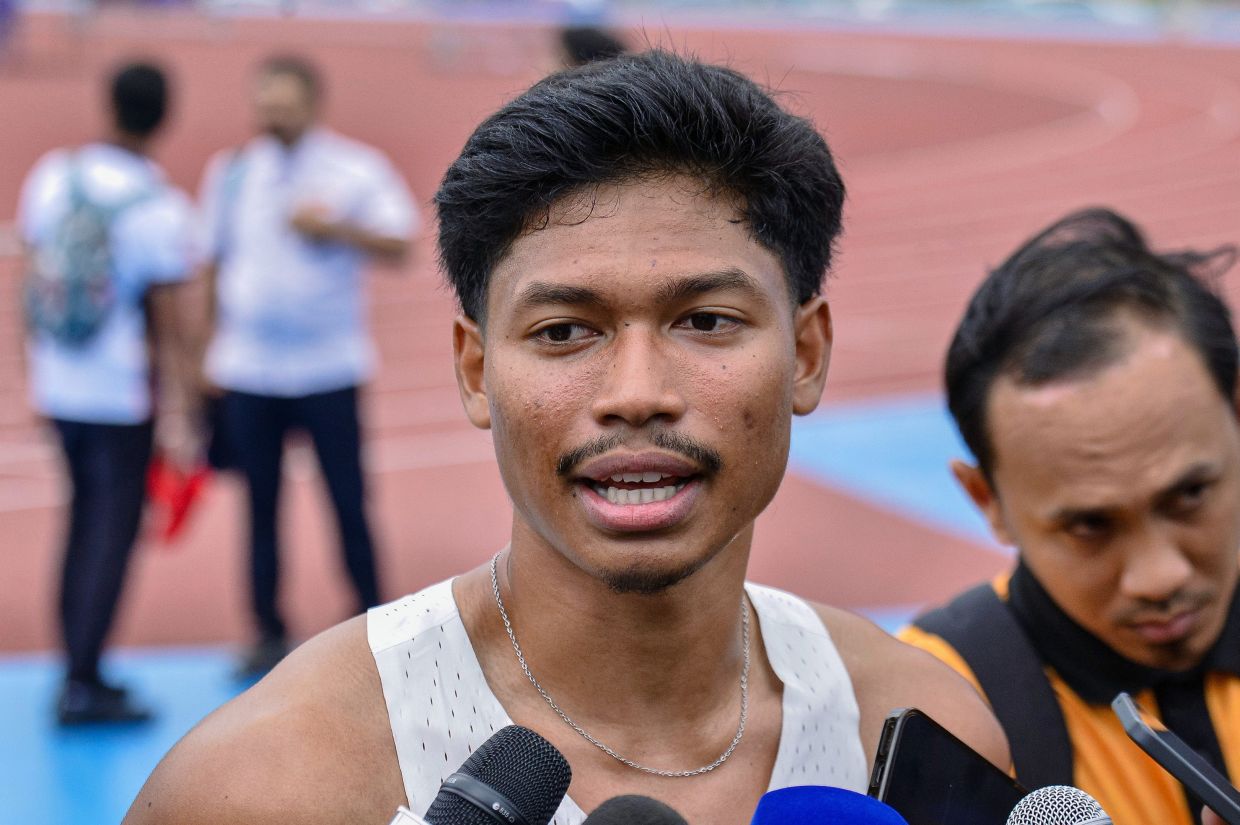
Twenty-one-year-old sprinter Mohd Azeem Fahmi has embarked on the next chapter of his academic and athletic journey by enrolling for a master's degree at Universiti Malaya, Malaysia's premier institution. The decision marks a significant turning point for the young athlete, who returns to domestic soil following nearly two years of training and study in the United States, where he developed his craft under the tutelage of respected coach Ken Harnden at Auburn University in Alabama.
Azeem's commitment to advancing his education comes as he simultaneously strengthens his position within Malaysia's competitive track and field landscape. His recent visit to the UM campus was marked by an official reception from vice-chancellor Prof Datuk Seri Dr Noor Azuan Abu Osman, signalling the institution's serious investment in supporting elite athletes who choose to balance world-class athletic development with rigorous academic pursuits. The cordial engagement underscores a broader institutional strategy at UM to attract and nurture Malaysia's sporting talent through comprehensive support systems.
The Faculty of Sports and Exercise Sciences at Universiti Malaya, represented during the meeting by Associate Prof Dr Zulkarnain Jaafar, will serve as the focal point for Azeem's postgraduate work. The programme aligns seamlessly with his undergraduate background in exercise physiology and kinesiology, providing continuity and deeper specialisation in areas directly applicable to his athletic career. The university's Sports Centre director, Afizal Abu Othman, was also present, reinforcing the multifaceted support infrastructure being mobilised to ensure Azeem's success in both academic and competitive domains.
UM has established itself as a natural home for Malaysia's elite athletes seeking to combine sporting excellence with degree-level education. The institution boasts an impressive roster of Olympic and national champions among its alumni. Diving's premier export Datuk Pandelela Rinong, along with her accomplished teammates Ooi Tze Liang and Bryan Nickson Lomas, all studied at the university while maintaining their paths to international sporting glory. This legacy extends to badminton, where former national women's doubles player Vivian Hoo completed her Bachelor of Sports Science degree in 2019, demonstrating that UM provides viable pathways for athletes across diverse disciplines to achieve both academic and competitive objectives.
Azeem's decision to return to Malaysia comes at a particularly opportune moment in his athletic development. His recent performance at the Malaysian Open, held at Universiti Putra Malaysia's Serdang campus, showcased the considerable progress he has made during his overseas training stint. Competing in the men's 100 metres final, he secured the gold medal, reaffirming his status as one of the country's most promising sprinters. His contribution to the men's 4x100 metres relay team, which also claimed gold, highlighted his value within Malaysia's sprint programme as the nation seeks to build depth and competitive strength in track events.
The relay victory was particularly significant for Malaysian track and field, as the squad featured Danish Iftikhar Mohd Roslee, Pengiran Aidil Auf Hajam, and Mohd Armin Zahryl. The collective success of this unit suggests that Malaysia is gradually establishing a more robust pipeline of sprinters capable of competing at regional and international levels. Azeem's presence within this dynamic group, combined with his continued training and development, positions him as a central figure in the country's medium-term athletic ambitions across sprint events.
Azeem's educational journey in the United States, which commenced in January 2023, provided him with exposure to world-class training methodologies and coaching expertise. Auburn University's programme in exercise physiology and kinesiology, combined with direct coaching from Ken Harnden, a coach known for developing technically proficient sprinters, has clearly borne fruit. The young athlete's return to Malaysia does not represent a step backward but rather a strategic consolidation, bringing international experience and conditioning back into the domestic competitive ecosystem while furthering his academic credentials.
The pursuit of a master's degree at this juncture in Azeem's career reflects a mature approach to athlete development that increasingly characterises Malaysia's approach to sports. Rather than treating athletic and academic pursuits as competing demands, institutions like UM and athletes like Azeem are demonstrating that these dimensions can be mutually reinforcing. Advanced study in sports science fields equips athletes with deeper understanding of their own physiology, training principles, and injury prevention—knowledge that directly translates to improved competitive performance.
For Malaysian track and field as a whole, Azeem's institutional choice carries broader implications. His enrollment at UM sends a signal to other emerging athletes that the country offers competitive pathways that do not require permanent relocation abroad, provided athletes are willing to invest in education alongside sport. This could help stem the brain drain of young talent seeking overseas opportunities and instead encourage the consolidation of Malaysia's homegrown sporting infrastructure. As UM and other local universities continue to invest in sports science facilities and coaching expertise, they create conditions that make remaining in Malaysia increasingly attractive to athletes at critical junctures in their development.
Looking forward, Azeem's master's degree programme offers him the dual benefit of continued athletic training under domestic conditions while gaining advanced qualifications that will serve him well beyond his competitive career. The explicit commitment from UM's vice-chancellor to facilitate the best possible pathway suggests institutional-level support that goes beyond academic enrolment, likely encompassing tailored training schedules, coaching coordination, and other athlete-centric accommodations. This comprehensive approach reflects international best practice in supporting dual-career athletes and positions Azeem for sustained success across both domains.

